• About Us
    • What Is Street Harassment?
    • Why Stopping Street Harassment Matters
    • Meet the Team
      • Board of Directors
      • Past Board Members
    • In The Media
  • Our Work
    • National Street Harassment Hotline
    • International Anti-Street Harassment Week
    • Blog Correspondents
      • Past SSH Correspondents
    • Safe Public Spaces Mentoring Program
    • Publications
    • National Studies
    • Campaigns against Companies
    • Washington, D.C. Activism
  • Our Books
  • Donate
  • Store

Stop Street Harassment

Making Public Spaces Safe and Welcoming

  • Facebook
  • Instagram
  • Pinterest
  • Tumblr
  • Twitter
  • YouTube
  • Home
  • Blog
    • Harassment Stories
    • Blog Correspondents
    • Street Respect Stories
  • Help & Advice
    • National Street Harassment Hotline
    • Dealing With Harassers
      • Assertive Responses
      • Reporting Harassers
      • Bystander Responses
      • Creative Responses
    • What to Do Before or After Harassment
    • Street Harassment and the Law
  • Resources
    • Definitions
    • Statistics
    • Articles & Books
    • Anti-Harassment Groups & Campaigns
    • Male Allies
      • Educating Boys & Men
      • How to Talk to Women
      • Bystander Tips
    • Video Clips
    • Images & Flyers
  • Take Community Action
  • Contact

“It is not normal. It is harassment.”

July 7, 2013 By Contributor

I have been subjected to a number of incidents over the years involving unwanted attention from men (both verbal and physical). It usually happens on a weekend night out. Unfortunately, it has gotten to the stage now where I actually enjoy getting ready to go out more than actually being out. What surprises and saddens me is that too many people (men and women) tend to dismiss these experiences as “over-reactions.”

I feel its time for us to speak up and say that this harassment is simply unacceptable. I have plenty of male friends who do not treat women in this way so why should this kind of behaviour be normalized?

It is not normal. It is harassment.

Do you have any suggestions for dealing with harassers and/or ending street harassment in general?

I think that men and women need to be educated more on personal boundaries and etiquette. Harassment is not acceptable. It is not “just a joke.” And it is not an “over-reaction” to call someone on their behaviour when it involved unwanted physical or verbal attention.  Also, let’s make victim-blamed a thing of the past.

– Anonymous

Location: Galway City, Galway. Ireland

Share your street harassment story for the blog.

Share

Filed Under: street harassment

USA: Interview with the Director of Hollaback!PHILLY

July 7, 2013 By Correspondent

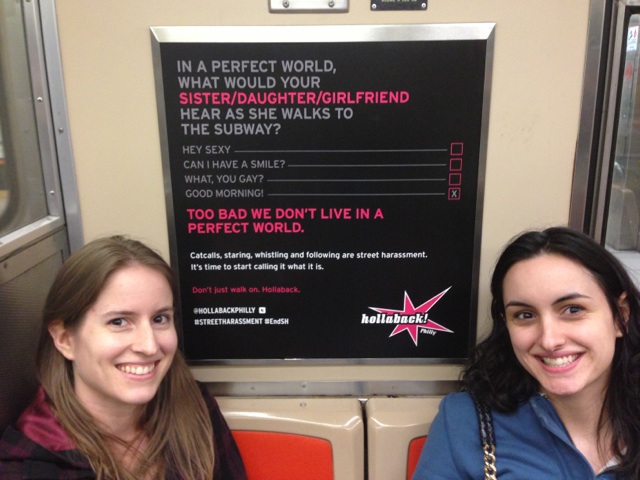
Anna Kegler & Rochelle Keyhan with one of their SETPA ads.

By: Erin McKelle, Jan. – June 2013 SSH Blog Correspondents

Rochelle Keyhan is the Director of Hollaback!PHILLY, lawyer, activist and writer. She started working on anti-street harassment non-profit Hollaback! in 2010 when she incorporated the organization as a non-profit 501(c) (3) pro-bono. She’s been an active feminist since her undergraduate years at UCLA, where she was the Editor in Chief of the university’s feminist magazine. She’s truly remarkable and I wanted to get her take on street harassment, working as a feminist activist and her work with Hollaback!

Erin: Can you tell me a little about yourself and your work both with Hollaback! and outside of it?

Rochelle: My passion is fighting gender-based violence and inequity. My day job is as a criminal lawyer, and I do all of my work on Hollaback! in my free time outside of work. I first became aware of Hollaback! while working with a different non profit, running their social media pages. Hollaback! posted a request for assistance with filing their 501(c)(3) application, which I had just learned how to do. In filling out that application you learn everything there is to know about the organization, and the more I learned, the more I became enamored with the movement. Soon after completing the application I joined Hollaback!’s Board of Directors and am currently the Treasurer on the Board. A year later in April 2011 I started HollabackPHILLY and have been the director ever since.

Erin: I saw that you first got involved with Hollaback! by volunteering to incorporate them as a non-profit. What drew you to the organization and what led you to start a chapter in your city?

Rochelle: At the time I discovered Hollaback! I was already a pretty outspoken and passionate feminist, but had been so desensitized to street harassment that it was an epiphany for me that I deserved to be angry about street harassment. The fact that it was such a new, less-explored issue, got me excited to be a part of it almost immediately. After a year on the board, I was more familiar with the organization and its long term activist goals, and I just knew that I needed to bring the movement to Philadelphia, which has its own serious street harassment problem. By raising awareness about street harassment, we’re expanding the reach of the fight against gender-based violence by going after the behaviors across the spectrum, instead of just focusing on the most physical forms of the violence.

Erin: Street harassment is obviously a huge problem and it is often not taken seriously by the police. How do you think that the laws around street harassment can be written to better serve women and LGBT folks? How can we better educate law enforcement to make them aware of the problem?

Rochelle: I don’t think that laws are the solution, so I actually wouldn’t suggest any form of legal revision. The focus now should be on education and mindset change. A big part of that is bringing in men and law enforcement, recruiting them as allies and equipping them with the knowledge and skills necessary to spread the message. I wrote an article for COPS, a department out of the USDOJ on how law enforcement can help the cause, which is pretty responsive to this question.

Erin: Hollaback Philly’s SEPTA Subway Advertisement PSA Campaign has gotten a lot of press this spring. Have you seen any changes that have happened because of it? Did you see an increase in public awareness?

Rochelle: The ads had a significant local impact, putting our efforts on the radar of the larger feminist organizations in the city. They also got the attention of City Council, which opened the door for conversations about potential partnerships. We also have had a large outpouring of local support via email and social media, thanking us for our effort and commending our transit authority for extending the advertisements. The ads helped people start conversations by providing an ice breaker. They also encouraged people to think through the issues on their own, and in their own ways, by giving them the freedom to process the ideas individually, without forcing conversations. Beyond the impact in Philadelphia, the ads went viral online, with over 500,000 Facebook impressions and 100,000 Tumblr re-blogs, expanding the conversation to a global dialogue about what cities can do to help spread the word about making our streets and transit systems safer for women and LGBTQ folks.

Erin: Do you see street harassment as being a potential defining issue of 4th wave feminism? Do you think it’s important that it be?

Rochelle: It’s already a large part of the fourth wave narrative, with organizations all over the world organizing around and marching against street harassment, while openly condemning the behavior online. People rising up to regain their rights to safe access to public spaces, fighting discrimination based on their gender, and holding their communities accountable, is of course an important part of any wave of feminism, so the 4th wave is no exception.

Erin: Street harassment comes from the difference in power and acts as an oppressor and reminder for oppressed groups that they are such. It’s a way for the dominant group to assert power. Do you think it will take ending sexism to end street harassment?

Rochelle: I actually think street harassment can end before sexism does, because it’s easier to be angry about violence and disrespect than it is to redefine masculine roles and claims to power by doing things like evening out salaries, sharing household duties, and electing more women into political power. Basically, it’s “giving up” less to eliminate street harassment than to eliminate sexism.

Erin: There has obviously been an increase in recent years in the feminist movement to end street harassment and the movement has been gaining ground. In your opinion, what is the best approach we can take to end street harassment both as activists and everyday citizens?

Rochelle: That’s a difficult question to answer. The “best” way to approach street harassment varies by situation and individual. But what I’ve learned over the past few years is that the most productive and effective conversations I’ve had with men and non believers happens when I come from a place of love and understanding. Curbing the anger goes a long way in creating the conversations as safe spaces for people to voice questions they might be embarrassed to ask, allowing for deeper, more nuanced conversations about the issue and how it impacts people differently. Hopefully the more conversations we have, the more people will join in the effort and the less careful the conversations will have to be to avoid isolating people from the movement.

Erin is an e-activist and blogger based in Ohio. You can find more of her work here and here.

Share

Filed Under: correspondents, hollaback, street harassment

“I looked like a prostitute because I was wearing a red lipstick”

July 5, 2013 By Contributor

Early morning, going to work. In my bag are books. One car stopped in front of me. I turned my face and kept walking. Then on the next block he appeared again. Asked if was going to work. I said to him what kind of question was that. And continued walking. He came again apologized for himself saying he wanted to meet me. I told I was going to work and that I was not interested. I never stopped walking, he kept following me and finally offended me saying that I looked like a prostitute because I was wearing a red lipstick!

Serious? In 2013? Give me a break please!

Do you have any suggestions for dealing with harassers and/or ending street harassment in general?

I always refuse in a polite way, if the guy keeps bothering me I start to answer very loud, mainly at public places. I have a little knife in my bag and if I need it I sure will use it.

– Rosa

Location: São Paulo Brasil

Share your street harassment story for the blog.
Share

Filed Under: Stories, street harassment

“I couldn’t shake the freaky feeling”

July 5, 2013 By Contributor

For my summer internship I have been traveling to and from DC via metro. As I texted my sister that I had reached my home metro stop, a man approached me and was very quickly four inches from my face. I looked up, startled, and asked if I could help him. Maybe he needed directions? He threw his hand towards me and said, “Hi my name is ‘uncomfortable street harasser’s name’ and I think you are beautiful.”

I had absolutely no idea what to do. My whole life I have been taught that if someone asks for a handshake, you reciprocate, and I had no desire to antagonize this crazed man, so I did. Immediately, I regretted it (and purelled later).

He said again, “You are beautiful” and added, “I am going to take you on a date.” At this point I had gained some composure and responded, “Thank you but I am not interested.” What the hell was coming out of my mouth? Why was I “thanking” him? This weirdo had come up to me while I was minding my own business and begun to harass me!

He then continued to ask me out on a date and tell me how much I would be missing should I reject him, which I already had multiple times. As I continued to politely deny him, I looked around to see where and what other metro stop people were doing. Was I safe? There was an older man with an LSU cap across the street giving my harasser a solid stare. He recognized that I was not comfortable and motioned for me to come over to him. But what if I was just exchanging one unwanted come on for another?

I went for Option C – excuse myself. I firmly told my street harasser that I had to make an important phone call and walked over to where others were waiting for a bus. The man eventually stopped staring at me and my sister arrived, but I couldn’t shake the freaky feeling.

I have to say. I am much more vigilant when waiting at the metro, even if I think I am safe in the sunlight.

– Katie

Location: King St. Metro Stop, Alexandria, VA

Share your street harassment story for the blog.

Share

Filed Under: Stories, street harassment

“The situation is going from bad to worst”

July 5, 2013 By Contributor

Hi, all. I’m a transexual woman who lives in a small town in Spain.

While I am respected by the majority of neighbours, there is a a small group of lazy young people, maybe in their late adolescence, who sit on the stairs of the church who say all kind of insults, ranging from fagot, transvestite, whore, and ask, “Do you have condoms?”

Every day the situation is going from bad to worst, today they started to walk behind me while menacing me.

I’m considering seriously to start to walk the streets with the cellular recording video on and present a formal denunce to the police using the records as proof.

Do you have any suggestions for dealing with harassers and/or ending street harassment in general?

If you expect harassment in a concrete situation, put your phone in mode video and recording on. But avoid to do it in sight of the harassers, this could end in a physical aggression. Do it before the harassment, there are situations like mine where it is perfectly predictable.

– Amanda Azañón Teruel

Location: Las Navas del Marqués, Hermita de la Plaza del Cristo, Spain

Share your street harassment story for the blog.

Share

Filed Under: Stories, street harassment

« Previous Page
Next Page »

Share Your Story

Share your street harassment story for the blog. Donate Now

From the Blog

  • #MeToo 2024 Study Released Today
  • Join International Anti-Street Harassment Week 2022
  • Giving Tuesday – Fund the Hotline
  • Thank You – International Anti-Street Harassment Week 2021
  • Share Your Story – Safecity and Catcalls Collaboration

Buy the Book

  • Contact
  • Events
  • Join Us
  • Donate
  • Facebook
  • Instagram
  • Pinterest
  • Tumblr
  • Twitter
  • YouTube

Copyright © 2026 Stop Street Harassment · Website Design by Sarah Marie Lacy