• About Us
    • What Is Street Harassment?
    • Why Stopping Street Harassment Matters
    • Meet the Team
      • Board of Directors
      • Past Board Members
    • In The Media
  • Our Work
    • National Street Harassment Hotline
    • International Anti-Street Harassment Week
    • Blog Correspondents
      • Past SSH Correspondents
    • Safe Public Spaces Mentoring Program
    • Publications
    • National Studies
    • Campaigns against Companies
    • Washington, D.C. Activism
  • Our Books
  • Donate
  • Store

Stop Street Harassment

Making Public Spaces Safe and Welcoming

  • Facebook
  • Instagram
  • Pinterest
  • Tumblr
  • Twitter
  • YouTube
  • Home
  • Blog
    • Harassment Stories
    • Blog Correspondents
    • Street Respect Stories
  • Help & Advice
    • National Street Harassment Hotline
    • Dealing With Harassers
      • Assertive Responses
      • Reporting Harassers
      • Bystander Responses
      • Creative Responses
    • What to Do Before or After Harassment
    • Street Harassment and the Law
  • Resources
    • Definitions
    • Statistics
    • Articles & Books
    • Anti-Harassment Groups & Campaigns
    • Male Allies
      • Educating Boys & Men
      • How to Talk to Women
      • Bystander Tips
    • Video Clips
    • Images & Flyers
  • Take Community Action
  • Contact

USA: Fighting the Mashers

May 8, 2013 By Correspondent

By: Talia Weisberg, SSH Correspondent

Street harassment is a daily phenomenon in every pocket of the United States during the present day. Interestingly, this social trend can be dated back to the late 1800s in America.

Back then, street harassment was called mashing. There are actually records of women who physically exacted revenge on their harassers. In 1904, a Manhattan woman arranged to meet privately with a masher so she could beat him up. Two years later, when a woman boxer in Massachusetts was grabbed by a man, she knocked him out and then revived him with smelling salts out of pity. Other women slapped mashers in the face with their handbags and umbrellas, gave them swollen eyes, and even lacerated their faces.

The police of the early 1900s were very active in combating street harassment. Female officers were often put in charge of catching mashers, and were usually extremely successful. In New York City, a group of jiu jitsu-trained policewomen called the Subway Squad patrolled the trains as plainclothes officers, looking out for mashing. In both the subway and aboveground, mashers were often caught through stings, where they had female officers or harassed women serve as bait to entice the would-be masher.

Interestingly, many victims of street harassment pursued legal justice against mashers. By the 1920s, women were likely to sue because of the availability of private hearings and public encouragement. This era was also the Jazz Age, when women began exploring their sexuality. Since they had gotten the right to vote in 1920, women felt more liberated. A possible result of this increased sense of self is that women were more likely to value their bodies, and were apt to prosecute a man for violating their space.

Men had mixed responses to mashing. Male officers were often apathetic towards victims of street harassment, part of the reason women police became so vital to the cause. However, many men in the force championed the anti-mashing cause. For example, after learning about a “masher’s corner” on 125th Street in Manhattan, the police chief stationed additional officers there. In general, men did take an active stand against street harassment. The Anti-Mashing Society was established in 1903 by a group of men frustrated by the mashing epidemic, and numerous men physically protected women who were being mashed.

What lessons can we, as anti-street harassment activists, learn from the history of mashing?

As effective as it may have been in the early 1900s, it may not be wise for us to support women beating harassers with their handbags. However, self-protection is vital, and women must be able to learn how to effectively protect themselves from street harassment. We cannot, however, pin the responsibility on women to not be harassed. We must educate men not to harass, and work with like-minded men to encourage their brethren to respect women’s space on the street. Our mission is to shift the social paradigm and change people’s attitudes. Hopefully, the term street harassment will sound just as foreign to our children as the term mashing does to our generation.

Talia Weisberg is a Harvard-bound feminist hoping to concentrate in Studies of Women, Gender, and Sexuality. Her work has appeared in over 40 publications and she runs the blog Star of Davida blog (starofdavida.blogspot.com).

Share

Filed Under: correspondents, SH History, street harassment

Digest of Street Harassment News: May 5, 2013

May 5, 2013 By HKearl

** Sign up to receive a monthly e-newsletter from Stop Street Harassment ***

Street Harassment Stories:

Share your story! You can read street harassment stories on the Web at:

Stop Street Harassment Blog

Collective Action for Safe Spaces

HarassMap in Egypt

Bijoya in Bangladesh

Resist Harassment in Lebanon

Ramallah Street Watch in Palestine

Name and Shame in Pakistan

Safe City India

Safe Streets in Yemen

Street Harassment in South Africa

Many of the Hollaback sites

Everyday Sexism

Street Harassment In the News, on the Blogs:

* Minnesota Daily, “Not Your Baby“

* Bikya News, “New Egypt anti-sexual harassment battle provides “safe car” service“

* BBC, “The Egyptian women fighting harassment“

* Huff Post Teen, “Street Harassment Is No Compliment“

* The GW Hatchet, “Students partner with Metro officials, urge commuters to report sexual harassment“

* Yahoo Games, “LEGO apologizes for ‘street harassment’ sticker“

* Slate, “Note to Lego: Harassment Isn’t a Construction-Worker Problem“

* Gender Focus, “See a woman reading? Leave her alone“

* Brute Reason, “Why You Shouldn’t Tell That Random Girl On The Street That She’s Hot“

* Consumerist, “Dad Complains To LEGO About Leering Minifig, Teaches Everyone About Brand Licensing“

* HBCU, “Street Harassment – Underdeveloped ‘Game’ is Civility Lost“

* xo Jane, “A Day Without Headphones: My 24-Hour Street Harassment Diary“

* Telegraph & Argus, “‘Speak out to help stop intimidation in Bradford’’

* Voice of America, “Sexual Violence Widespread in India, UN Says“

* The Gloss, “It’s Spring, Get Psyched For More Street Harassment“

* Athens Ohio Today, “Anti-street harassment group launches site for Appalachia“

* This Week in Blackness, “Hey Yo Ma: A Crash Course In Street Harassment“

Announcements:

* New SSH Resource: Companies that Trivialize Street Harassment

* View photos from International Anti-Street Harassment Week 2013!

10 Tweets from the Week:

1. @liannedemello Rescued a young woman being harassed by a couple of creepy guys on the Tube. They were so surprised they backed off. #streetharassment

2. @twitdemaria The self defense classes organized by @TahrirBodyguard helped me to feel more confident when walking in streets:with no fear. #endSH

3. @fazlalizadeh Just had two random guys stop and chat with me about street harassment as I was wheat pasting a piece. Ha.

4.  ‏@sfbuzzalino Street harassment of women by men is part of the foundation of #rapeculture #slutshaming #JacksonKatz

5. @inmywindow Street harassment was the exact opposite of what I needed today. When the fuck will it stop?

6. @lilyhiottmillis Street harassment literally makes me view all men in contempt for the rest of the day #misandry

7. @captain_seb My first time going outside without a coat on and my first street harassment of the year! #murdereverybody #maybejustthemen

8. @SocialJerkBlog “Not great, I’m having menstrual cramps.” If you keep following me asking, “Ma, how you feelin” this is what you get. #streetharassment

9. @eyoMoMO The worst thing about street harassment is that it’s not so much about complimenting you as much as it is about making women squirm

10. @ArielleDRoss Preach. RT @emmajroe: There are only two seasons for Toronto cyclists — winter and street harassment.

Share

Filed Under: News stories, street harassment, weekly round up

Why it’s not okay to “compliment” strangers on the street

May 3, 2013 By HKearl

I LOVE this article by Miri about why men should not tell random women on the streets that she is “hot” or otherwise comment on her appearance. Here are a few key quotes but I recommend reading and sharing the whole article!

“It seems that men are finally starting to realize that many women do not like street harassment (or, in the parlance of the uninitiated, “unsolicited compliments about a stranger’s appearance”). This is really great and a sign that activists are doing a good job.

However, predictably, I’ve also seen a surge of men desperately trying to find loopholes so that they can still, yes, give women their irrelevant and unasked-for opinion on their appearance. Hence all the “But what if I say it this way? But what if I say it that way? But what if I make it REALLY CLEAR that I’m NOT TRYING TO BE CREEPY? But why can’t I just give a girl a compliment for crying out loud?

…

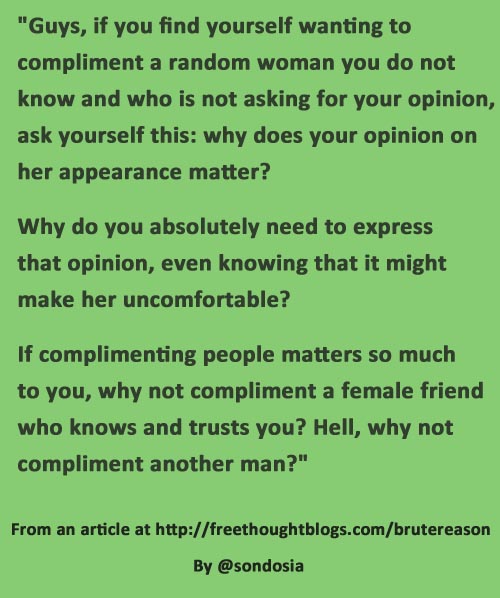
“Guys, if you find yourself wanting to compliment a random woman you do not know and who is not asking for your opinion, ask yourself this: why does your opinion on her appearance matter?

Why do you absolutely need to express that opinion, even knowing that it might make her uncomfortable?

Why is it her responsibility to deal with that potential discomfort or “get over it,” not your responsibility to keep your opinions to yourself unless they are relevant or solicited?

And, most importantly–if complimenting people matters so much to you, why not compliment a female friend who knows and trusts you? Hell, why not compliment another man?”

Share

Filed Under: street harassment

“I have to be on guard”

May 3, 2013 By Contributor

I was walking to the train station to get to work this morning, when this dreadlocked guy walked by me and thumped his fist against his chest. I guess he assumed that because I also had dreadlocks that I’d reply back in kind, but I instead said, “Good morning.” This caused him to go, “Huh? Huh?”

I’ve seen this guy before a few weeks prior. I opened the door of a nearby 7-11 and he just walked right through it without saying “Thank you” and went to talk to his friend hanging out outside as if I didn’t exist. I said, “You’re welcome!” sarcastically a bunch of times until I finally got a “Thank you” from him.

Back to today. I don’t think that this guy was following me since he walked over to the street a block away (whereas I walk down another street and then turn towards this street when I get closer to the train station), but once I was on the same street he started yelling “Yo!” and “Psst!” as if he wanted my attention. He was not going to get it, but I kept looking back to see what this clod was up to, keeping one step ahead of him. I managed to get to the train station and on a train, and thankfully did not see this guy enter the train station.

This incident made me uncomfortable, and since I have a feeling that I may see this guy again, I have to be on guard. By his weird reaction to my “Good morning” and his lack of sense at the 7-11 a few weeks ago, I get the impression that this guy’s not in his right mind. I didn’t feel that this guy’s behavior warranted calling the police, but if it does get to that point I have no problem doing such.

– Anonymous

Location: Courthouse area (Arlington, VA)

Share your street harassment story today.

Share

Filed Under: Stories, street harassment

USA: Sky’s Out, Thighs Out

May 2, 2013 By Correspondent

By Lauren Duhon, SSH Correspondent

Unless you’ve been living under a rock for the past couple of weeks, spring is here, summer is right around the corner and the warmer weather is here to stay. With higher temperatures and sunnier days, it’s time to break out the short shorts, sundresses and swimsuits. Fewer clothes shouldn’t be a reason to justify sexual harassment, but all too frequently I hear men making comments, usually not in a discrete manner, as young women emerge from winter’s cold embrace.

Walking through campus on any given day, I’ve heard countless guys comment on the anatomy of female students; stripping them down with their minds bit by bit like they’re some type of prey for the taking. “Oh, man, did you see that ass?” Charming, isn’t it? A different situation happened to me the other day at a festival. I was wearing a dress when a guy walked up to me, looked right down my dress, made a comment about my breasts and then tried to strike up a conversation about my camera (I was taking photos for my university’s newspaper). The “best” (for lack of a better word) one I’ve heard is “sky’s out, thighs out,” which several of my friends use in reference to the female students and their shorter shorts during this time of year.

All too often I find myself looking into the mirror before I leave my apartment and wanting to put on more clothes in an attempt to avoid unnecessary commentary that I may come across during the day.  And, most of the time, I have grown to dislike the warmer months simply based on the fact that you are less covered and feel more vulnerable. As if I feel like I have to be more modest. Not everyone may feel this way, but I shouldn’t feel ashamed for my clothing decisions. What I choose to wear shouldn’t affect my day-to-day life, nor should some random man influence that decision.

I blame society for perpetuating the wrong idea. The way a woman dresses shouldn’t define or insinuate any sort of action from the opposite sex. Don’t say it’s okay or everyone does it, because it’s not and no one should. Everyone is naturally attracted to others, that’s the normal part. But, that doesn’t grant anyone a free pass to harass others as they please.

So, next time you see an attractive girl, please think about what you’re doing. Street harassment is not a compliment. No one wants to be catcalled or whistled at. Keep your thoughts to yourself and avoid making any vulgar comments. I’d like to walk down the street with confidence knowing I won’t feel attacked for my outfit of choice.

Lauren Duhon is a student journalist from LSU in Baton Rouge, La.

Share

Filed Under: correspondents, Stories, street harassment

« Previous Page
Next Page »

Share Your Story

Share your street harassment story for the blog. Donate Now

From the Blog

  • #MeToo 2024 Study Released Today
  • Join International Anti-Street Harassment Week 2022
  • Giving Tuesday – Fund the Hotline
  • Thank You – International Anti-Street Harassment Week 2021
  • Share Your Story – Safecity and Catcalls Collaboration

Buy the Book

  • Contact
  • Events
  • Join Us
  • Donate
  • Facebook
  • Instagram
  • Pinterest
  • Tumblr
  • Twitter
  • YouTube

Copyright © 2026 Stop Street Harassment · Website Design by Sarah Marie Lacy