• About Us
    • What Is Street Harassment?
    • Why Stopping Street Harassment Matters
    • Meet the Team
      • Board of Directors
      • Past Board Members
    • In The Media
  • Our Work
    • National Street Harassment Hotline
    • International Anti-Street Harassment Week
    • Blog Correspondents
      • Past SSH Correspondents
    • Safe Public Spaces Mentoring Program
    • Publications
    • National Studies
    • Campaigns against Companies
    • Washington, D.C. Activism
  • Our Books
  • Donate
  • Store

Stop Street Harassment

Making Public Spaces Safe and Welcoming

  • Facebook
  • Instagram
  • Pinterest
  • Tumblr
  • Twitter
  • YouTube
  • Home
  • Blog
    • Harassment Stories
    • Blog Correspondents
    • Street Respect Stories
  • Help & Advice
    • National Street Harassment Hotline
    • Dealing With Harassers
      • Assertive Responses
      • Reporting Harassers
      • Bystander Responses
      • Creative Responses
    • What to Do Before or After Harassment
    • Street Harassment and the Law
  • Resources
    • Definitions
    • Statistics
    • Articles & Books
    • Anti-Harassment Groups & Campaigns
    • Male Allies
      • Educating Boys & Men
      • How to Talk to Women
      • Bystander Tips
    • Video Clips
    • Images & Flyers
  • Take Community Action
  • Contact

Egypt: 1000s March Today, Feb 12 Protest Planned

February 6, 2013 By HKearl

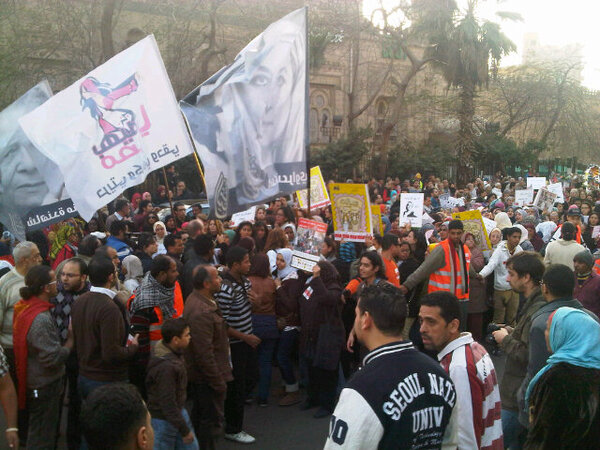
Today’s Protest. Image via @Gsquare86

During the Jan. 25 protests this year in Cairo, Egypt, there were numerous instances of mob sexual violence against women (read some of their stories). Various anti-harassment groups patrolled Tahrir Square and volunteers were able to help break up most of the mobs but even still, many women required medical attention after they were safe.

Today, more than 1000 people marched in Cairo to protest the violence against women. View photos.

Anti-harassment groups are asking people worldwide to rally in front of Egyptian Embassies on Tuesday, February 12, at 6 p.m. (in whatever time zone you’re in) to protest what they see as the government’s lack of support for stopping such attacks and for perhaps hiring impoverished men to initiate attacks.

Stop Street Harassment is proud to be one of the supporting groups of this effort. If you live near an Embassy, I urge you to show your support and add your presence/voice/body to amplify these efforts.

Share

Filed Under: street harassment Tagged With: Cairo, Egypt, embassy, marches, protest, Tahrir

“Actually knowing the victim and the perpetrator shakes everyone”

February 5, 2013 By HKearl

*Trigger Warning*
I saw this status update through  my Facebook feed — if you’re in Delhi, India, you can take action tomorrow at 2 p.m.
“One of our tech center girls was sexually assaulted and tried to be killed. A screwdriver was forced into her mouth. Hearing about other people’s cases from outside is one thing. Actually knowing the victim and the perpetrator shakes everyone. The young girl is in serious condition in AIIMS. We are organizing a march in the community tomorrow at 2 pm to show our solidarity for the victim and to help the girls of the tech center talk to their community members about their rights and their fears. Join us tomorrow at 2 pm at Jalvihar Bus Terminal, Lajpat Nagar 1.”
Share

Filed Under: street harassment

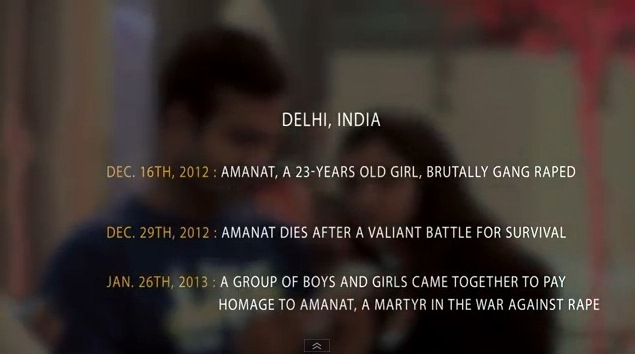
Delhi Flash Mob against Delhi Gang Rape 2013

February 5, 2013 By HKearl

Beautiful:

Share

Filed Under: street harassment Tagged With: #delhigangrape, delhi, flash mob

We need equal access to public spaces now!

February 5, 2013 By Contributor

On Saturday night around 2 a.m., after dinner and card games with some friends, I exited the metro in Arlington and began my very routine ten-minute walk home. The temperature was below freezing and I was bundled uncomfortably in my coat, trying my hardest to make it home as quickly as possible. Moments after beginning my trek, two men walked toward me.

One of them sort of walked past me – and stopped a few feet away – while the other man came up to me and started to talk. And from the way he began his interactions, I was fairly certain that they wanted something sexual. I’ve been approached on the street for this reason before and the timing seemed right. And so did the conversation. He asked me what I was doing and where I was going and, when I said I was going home, he wanted to know where I lived. I motioned up the hill in the obvious direction that I was walking and tried to get away. I was sandwiched between him and a building.

Then the conversation’s tone changed. He pointed to my North Face jacket and said I must have a lot of money. I’m not sure what kind of rich white boy he thought I was, but the comment was almost laughable. But he said it again. And again I said I wasn’t rich. In a sort of startling way he asked what my name was and, after repeating the question several times and me saying it didn’t matter, I escaped up the hill and didn’t look back. Home was only a few blocks away, and thankfully they didn’t follow me. I couldn’t tell if the other man was annoyed that his friend was doing it or if he was there to offer support in some way. A lot was unclear from my interaction with them.

I didn’t know what they wanted. I thought they were going to ask to go home with me, or ask me to go home with them, but then I thought they wanted to rob me. And then, when he kept asking for my name, I thought he might have wanted something sexual again. I also didn’t know why they targeted me. Did they want someone shorter than them? If they wanted to sleep with me, then possibly. If they wanted to rob me well, then, probably. Did my race affect their decision to pursue me? And how important was it that they perceived me to be male? I wanted to be active in my dismissal of them, but I couldn’t. I wasn’t sure how to respond because I didn’t know what I was responding to.

And as scary as it was, and as I try now, still, to conceptualize exactly what happened to me, it’s raised some interesting questions in my mind about how I sort of binarize male-on-male street harassment. I think about it in a very plain way. The perpetrator might be a homophobic straight guy, or a group of men (not necessarily all straight) operating within a homosocial space as they prove their heterosexuality via the harassment of others. Or the perpetrator could also be gay and approaching another gay man as I thought the two men above were initially. While these two options use hate-filled and sexualized language, respectively, in both instances the man is targeted because he is perceived to be gay. And either way, access to public spaces is being restricted.

So it’s more complex than my assumptions. My perception of the situation included both of these models. It was murky. I’m not sure that I would have rather been harassed in a clearer way, because I don’t want myself or anyone else to ever be harassed, but not understanding this incident has certainly stayed with me in a very different way. Did they want to sleep with me? Did they just want to rob someone? Or did they want to rob me because they perceived me to be gay? I can’t draw many conclusions, because if they wanted to rob me they certainly could have, and if they wanted to assault me they could have accomplished that as well. Maybe they were drunk and really had no goal other than to mess around with the nearest passerby. I’m really not sure.

What I do know is that I perceived the event in a way that I’m not sure all men would have. Men who are perceived to be gay or bisexual expect harassment in public spaces because of the ways that we interfere with some men’s ideas about appropriate masculinity and sometimes because our appearances might be pleasing to other men. In my own research that I’ve cited before, more than 70 percent of the gay and bisexual men I surveyed said they constantly assess their surroundings when they are navigating public spaces. This number, I imagine, is lower for those whose appearance is consonant with societal gender expectations.

So while I can’t be sure about what I experienced that night, I know what it felt like, and how it would have felt for others who experience harassment regularly. Not everyone walking down the street is about to harass, but when it happens often enough it’s hard not to think about. And that’s one of the things that makes street harassment so dangerous. It’s not forgotten. It takes up mental space. It’s complex. Sometimes we can’t make sense of it, but that shouldn’t be our responsibility. Equal access to public spaces is something we need now.

This is a guest post by Patrick McNeil. Patrick is finishing his master’s thesis at The George Washington University in Washington, D.C., where he is pursuing his Master’s in Women’s Studies. His work focuses on whether and how gay and bisexual men experience street harassment and how this form of harassment intersects with and diverges from the gender-based street harassment of women. Follow him on Twitter at @patrickryne.

Share

Filed Under: male perspective, Stories, street harassment

Interview with UK Researcher

February 4, 2013 By Contributor

Editor’s Note: Fiona Elvines is Operations Coordinator at Rape Crisis South London where she helps people who have experienced rape and/or childhood sexual abuse. She is also in her final year of PhD research at London Metropolitan University where she is studying street harassment.

Hollaback Edinburgh recently conducted an interview with her about her dissertation (The Great Problems are in the Streets: Women’s Experiences of Male Stranger Intrusion) and they kindly allowed me to excerpt some of it here. You can read the full interview on their site.

1. What led you to this research?

I came to this research initially through my work at Rape Crisis and thinking about how the impact of the routine intrusions women encounter from men on the street make it incredibly difficult to feel like you can move past an experience of criminalised sexual violence like rape. I wanted to know more about what women who have experiences along the continuum of sexual violence feel about intrusion from male strangers in public space, and how we strategise or make sense of ourselves through it. I was also really frustrated by the victim blaming I encounter in working in rape prevention and wanted to develop an evidence base for the numerous ways in which women already limit and adapt our daily movements based on men’s intrusive practices.

2. Why do you think this is under-researched?

I think that the study of all forms of male violence against women is still really young and that feminists have worked hard to capture the evidence needed for policy change on issues like rape, domestic abuse and childhood sexual abuse. As much as I think this focus has been and is necessary, I feel it’s resulted in a loss of interest in the routine aspects of men’s intrusive practices, missing a crucial aspect of women’s everyday experience. I also think male stranger intrusion is normalised, minimised and trivialised, and that the sheer frequency of intrusive encounters means forgetting is brought in as a natural coping strategy. The women I’ve spoken with have told me how, when they have spoken out about what they’ve experienced be it to friends or parents or a partner, they have been met with a response that minimises their experience of it, reframes the intrusion as complimentary, or simply tells her it’s just part of growing up. All of this has resulted in a lack of understanding in terms of the scale of the problem and the impact it has on women’s daily decision making, sense of safety and relationship to our bodies and our self. This is starting to change, particularly with the rise of blogs such as Hollaback and Everyday Sexism, which have meant that we are starting to get a sense of the extent to which women are negotiating men’s intrusion in public space and beginning to hear experiences that might help to validate our own.

3. What kind of response did you get when you put the call out for participants?

The response was amazing. I received over 150 emails from women within 2 hours of my call being tweeted.

4. Were you surprised by the response?

Completely. I really wasn’t expecting to speak to more than 20 women. I ended up with 51 participants who completed an initial conversation with me and then kept a diary of their experiences from 2 weeks to 2 months before talking to me again or sending through feedback about their findings and any changes or discoveries they had made during the course of the research. I feel the response itself demonstrates the extent to which women experience such encounters as meaningful in particular ways, and illustrates how spaces for us to talk about the meaning they have for us are difficult to find.

5. What would you say to people who have been street harassed?

The most important message to get out there I believe has to do with countering these early responses. You get to decide what does and doesn’t count as violence or intrusion or harassment. Your experience of it is valid and you get to choose the meaning that it has. I would also say that no one can tell you how you should, or if you should, respond, react or manage each encounter. Everyone I spoke with does some version of an escalation calculation to strategise their response based on perceived safety and personal contextual factors such as history, mood or simply tiredness. We can only benefit from an increase in women talking about experiences the whole way along the continuum of sexual violence. Hopefully moving us towards a more complete understanding of the complexity, impact and motivations behind men’s intrusive practices, and women’s resistance and resilience in the face of them.

Share

Filed Under: Activist Interviews, street harassment

« Previous Page
Next Page »

Share Your Story

Share your street harassment story for the blog. Donate Now

From the Blog

  • #MeToo 2024 Study Released Today
  • Join International Anti-Street Harassment Week 2022
  • Giving Tuesday – Fund the Hotline
  • Thank You – International Anti-Street Harassment Week 2021
  • Share Your Story – Safecity and Catcalls Collaboration

Buy the Book

  • Contact
  • Events
  • Join Us
  • Donate
  • Facebook
  • Instagram
  • Pinterest
  • Tumblr
  • Twitter
  • YouTube

Copyright © 2026 Stop Street Harassment · Website Design by Sarah Marie Lacy