• About Us
    • What Is Street Harassment?
    • Why Stopping Street Harassment Matters
    • Meet the Team
      • Board of Directors
      • Past Board Members
    • In The Media
  • Our Work
    • National Street Harassment Hotline
    • International Anti-Street Harassment Week
    • Blog Correspondents
      • Past SSH Correspondents
    • Safe Public Spaces Mentoring Program
    • Publications
    • National Studies
    • Campaigns against Companies
    • Washington, D.C. Activism
  • Our Books
  • Donate
  • Store

Stop Street Harassment

Making Public Spaces Safe and Welcoming

  • Facebook
  • Instagram
  • Pinterest
  • Tumblr
  • Twitter
  • YouTube
  • Home
  • Blog
    • Harassment Stories
    • Blog Correspondents
    • Street Respect Stories
  • Help & Advice
    • National Street Harassment Hotline
    • Dealing With Harassers
      • Assertive Responses
      • Reporting Harassers
      • Bystander Responses
      • Creative Responses
    • What to Do Before or After Harassment
    • Street Harassment and the Law
  • Resources
    • Definitions
    • Statistics
    • Articles & Books
    • Anti-Harassment Groups & Campaigns
    • Male Allies
      • Educating Boys & Men
      • How to Talk to Women
      • Bystander Tips
    • Video Clips
    • Images & Flyers
  • Take Community Action
  • Contact

USA: Post-Election Street Harassment in New Orleans

November 28, 2016 By Correspondent

Sequoya La Joy, Louisiana, USA, SSH Blog Correspondent

After GOP presidential candidate Donald Trump won the votes of the electoral college this November, the climate for women in New Orleans has changed. As a university student, our on-campus counseling center has been extremely busy and overbooked since after the election. As a sexual assault advocate on campus, I have received an increase number of calls from people who are scared to be assaulted and scared to go out in public.

I walk a small six block commute from my parking garage to my workplace and while on this commute have had an increase of unwanted comments on my body parts than I have even in the summer when I wear less clothing. I have died turquoise hair at the moment and have had multiple men stop me to tell me they like my hair and then ask me if the carpet matches the drapes. I also had a man walk closely behind me for 6 blocks at 2 am until I stopped to pretend to make a phone call. When I stopped, I made sure I was in a well lit place and the man stopped too. He asked if I spoke Spanish and if I had the time and could help him. I answered back in Spanish and told him the time and he told me he was visiting from Central America and then invited me to follow him and party. I told him I was on my way somewhere and waited until he walked a few blocks ahead before I turned the corner to walk towards my parking garage. I realize I feel much safer knowing that my parking garage has 3 entrances that need keycodes to be opened but I still do not feel safe on the six block walk from my work to my car that I have taken hundreds of times.

I also recently went thrift shopping with a friend of mine. A male employee of the shop stopped us several times while we were together and after we had separated. It seemed as if the man had an intellectual disorder or impairment but he still touched my shoulder and back in a way that made me uncomfortable and complimented my hair and clothing. He also told my friend multiple times that he liked her legs and how nice her legs looked in the boots. When we exited the store, he held the door for us and whispered in her ear about her killer legs and told us to both be sweet. In this situation, I knew the employee was overstepping boundaries by continuing to find us in the store and initiate conversation. I also knew by his sexual comments about my friend’s legs and his touching of my shoulder and back that this would be considered sexual harassment. However, as I read this man may have been intellectually impaired, I didn’t know how to react. I didn’t want to cause a scene or come off as mean and the friend I was with who would have normally told someone who was making her uncomfortable to get lost also didn’t know what to say to this man.

I thought a lot about this after getting home and I thought about the Republican state I live in. It made me think if I had any place to tell this man not to talk to women like that when the president elect had publicly shamed, assaulted, harassed, and insulted women. I have personally experienced more street harassment this month than in other months and now am at a crossroads about how to deal with it. Also, after the incident of being harassed by the store employee, I wonder if women will ever be able to escape being subjected to harassment. In this political climate, what are politicians and the media doing to try and reduce instances of sexual harassment and assault?

Who is responsible for educating harassers on how to treat women?

Is it the job of the harassed to constantly educate and inform their harassers that what they’re doing is wrong, uncomfortable, and scary?

I feel as a woman who has dealt with a lot of harassment in public and private spaces over the years, that it is not my responsibility to prevent my own harassment or educate my harassers. Sometimes, I am tired and cannot grapple with the mis-education our patriarchal society has given my harassers and I believe that that is okay.

It is not our job to educate our harassers.

Sequoya is a Native American and Italian woman from Chicago who fell in love with New Orleans. She’s currently a Sociology Major at Loyola University New Orleans and supports her higher education habit by slinging drinks to the masses. She aspires to attain a PhD and write a best seller. She currently operates a small blog.

Share

Filed Under: correspondents, Stories, street harassment Tagged With: harassment, new orleans, trump

Spain: Pros and Cons to Self-Defense Classes

November 25, 2016 By Correspondent

Alice C.R., Barcelona, Spain SSH Blog Correspondent

The 25th of November is the International Day for the Elimination of Violence against Women. Like every year and (almost) everywhere else, Spain and Barcelona have organized various events, from conferences to theater play and demonstrations.

I have always had mixed feelings about such a “Day”. Of course, I like the idea of focusing on violence against women. This is a good way to catch the attention of people and media and I hope this can help to rise awareness about how real it is. Statistically speaking, we all know women who have been the victim of this kind of violence.

But at the same time, I am a bit skeptical. What about the others days? Acts of violence occur every single day. Putting a focus on one day seems to me like a good deed we only do to have a clear conscience so we can forget about it until next year. And it seems even more true with the success of all these International Days. I have been quite surprised to learn about the existence of an International Underwear Day, a World Egg Day and a World Pasta Day, among hundreds of other “celebrations”.

But, if at least one person can learn more and become aware thanks to the 25th of November, it will make my day.

As I was saying, in Barcelona we have a lot of events and activities. And not only the 25th but across the whole month of November.

I made an intervention yesterday about a project I will speak about next time and I will attend a self-defense workshop next Saturday. And this is what I would like to speak about. It is not really specific to Spain nor Barcelona but it is a topic that has caught my attention for a while.

Every 25th of November and every 8th of March (International Women’s Rights Day), woman are offered self-defense classes and workshops. I think it is very important to offer specific classes to women since women are subjected to specific violence. While workshops are very well done, others are not so well prepared and I must say that some initiatives simply offend me.

Let’s start with what I think is problematic:

First of all, I am tired of the people who say, “Women should go to self-defense class to learn how to defend themselves and protect themselves from being assaulted”. Effectively, you can find in Barcelona some “anti-rape” self-defense workshop. Programs include how to use your keys, a piece of paper and how to deal with strangulation…

I do not like that:

– It tells me that if I do it, I will be able to avoid a rape or any other assault. I could say, “Hurrah! I am protected”. But we all know it does not work like that. Self defense is good, self defense can help you in some dangerous situation but self defense can’t guarantee you will be protected.

This is just another way to put the responsibility on the victim. We ask the potential victims to do an activity whether they like it or not, to take away from their free time, from their energy, from their savings (usually you have to pay for most of these classes) instead of asking potential harassers and attackers to follow workshops and classes about how not to harass and attack.

– It won’t change anything about a possible harassment or assault. I mean, if I need to defend myself that means that I am already attacked. Prevention=zero. But if we want reduce the amount of harassment and assault we need to focus on prevention. The best prevention is education. Educate people that “no” means “no”, that no one is “asking for” being harassed, assaulted. Well, you get the idea.

All this makes me feel that women’s fear for rape and assault is bankable. The offenses and crimes we can be victim of generate a business at our expense.

Then, why did I enrolled for a workshop myself?

Well, because I believe self defense can help me being more confident and develop my strength.

In fact, I am not against it, but this has to be done in good, safe conditions by instructors who know the consequences of an assault, the consequences of being harassed on your way home after a long day at work or in the bus going out with your friends. I am sure a lot of instructors try to do their best and really want help women to feel more safe and confident but from being in their class, I know this does not work.

What works is a class where you feel free to leave if you feel uncomfortable with an exercise, not were you are “forced” to participate because you need to “surpass yourself”, where you will be taught how to develop your proper strength and not standard way of defense, and where no one will tell you that every woman should practice self-defense but that every women should have the right to feel and be safe in any public space even without taking part in self defense class.

Alice likes researching, analyzing and writing about Women’s Rights, gender bias, and intersectionalism with a special focus on sexual violence, rape, rape culture, the impact of street harassment and how the media deals with these issues. She is currently working on a new project focused on how some media participate in the revictimization of victims. Follow her and her projects on her Facebook page and via Twitter @Alyselily.

Share

Filed Under: 16 days, correspondents, street harassment

Int’l Day for the Elimination of Violence against Women 2016

November 25, 2016 By HKearl

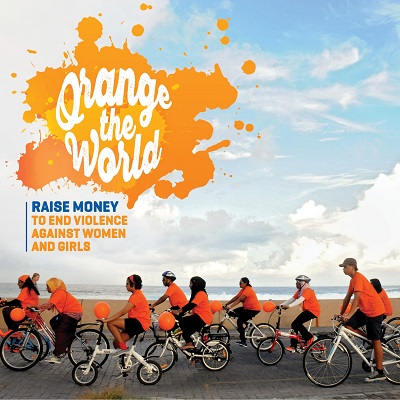
Image via UN Women
UN Women

Today, November 25, is the International Day for the Elimination of Violence against Women, organized by the UN. The UNiTE campaign “strongly emphasizes the need for sustainable financing for efforts to end violence against women and girls towards the fulfillment of the 2030 Agenda for Sustainable Development.”

Why?

“One of the major challenges to efforts to prevent and end violence against women and girls worldwide is the substantial funding shortfall. As a result, resources for initiatives to prevent and end violence against women and girls are severely lacking.”

To that end, we encourage you to consider donations to these organizations that are working to address and end violence against women and girls:

  1. Stop Street Harassment (of course) to help fund our National Street Harassment Hotline in 2017. You can also donate to support our 2017 Safe Public Spaces Mentoring Program and an updating of the laws in our Know Your Rights Toolkit, which was produced in 2013.
  2. Collective Action for Safe Spaces (Washington, D.C.)
  3. Girls for Gender Equity (New York City)
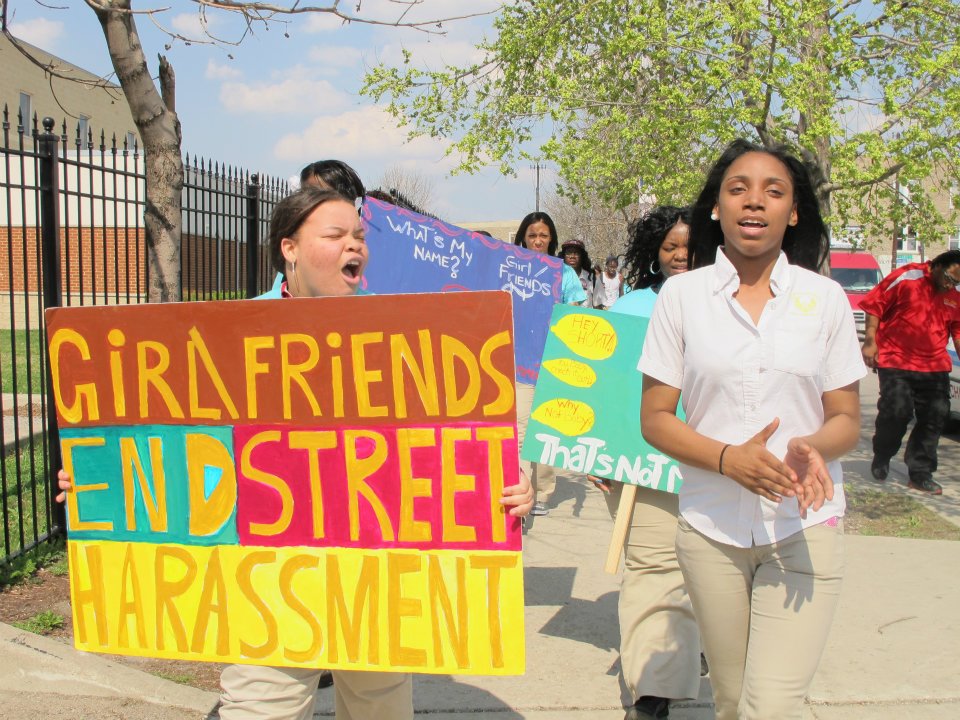
  4. A Long Walk Home (Chicago)
  5. End Rape on Campus (national, USA)
A Long Walk Home Girl/Friends in Chicago

Today is also the first day of the 16 Days of Activism Against Gender-Based Violence Campaign (being commemorated for its 25th year), coordinated by the Center for Women’s Global Leadership.The theme of the 16 Days Campaign is “From Peace in the Home to Peace in the World: Make Education Safe for All”.  According to the 16 Days website,

“This theme recognizes that structural discrimination and inequality is perpetuated in a cycle of violence that does not end even when girls and young women are in the act of gaining an education. Gender-based violence with respect to the right to education is a consistent threat in public spaces, schools, and homes and is a detriment to the universal human right to education and it is our obligation to focus on the precarious situation of education for girls and boys, young women and men this year through the 16 Days Campaign.”

Many girls and women also face violence and harassment simply traveling TO and FROM school and college. This also must be addressed if we want to see girls be able to safely receive an education.

For more information on this specific problem, see the Safe Routes to School National Partnership’s report that includes information on street harassment.

Join the conversations online with #16Days and take a stand against violence against women.

Remember, donate if you can! Our work relies on the generous contributions of people like you.

Share

Filed Under: 16 days, street harassment, UN events and efforts Tagged With: 16 days, girls walking to school, violence against women

India: Uber Installs Panic Buttons and Feminists Call for Freedom from Fear

November 23, 2016 By Correspondent

Lea Goelnitz, Delhi, India, Former Blog Correspondent

“When I walk down the streets I put on my death stare and scan every man´s face, I pass by. Their eyes are not on my face, but all over my body. I hold my head high and my hands make a fist. I am ready to fight anyone who comes near me. I am afraid, but more than that I am angry, really angry,” one young woman in Delhi tells me.

We actually talked about something else entirely, but when two women in Delhi meet, the conversation almost always turns to harassment and how to deal with it. Safety and freedom are the buzzwords we throw in. In the absence of both, these big words become tiny demands for dignity.

“I want to ride the metro in the middle of the night – unaccompanied and without a knot in my stomach“ a woman tells me.

Another one wants “to explore unknown neighborhoods and enjoy sights, admire their beauty and get lost in the crowds in narrow lanes.” But they say they cannot. With all the responsibility for their own safety put on them – What did you wear? Where did you go? Did you send a screenshot of your Uber ride to a friend? How late was it? Did you drink? Were you alone? What did you say? – there is little energy left to enjoy a stroll through the city.

Women are conscious about what to wear, which route to take, who to ask for directions and what mode of transport to take. Being on guard constantly is work, which drains lots of energy. This work is neither acknowledged nor rewarded. Still women are blamed if they don’t do “their part”. The regular obnoxious and very offensive rape analogies spit up by politicians and judges every now and then reinforce the idea that women are solely in charge for their safety and perpetrators cannot help themselves. It also sends a very clear message to all women: You are in this alone. Society will not change and no one will help you.

And of course this narrative is also offensive to men, dehumanizing them as out of control and overpowered by urges. Weirdly men do not seem to be bothered by that.

The focus remains on women: There are women-only compartments in metros and buses. A liquor store has a women-only section and advertises harassment-free alcohol shopping. This way men will never have to get used to the existence of women in public. Uber has safety buttons in their cars. From January 2017 onwards, all mobile phones in India are required to have a safety button. The pepper spray sold in shops and via amazon comes in a pink design. There also are plenty of apps which crowdsource safer ways home or send alerts and emergency texts and your GPS to your contacts. Technology and the market adapt to any tragedy.

While all of these may have value as short term solution, they are also distractions, adding more to the list women feel they must do for their own safety. Women´s physical and psychological well-being become collateral damage. Why don’t you have the app? Why didn’t you buy that new phone? Why did you get into the Uber without checking if it has the button already? Why didn’t you take that self-defense class? All this easily leads to: Why don’t you stay at home?

There is another way to approach safety concerns. Various feminist initiatives show victim-blaming the finger, change the discourse about responsibility and encourage fear to be turned into anger and confidence.

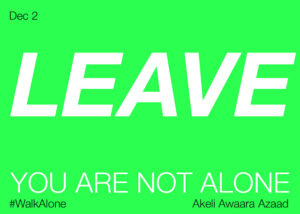
leaveThe campaign #HaveShortsWillSmoke by ”the spoilt modern Indian woman” asks women to share pictures of them wearing shorts or skirts and having a drink or smoking and share the comments they got in public. The initiative Blank Noise exhibits clothing of women, they wore when they were harassed. Of course, all kinds of clothes are represented, debunking the myth that covering up is a solution. #Walkalone and #FreeFromFear are the hashtags women use to demonstrate how they took a route, which they walked despite being afraid. Blank Noise declares them to be Sheroes, as they do not let fear influence their mobility and independence. Safecity started documenting areas that feel safe in order to encourage more women to come out and make the area even safer.

These are small steps and low-scale initiatives not having a big impact one might argue. But as opposed to the above mentioned “security measures”, which not only rely but bet on women´s fear do not even scratch the surface of the problem, but sustain the status quo, these feminist ideas provide a much-needed refreshing and creative input that inspires courage, anger and action. More please!

Lea works in journalism and women´s rights and is involved in the women´s rights NGO Discover Football, which uses football as a tool for empowerment and gender equality. Follow her on Twitter, @LeaGoelnitz.

Share

Filed Under: correspondents, street harassment Tagged With: Blank Noise, delhi, uber, women-only

“It looks like we need a new definition of normal”

November 22, 2016 By Contributor

It did not just happen once. Every time I’m walking alone in the area, even with oversized shirt and legging, I hear them talk in the local dialect. I am of Chinese descent and don’t really look like locals appearance-wise, so they thought I wouldn’t understand them. Whistles and questions like, “Where are you going, beautiful?” I would mostly ignore. But this afternoon at the airport when I heard a guy (40ish yo) said loudly to his friends, “Damnnn, this one looks delicious,” as I was passing by, I couldn’t help but stop and asked if he was talking to me or talking about me. All of them (6-7 people) just turned away and avoided eye contact, he looked quite shocked to be confronted. So I walked away, shaking, but victorious.

Whenever you are in a public space with a lot of people and lights, don’t hesitate. Confront them. Most of them would rather run and hide than be confronted. Believe me most of them would not even have the balls to look you in the eyes and apologize. I actually wanted to scream out the question one more time if they acted stupid, but they acted ashamed, so I just went off. What I couldn’t believe is when I told my friend of the incidence, he said isn’t that normal, the catcalling?

It looks like we need a new definition of normal.

Optional: What’s one way you think we can make public places safer for everyone?

I don’t agree with women-only passageway or space or whatever. It’s not us who needs to be confined, it’s the guys who need some good lessons in respect. Put up a fine. Anyone with video proof can sue someone who catcalls. Or anyone who witnessed a street harassment and can provide visual and audio proof of it should get a reward.

– FW

Location: Bali Ngurah Rai International Airport, Indonesia

Need support? Call the toll-free National Street Harassment hotline: 855-897-5910

Share your street harassment story for the blog.
See the book 50 Stories about Stopping Street Harassers for idea
s.

Share

Filed Under: Stories, street harassment

« Previous Page
Next Page »

Share Your Story

Share your street harassment story for the blog. Donate Now

From the Blog

  • #MeToo 2024 Study Released Today
  • Join International Anti-Street Harassment Week 2022
  • Giving Tuesday – Fund the Hotline
  • Thank You – International Anti-Street Harassment Week 2021
  • Share Your Story – Safecity and Catcalls Collaboration

Buy the Book

  • Contact
  • Events
  • Join Us
  • Donate
  • Facebook
  • Instagram
  • Pinterest
  • Tumblr
  • Twitter
  • YouTube

Copyright © 2026 Stop Street Harassment · Website Design by Sarah Marie Lacy