• About Us
    • What Is Street Harassment?
    • Why Stopping Street Harassment Matters
    • Meet the Team
      • Board of Directors
      • Past Board Members
    • In The Media
  • Our Work
    • National Street Harassment Hotline
    • International Anti-Street Harassment Week
    • Blog Correspondents
      • Past SSH Correspondents
    • Safe Public Spaces Mentoring Program
    • Publications
    • National Studies
    • Campaigns against Companies
    • Washington, D.C. Activism
  • Our Books
  • Donate
  • Store

Stop Street Harassment

Making Public Spaces Safe and Welcoming

  • Facebook
  • Instagram
  • Pinterest
  • Tumblr
  • Twitter
  • YouTube
  • Home
  • Blog
    • Harassment Stories
    • Blog Correspondents
    • Street Respect Stories
  • Help & Advice
    • National Street Harassment Hotline
    • Dealing With Harassers
      • Assertive Responses
      • Reporting Harassers
      • Bystander Responses
      • Creative Responses
    • What to Do Before or After Harassment
    • Street Harassment and the Law
  • Resources
    • Definitions
    • Statistics
    • Articles & Books
    • Anti-Harassment Groups & Campaigns
    • Male Allies
      • Educating Boys & Men
      • How to Talk to Women
      • Bystander Tips
    • Video Clips
    • Images & Flyers
  • Take Community Action
  • Contact

“Happiness was replaced with confusion then fear, shame and guilt”

July 21, 2016 By Contributor

It was midday of a summer day. I was standing with tens of other university students. We were all crowding around the board which held our final exam results. It was supposed to be a happy day for me, I got straight A’s and topped my class. Instead someone groped me seconds after I saw my results.

Happiness was replaced with confusion then fear, shame and guilt. I just pushed my way out of the crowd. I didn’t scream or even look back to see the guy’s face. I remember he laughed when I pushed him away and I am sure he went on to grope other girls in the same crowd.

Optional: Do you have any suggestions for dealing with harassers and/or ending street harassment in general

Raise awareness. Make more people understand that harassment is not a compliment, how scary it can feel and that they should stop blaming the victims or saying things like, “She shouldn’t dress like that” , “She shouldn’t go there alone”.. etc. Because even if harassers don’t stop, at least the victims would not be too afraid to speak up and get support, specially young teenage victims.

– Anonymous

Location: University of Khartoum central campus, Khartoum, Sudan

Need support? Call the toll-free National Street Harassment hotline: 855-897-5910

Share your street harassment story for the blog.
See the book 50 Stories about Stopping Street Harassers for idea
s.

Share

Filed Under: Stories, street harassment

“That shut them up completely”

July 20, 2016 By Contributor

I was on my way walking to work, when two men working on the roof of a building started hooting and hollering at me. I stopped in my tracks and yelled back, “I hope you fall off that building and are crippled for life because you’re already crippled in the head.” That shut them up completely.

– Anonymous

Location: Poughkeepsie, NY

Need support? Call the toll-free National Street Harassment hotline: 855-897-5910

Share your street harassment story for the blog.
See the book 50 Stories about Stopping Street Harassers for idea
s.

Share

Filed Under: Stories, street harassment

Street Harassment Phone Hotline Launches Today

July 19, 2016 By HKearl

FacebookAd

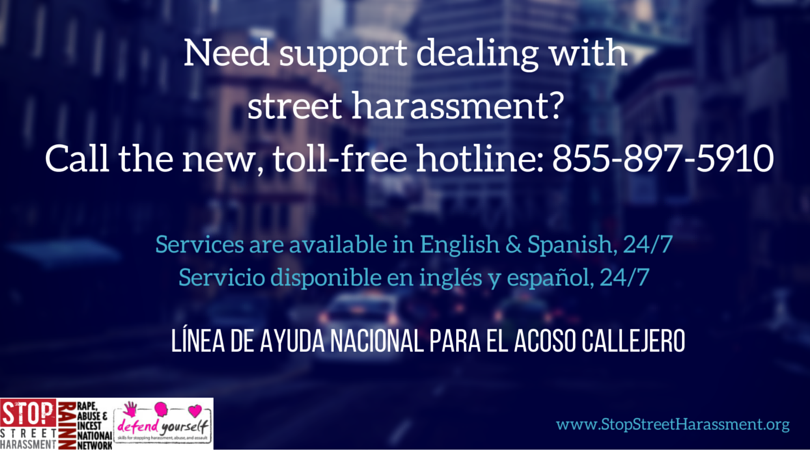
3.5 years after the idea for a street harassment hotline was hatched and six months after a plan was formed, I am thrilled to share that as of TODAY, anyone in the USA can call toll-free for support, help and advice about street harassment. The service is available 24/7, in English or Spanish.

855-897-5910

Help Spread the Word:

  1. Download shareable social media images and post them on your accounts. There are also images that can be posted on websites and designs that can be printed as postcards or stickers.
  2. Join our Thunderclap. We need at least 100 people signed up for the message to be sent out.
  3. If you are willing to post physical copies of the hotline information (postcards, stickers) in your community (e.g. on community message boards, in public bathrooms, on lamp posts) and/or distribute them at events or conferences, please list your mailing address and I will send you some.

More about the Hotline:

Stop Street Harassment has partnered with the Rape, Abuse & Incest National Network (RAINN) and Defend Yourself to launch the first-ever national street harassment hotline.

The phone service starts TODAY, July 19 (call: 855-897-5910), and an online (through secure IM) option will be available starting on August 10 via www.StopStreetHarassment.org.

The services both will be offered 24/7, in Spanish and English. People will be able to find emotional support, get advice for how to deal with harassers, learn what their legal rights are, and more.

Everything is in place – now we just need to spread the word so people know about it!

Many thanks to the 50+ people who donated to make it possible, to our Spanish language translation volunteers, to our graphics design volunteer, and to Defend Yourself and RAINN for partnering on this. It would not exist otherwise!!

Share

Filed Under: Advice, Resources, SSH programs, street harassment Tagged With: defend yourself, hotline, RAINN

“I deserve far more respect than this”

July 16, 2016 By Contributor

This has happened twice this week. Mere yards from my home, while I was walking down the sidewalk, people in their cars (all of them men) have wolf-whistled or catcalled at me, yelling rude things. In some cases, I wasn’t even 50 feet from the edge of my property. I feel unsafe in my own neighborhood every time it happens; like I can’t leave my apartment to go walk to the store without being bothered. It’s violating, it’s rude, and it leaves me angry and on the verge of tears. I deserve far more respect than this.

Optional: What’s one way you think we can make public places safer for everyone?

I’m not sure at this point, other than finding a way to make these scumbags picture that their mother/father/priest/etc. is there watching them do it.

–  SS

Location: Westminster, CO, USA

Share your street harassment story for the blog.
See the book 50 Stories about Stopping Street Harassers for more idea
s.

Share

Filed Under: Stories, street harassment

USA: The Normalization of Street Harassment in Childhood Television

July 15, 2016 By Correspondent

Mariel DiDato, NJ, USA, SSH Blog Correspondent

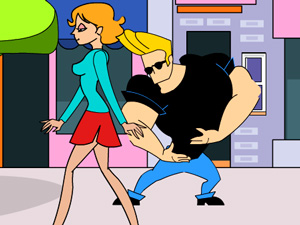
johny-bravo-s-flirts
Johnny Bravo

As a child-turned-adult Pokémon fanatic, I have succumbed to the hype of Pokémon-Go. While basking in my nostalgia, I decided to watch some early episodes of the iconic cartoon. Watching childhood television shows as an adult, I often catch things that I didn’t pick up on as a kid. Certain jokes now make sense, while other things don’t seem as funny. One example of a less-funny aspect of Pokémon is Brock’s persistent advances towards almost every female character besides Misty, and the continued response of female annoyance or rejection. I wouldn’t necessarily claim this show is sexist, as they feature multiple female characters in leadership roles. However, the repeated romantic attempts towards much of these characters, played off with the “boys will be boys” narrative, is something I did not appreciate.

This prompted me to think about the other shows I watched as a child that normalized this kind of behavior. I realized that Pokémon is hardly the worst offender. Johnny Bravo is a show that features catcalling and female rejection as the main source of humor. Even more infamous is Pepe LePew, a male skunk whose storyline involves chasing and grabbing onto a female skunk who, very obviously, does not want to be approached or touched by him.

Although this harassment and female rejection is repeatedly portrayed as comical, the real-life version of this experience is far from laughable. On the Pokémon end of the spectrum, Brock takes rejection with a blushed face, and then moves onto the next woman. Johnny Bravo’s objects of affection sometimes even strike him, leading him to simply move on to his next target, like Brock. However, the reality of female rejection often leads to male escalation, with women receiving a spectrum of responses that can range from insults, threats, and actual violence. Women are aware of this fact; smiling and receiving compliments from harassers is often misconstrued as acceptance and openness, when it is really a method of de-escalation. It is sad to see this portrayed to young children as something to be laughed about. Even while LePew’s victim can be seen struggling to break free from his arms as he kisses her, the whole situation is trivialized to the point of comedy. It is as though harassment is seen as nothing more than a mere annoyance, generally harmless to the women it affects.

More and more data reveal that street harassment is anything but funny or harmless to its victims. Studies show that the continued street harassment most women face before the age of 18 is linked to a multitude of negative effects. One 2008 study found street harassment to be correlated with self-objectification and fear of rape. This, in turn, can lead women to fear travel of any distance, restricting their freedom of movement. In addition, there is evidence that continued and frequent abuse, such as the street harassment women can be subjected to virtually any time they leave their homes, can be more harmful than experiencing one traumatic event.

However, in these cartoons, sexual harassment is shown to be a trivial event that can be laughed off. Young boys are potentially learning that, while ineffective, street harassment is an acceptable way to pick up women. In each of these shows, there is an example of the male “getting the girl.” This might send the message that harassing multiple women is okay. Eventually, one will say “yes” and it will all be worth it. Plus, the women who say no will walk away irritated, but intact. On the other hand, young girls are potentially being taught that objectification and harassment is an appropriate and acceptable part of being female.

Street harassment was a problem prior to the invention of television. Misogynistic cartoon characters did not create the larger problem of sexism in society, but they are instrumental in keeping these messages alive and normalizing them for younger generations. It’s easy to criticize outright sexism on television, but it is also important to pick up on these more discreet messages that people of all ages are receiving. I don’t think I’m going to stop watching shows like Pokémon, but I will definitely be more aware of these indirect messages in the media. I will also be supporting shows that depict healthy relationships, instead of normalizing deeply harmful social interactions. I encourage others to do the same, and hopefully future generations will enjoy cartoons that don’t rely on sexism for their laughs.

Mariel is a recent college graduate, feminist, and women’s rights activist. Currently, she volunteers for a number of different organizations, including the Planned Parenthood Action Fund of New Jersey and the New Jersey Coalition Against Sexual Assault. You can follow her on Twitter at @marieldidato or check out her personal blog, Fully Concentrated Feminism.

Share

Filed Under: correspondents, street harassment Tagged With: cartoons, catcaling, female rejection, kids, messages, objectification, trivialization

« Previous Page
Next Page »

Share Your Story

Share your street harassment story for the blog. Donate Now

From the Blog

  • #MeToo 2024 Study Released Today
  • Join International Anti-Street Harassment Week 2022
  • Giving Tuesday – Fund the Hotline
  • Thank You – International Anti-Street Harassment Week 2021
  • Share Your Story – Safecity and Catcalls Collaboration

Buy the Book

  • Contact
  • Events
  • Join Us
  • Donate
  • Facebook
  • Instagram
  • Pinterest
  • Tumblr
  • Twitter
  • YouTube

Copyright © 2026 Stop Street Harassment · Website Design by Sarah Marie Lacy