• About Us
    • What Is Street Harassment?
    • Why Stopping Street Harassment Matters
    • Meet the Team
      • Board of Directors
      • Past Board Members
    • In The Media
  • Our Work
    • National Street Harassment Hotline
    • International Anti-Street Harassment Week
    • Blog Correspondents
      • Past SSH Correspondents
    • Safe Public Spaces Mentoring Program
    • Publications
    • National Studies
    • Campaigns against Companies
    • Washington, D.C. Activism
  • Our Books
  • Donate
  • Store

Stop Street Harassment

Making Public Spaces Safe and Welcoming

  • Facebook
  • Instagram
  • Pinterest
  • Tumblr
  • Twitter
  • YouTube
  • Home
  • Blog
    • Harassment Stories
    • Blog Correspondents
    • Street Respect Stories
  • Help & Advice
    • National Street Harassment Hotline
    • Dealing With Harassers
      • Assertive Responses
      • Reporting Harassers
      • Bystander Responses
      • Creative Responses
    • What to Do Before or After Harassment
    • Street Harassment and the Law
  • Resources
    • Definitions
    • Statistics
    • Articles & Books
    • Anti-Harassment Groups & Campaigns
    • Male Allies
      • Educating Boys & Men
      • How to Talk to Women
      • Bystander Tips
    • Video Clips
    • Images & Flyers
  • Take Community Action
  • Contact

“She gets whistled at while walking alone along streets”

July 14, 2016 By Contributor

This did not happen to me, but to my girlfriend. I heard stories from her that she gets whistled at while walking alone along streets. These whistles come from men in cars as well as pedestrian passersby. Sometimes, hawker stalls owners compliments her and ask her for her name. It happens too in cinemas and public places.

Optional: What’s one way you think we can make public places safer for everyone?

I hope that the awareness is raised in Malaysia about the rudeness of catcalling to a complete stranger. I believe that currently there is no act or law in place to curb this. I do want to help in preventing this happening to anyone, be it male or female. Thank you for your kind help. 🙂

– JH

Location: Kuala Lumpur, Malaysia

Share your street harassment story for the blog.
See the book 50 Stories about Stopping Street Harassers for more idea
s.

Share

Filed Under: Stories, street harassment

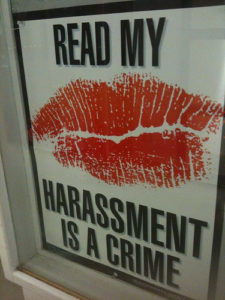
Street Harassment is a Hate Crime in Nottingham, UK

July 14, 2016 By HKearl

HarassmentisaCrimeThere’s big news out of the UK this week.

Via the Telegraph:

“”A police force has become the first in Britain to recognise misogyny as a hate crime, in an effort to make the county a safer place for women.

Nottinghamshire Police is recording incidents such as wolf whistling, street harassment, verbal abuse and taking photographs without consent within the hate crime definition.

It also includes unwanted sexual advances, uninvited physical or verbal contact and using mobile phone to send unwanted messages….

Sarah Green, acting director of the End Violence Against Women Coalition, said: ‘We welcome this because it comes off the local police force talking to and listening to local women’s groups. What we are talking about is not trivial behaviour – some harassment that women and girls receive in public is upsetting and should have the attention of the authorities.’

She added: ‘Police in Nottingham have not changed the law but they have listened to local women who said the behaviour bothered them. Together, they are recording it so they can monitor it and look back on who is doing it and where it happens.'”

While there are a lot of complications regarding criminalizing street harassment, and there are a lot of nuances for why it’d be hard, possibly unfair, and largely unenforceable to make all verbal street harassment illegal (especially in the USA), I still can’t help but cheer and tear up a little bit to see these horrible, demeaning and needless interactions classified as a HATE CRIME!! They should have no place in our society.

More about this story from Washington Post and Guardian.

“Misogyny hate crime is classed under the new policy as “incidents against women that are motivated by an attitude of a man towards a woman, and includes behaviour targeted towards a woman by men simply because they are a woman”…

Rachel Krys, co-director of the End Violence Against Women Coalition, said: ‘It is great that police in Nottingham will be capturing the way a lot of harassment in public spaces is targeted at women and girls. In a recent poll we found that 85% of women aged 18-24 have experienced unwanted sexual attention in public places and 45% have experienced unwanted sexual touching, which can amount to sexual assault.

‘This level of harassment is having an enormous impact on women’s freedom to move about in the public space as it makes women feel a lot less safe. The women we spoke to do a lot of work to feel safer, including avoiding parts of the city they live in, taking taxis and leaving events in groups.’

Krys said recording such incidents would give police and policymakers a much clearer grasp on the levels of harassment women and girls are subjected to, and better understand measures which could reduce it.

‘It should also challenge the idea that women and girls in public or online spaces are ‘fair game’,’ she added. ‘We know that ignoring harassment and sexist bullying creates the impression that other types of violence against women will be tolerated so we welcome any action which counters this.'”

Share

Filed Under: News stories, street harassment Tagged With: hate crime, laws, UK

USA: What Can I Say? Taking Submissions for Witty Responses to Harassers

July 10, 2016 By Correspondent

Hope Herten, IL, USA, SSH Blog Correspondent

ViaHollabackDesMoinesIf we had a daily post limit for life, I would have to be quiet for the vast majority of my waking minutes. Talking is one of my favorite hobbies; I’m an expert in forming opinions and I’m a speaking-my-mind frequent flier. As a person who always has something to say, why can’t I stand up for myself when faced with unwanted harassment?

A combination of fear and surprise is probably the top contributing factor; rarely am I approached when I am expecting it or by someone less threatening than me. Though I tell myself that maybe not saying anything at all is the high road, I can’t help feeling that an inability to speak reinforces the power structure being exploited by my harassers.

Often we are taught that it is better to say nothing at all than to speak too quickly and let our emotions run away with our words, and though many intelligent men and women have preached this ideal, I have come to struggle with it, particularly in the last few weeks where harassment has become more frequent in my life.

Is it better to say nothing when patriarchal men try to assert dominance over you in public than to say something that may come out wrong? Does it make a bigger impact to ignore a harasser or give him a piece of your mind? Are harassers impacted at all by what you say or don’t say to them? Am I showing my strength by saying nothing or am I admitting defeat? None of these questions seem to have a clear-cut answer; there is no prescription for patriarchy, no magic words to make someone see what they are doing is harmful.

My conclusion comes back to my favorite aspect of feminism: choice. Silence can be a deliberate act of defiance, refusing to let an oppressive voice cause you to lose your cool and say things you don’t mean. Simultaneously, refusing to stay silent is a choice to empower yourself in a different way, vocalizing your refusal to submit. For some, being forced to speak out of anger or fear can help reinforce the power structure that harassers are acting in. For me, silence isn’t a courageous act. I am scared to speak when harassed in public for fear of saying something wrong, I am afraid of angering the harasser, and I worry that what I say won’t matter. I need to remind myself that I am strong and intelligent and that despite what my words mean to an oppressive body, they mean a lot to me and I will not be made silent by a complete stranger.

I want to remind all of you, that no one should make you do something that makes you feel like a lesser person.  Whether you remain silent or speak up, make it your act of protest. Don’t let a single person or moment push you down, because as a collective, feminists are coming together to give you the freedom to go outside and not have to make the choice at all.

P.S. If you are looking for some great suggestions Stop Street Harassment already has some, here and here.

Hope is a full-time undergraduate student studying public health and Spanish in Chicago, IL.  If you want to keep up with Hope you can follow her on Twitter @hope_lucille or check out her public health blog.

Share

Filed Under: street harassment

USA: How much of Sexual Harassment of Women is Media’s Responsibility?

July 8, 2016 By Correspondent

Manish Madan, Ph.D, USA, SSH Blog Correspondent

Note-Card-CapableA few weeks ago, I participated in a panel discussion on street harassment. My fellow participants included a lifelong advocate on gender rights and women’ safety in India, Dr. Sharada Jayagopal – part of Women Graduate-USA, a physician by profession, and the TV personality, Ms. Renee Mehrra who is also a well-known activist for women’s right. Renee asked me about my views on the role of media (particularly Bollywood movies) in regards to the sexual harassment of women. I think as a society we need to ask this question more often given the wide-reach of media, its permeability in our society, and how it shapes our opinions and beliefs.

So for the purpose of this post, I will revisit some of the research about media’s role influencing the sexual harassment of women. The presentation of women often based solely on their physical appearance, including certain manners inviting sexual innuendos, is often noted in the research. In some cases, media shows women to be submissive.

Media cultivation theory states, “The views shown on the television media is mostly taken as the messages and beliefs that are real and valid’” and will argue that the consistent portrayal of women in a sexually objectifying manner or as someone who can be harassed and will remain submissive when harassed, is likely to be taken as a reality outside the “idiot box” as well.

Naturally, the media content varies within the genres, such as music videos, soap operas, comedies, action movies, dramas, etc. Some genres attract more objectification than others. For instance, Selena Gomez’s song Good for You will be strikingly different from CNN Erin Brunnet’s Out Front — unless it involves Chris Matthews at CNBC “Hardball” (no pun intended!) asking her to come close to the screen during a video interview just so her could tell her, “You look great!”

In a study from Italy, Silvia Galdi and her co-authors examined the relationship between the objectification of women as sexual objects and the likelihood of sexual harassment occurring using Italian TV Programs. The authors used three sets of video clips depicting, i) objectified women, ii) non-objectified women, and iii) no women in the video. The study showed participants’ higher harassment penchant after watching the objectification TV program compared to watching the non-objectified women professionals or the ones where there were no women in the video.

The study also noted that male participants reported greater intentions to engage in sexual coercion and a higher likelihood to engage in harassment behavior as a result of viewing TV programs that depicted objectified women. Interestingly, participants who watched objectified programs were also more likely to conform with the traditional masculinity norms regarding dominance (used as a symbol of sex and power), and aggression.

The question thus goes back to the initial discussion, does the media create new social realities or is it a mere transmitter of existing social certainties? Thoughts?

Either way, such realities or certainties that comprises one gender or makes their existence vulnerable in a public space must be addressed.

There is also evidently some research that shows that the amount of time a youth spends consuming some form of the media is much more than the time spent in school or having interpersonal communications with parents. That said, if I view our social structure that enables an environment of sexual harassment as a jigsaw puzzle, then media will perhaps be one vital piece that has some role in this puzzle. Expanding the landscape of women portrayal in media with shows like #Quantico with a female lead charting her own course is probably a good change going forward where the women are not seen as mere sexual objects.

Do you think someone will consider sexually harassing the FBI recruit, #AlexParrish?

As a civilized society formed on principles of equality and respect, the media does have a role in either condoning or monitoring the objectification (often sexual in nature) of women, and having a larger role to play in our society’s struggle toward addressing the sexual harassment of women.

In conclusion, while I discussed the role of media in gender objectification, I also want to offer caution in singularly blaming it for the gender harassment as it will lead us to a reductionist approach. It is not only media nor is it all media, but perhaps there is a little bit of everything. Media is one bit of the puzzle and we also need to focus on various social, cultural, patriarchal and environmental factors that also promulgate the concept of gender harassment in our society.

Please use #MediaRoleinSH to share your views. I will look forward to reading and commenting on it!

#SexualHarassment #Masculinity #Dominance #MediaPortrayalofWomen #Italy

Manish is a Professor of Criminal Justice at Stockton University where his research focuses on examining sexual harassment, gender empowerment, spousal abuse and policing issues. You can follow him @Prof_Madan or reach out to him at www.manishmadan.com.

Share

Filed Under: correspondents, street harassment Tagged With: media, sexual objectification

“I told him he needs to control his comments.”

July 7, 2016 By Contributor

Just yesterday, at a Family Dollar, I was harassed by a middle aged man. I was wearing a bandage skirt and he said, “I feel like I just want to grab that thing. You need to cover it up because I’m attracted to shit like that.”

I told him he needs to control his comments. He told me my man was an idiot for letting me dress like that. I felt very terrified, because he just threatened to rape me, technically.

– Betty Miller

Location: Broad and Girard Ave. in Philadelphia, PA

Share your street harassment story for the blog.
See the book 50 Stories about Stopping Street Harassers for more idea
s.

Share

Filed Under: Stories, street harassment

« Previous Page
Next Page »

Share Your Story

Share your street harassment story for the blog. Donate Now

From the Blog

  • #MeToo 2024 Study Released Today
  • Join International Anti-Street Harassment Week 2022
  • Giving Tuesday – Fund the Hotline
  • Thank You – International Anti-Street Harassment Week 2021
  • Share Your Story – Safecity and Catcalls Collaboration

Buy the Book

  • Contact
  • Events
  • Join Us
  • Donate
  • Facebook
  • Instagram
  • Pinterest
  • Tumblr
  • Twitter
  • YouTube

Copyright © 2026 Stop Street Harassment · Website Design by Sarah Marie Lacy