• About Us
    • What Is Street Harassment?
    • Why Stopping Street Harassment Matters
    • Meet the Team
      • Board of Directors
      • Past Board Members
    • In The Media
  • Our Work
    • National Street Harassment Hotline
    • International Anti-Street Harassment Week
    • Blog Correspondents
      • Past SSH Correspondents
    • Safe Public Spaces Mentoring Program
    • Publications
    • National Studies
    • Campaigns against Companies
    • Washington, D.C. Activism
  • Our Books
  • Donate
  • Store

Stop Street Harassment

Making Public Spaces Safe and Welcoming

  • Facebook
  • Instagram
  • Pinterest
  • Tumblr
  • Twitter
  • YouTube
  • Home
  • Blog
    • Harassment Stories
    • Blog Correspondents
    • Street Respect Stories
  • Help & Advice
    • National Street Harassment Hotline
    • Dealing With Harassers
      • Assertive Responses
      • Reporting Harassers
      • Bystander Responses
      • Creative Responses
    • What to Do Before or After Harassment
    • Street Harassment and the Law
  • Resources
    • Definitions
    • Statistics
    • Articles & Books
    • Anti-Harassment Groups & Campaigns
    • Male Allies
      • Educating Boys & Men
      • How to Talk to Women
      • Bystander Tips
    • Video Clips
    • Images & Flyers
  • Take Community Action
  • Contact

Women’s Equality Day Wish: No Street Harassment

August 26, 2011 By HKearl

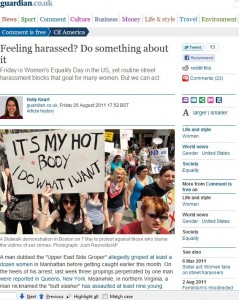
The Guardian just published  an op-ed I wrote for today’s Women’s Equality Day! Check it out and consider leaving a comment.

(By the way, a dozen op-eds and articles I’ve written have been published since I did The Op-Ed Project training last year. I highly recommend it!!)

A man dubbed the “Upper East Side Groper” allegedly groped at least a dozen women in Manhattan before getting caught earlier this month. On the heels of his arrest, last week three gropings perpetrated by one man were reported in Queens, New York. Meanwhile, in northern Virginia, a man nicknamed the “butt slasher” has assaulted at least nine young women in shopping malls across the past few months. He has not been caught.

Aren’t these just unfortunate, isolated, random incidents, you may ask. No.

The news stories simply bring to light experiences that happen to too many women. Recently, when a woman in Astoria, New York, blogged about a man groping her, 45 women emailed her with similar stories. More than half of 800 female survey respondents of a 2008 study said they had been groped or sexually touched in public. The majority of the respondents were only in their teens and twenties. When I was 18 years old, a man groped me on a street near my college campus, making me part of that percentage.

Today is Women’s Equality Day in the United States. But equality is more of a wish than our reality when so many inequalities exist – including women’s unequal access to public places because of gender-based street harassment, including gropings and slashings.

Street harassment comprises actions and comments between strangers in public that are disrespectful, creeping, threatening and unwanted. It ranges from whistling and sexist or sexual comments to flashing, stalking, groping and assault. It primarily impacts women, including more than 80% of women worldwide, and it directly limits their access to public spaces.

The milder forms of harassment like whistling and comments are often dismissed as a compliment – something women “ask for” – or a harmless annoyance. The reality is, they cause harm; and their accumulation can make women feel wary in public and even “choose” not to go places unaccompanied.

For Psychology Today, Dr Kathryn Stamoulis recently wrote about how a teenage girl she counsels confided that she did not want to run errands for her parents or go to school unaccompanied because adult men sexually harass her. Many harassed individuals are like her: teenage girls whose perception of self, of men, and of their place in the world, is negatively impacted by the sexual harassment they face on the streets.

Women who face lots of mild forms of harassment, or just one serious form like groping or stalking, may feel obliged to change commuting routes, only go places accompanied, or even move neighbourhoods, change jobs or quit hobbies to avoid further victimisation. Street harassment genuinely impedes women’s equality by limiting women’s access to public places; it denies them the liberty they should have of being able to walk freely in public without harassment.

Thankfully, more and more people are recognising that street harassment is a barrier to equality and a denial of liberties – and they’re taking action. Ever since New York City councilwoman Julissa Ferreras found out that teenage girls in her district face street harassment on their way to and from school, she has made the issue a priority. Last week, she took to the streets to raise awareness about the rampant groping in Queens, and last fall, she broke new ground by organising the first-ever city council hearing on street harassment.

A college student at Stanford University with whom I’ve corresponded is currently organising a coalition of people and groups in the California Bay Area to advocate for anti-street harassment measures. This summer, she worked with transit authorities to add sexual harassment information to their brochures and website and possibly to start an awareness ad campaign.

In Washington, DC this past spring, 50 volunteers, just ordinary residents of the city, participated in a community safety audit, organised by Holla Back DC! and me. On designated dates, they fanned out across the city to analyse what the streets looked like during the day, and at night, and then made recommendations for how to make the city safer. During the last week of September, we will be encouraging interested persons to keep a “street harassment log” for a week using a log we provide. Because street harassment is under-documented and researched, the goals of these projects are to start documenting harassment better – and to add to the growing number of stories being collected online – so we can then work on solutions.

What can you do to ensure women have equal access to public spaces? Your role can be as simple as sharing a story, talking about boundaries and consent, or helping out when you see harassment occurring. Every action helps and every action can bring us closer to Women’s Equality Day being a reality, not just a wish.

Share

Filed Under: News stories, Stories, street harassment Tagged With: groper, slasher, street harassment, upper east side groper, women's equality day

Interview: Flier Project

August 24, 2011 By HKearl

Autumn, a fourteen-year old trans woman and feminist who lives in New Jersey is working on an anti-street harassment flier project and she agreed to answer a few questions about it.
Stop Street Harassment: What inspired you to create and post fliers about street harassment?
Autumn: While I was in New York, I saw a very impromptu flier rebuking street harassers and misogynists in general. I thought this was a very clever idea, and a very easy way to start voicing my opinion in an open forum. So, I took a few nights of making very minimalistic, blunt posters on a number of issues that feminism focuses on.
Stop Street Harassment: What messaging is on the fliers?
Autumn: I made multiple fliers, actually. In my first, I tried to give the reader a general summary of feminism, dispelling stereotypes of feminists and trying to assert what actual feminism means. The second one was exclusively against street-harassment, and the third is against slut-shaming. I purposefully tried to make them very minimalistic and bare, with only text and such, as I felt if I put too much graphic decoration in them, it would take away from the message.
Stop Street Harassment: Where are you posting them and what do you hope the outcome will be?
Autumn: Luckily I live adjacent to Manhattan, so one of these days I am going to print and copy about one hundred and spend a day posting them in the subway, bus terminals, traffic light poles, really anywhere they will be seen. I also plan on taking them to Slut-Walk. I have them in PDF format, and I invite anyone who wants to download and post them in their respective city as well – it can’t hurt! I’m not really trying to get people to become radical feminists, but rather I just want people to realize that street harassment and slut shaming are not acceptable things.
Stop Street Harassment: Anything else you want to add?
Autumn: I’ll be attending the Slut-Walk in New York in October, and if anyone has a Tumblr, mine is autumn-and-gomorrah.tumblr.com. Though it’s not exclusively a feminist-dedicated blog, probably ninety percent of my posts are about feminist topics or anarcha-feminism.
Check back for a follow-post with an update on her project.
Share

Filed Under: Activist Interviews, street harassment Tagged With: activist interview, street harassment

45 women report gropes on the street in Astoria, NY

August 23, 2011 By HKearl

On the heels of the arrest of the alleged Upper East Side Manhattan groper, the problem of men groping women in public is back in the news after a series of groping reports in Queens, New York.

From the Queens Chronicle:

“If you have breasts, you get hit on. That’s how this neighborhood is,” said Nicolle Loayza, 26. She was talking about Jackson Heights, where she was born and raised. A man accused of groping three women in the neighborhood on two different occasions last July is still at large, said Councilman Danny Dromm (D-Jackson Heights) this week.

On the heels of these attacks and a spate of separate groping incidents reported in Astoria and the Upper East Side, council members Julissa Ferreras (D-Corona) and Dromm stood on the corner of 90th Street and Roosevelt Avenue to pass out fliers with the police drawing of the Jackson Heights groper last week.

In Astoria, various groups, including the New York Anti Crime Agency and the office of Councilman Peter Vallone (D-Astoria), have mobilized to make community members more aware of the problem and help women in the neighborhood.

At least two different men accused of groping Astoria women have been arrested, according to Vallone’s office. Published reports have identified these two men as Miguel Hermenegildo, 33, and Dennis Bryan, 22. A different Queens man, Jose Alfredo Perez Hernandez, 18, has been arrested in connection with gropings on the Upper East Side.

The issue first came to attention last July because of Kate Salute, an Astoria woman who blogged about being groped on “Why Leave Astoria?” prompting an outpouring of similar stories from other women. Salute wrote in an email that some 45 women have since come forward…

In Jackson Heights, Loayza pointed to the spot on Roosevelt Avenue where she said men often wait just to look up women’s skirts when they climb the stairs to the 90th St. 7 train.

She described the time a man grabbed her crotch a few blocks away when she was just 12 years old, and said men often follow her home from the train, catcalling her along the way. However, she has never reported a single incident.

“I’ve learned to deal with it,” she said. “You just walk around the block and try to lose them.”

But Ferreras thinks this is precisely the problem.

“It’s not just about shrugging it off or avoiding a corner,” Ferreras said.

Dromm, Ferreras and Vallone are encouraging women in their districts to continue coming forward.”

At what point does this constitute a hate crime?! 45 women have been groped in one area just for being female in public. What the hell.

I’m glad local leaders are taking action and working to fix the problem and that there was an awareness rally last week. Ladies of Astoria, keep sharing your story!

I’m not surprised Ferreras is one of the individuals speaking out; she called the first-ever street harassment city council hearing in NYC last year. She’s a great advocate for ending street harassment.

Now, the outcry needs to continue until the groping ends.

Share

Filed Under: News stories, street harassment Tagged With: Astoria groper, Julissa Ferreras, street harassment

Eight street harassment incidents in one afternoon!!

August 22, 2011 By Contributor

I finished hanging out with my friend today and we parted ways at the Safeway on Columbia Road in  Washington, DC. As soon as we went our separate ways, the harassers came out of the woodwork and I was harassed eight times! Since moving to a mostly-white suburb, the harassment I face has decreased tremendously. I feel that being a black woman in this mostly-white area makes me pretty invisible, so facing this much harassment was a shock.

The first four harassment encounters happened along Columbia Road, between Ontario Road and 16th Street NW.

1. A guy sitting outside of Crumbs and Coffee—in a Crumbs and Coffee uniform —said, “Howya doin’ ?” in a sexual tone. I ignored him.

2. I passed one guy who looked me up and down and said, “Hello, baby, how you doin’?” I ignored him too.

3. A third man also looked me up and down and said, “Hey, beautiful—man, you are beautiful!” He also got ignored.

At this point I called my friend’s phone to leave a message about how ridiculous all these men are and how it happened the moment we split up. I think the behavior of these men is laughable. During this, a fourth man sitting on the sidewalk looked at me. I assumed he heard me on the phone and would be discouraged from saying anything, but nope!

4. The fourth man said, “Hey, baby, lookin’ good, baby.” Once again, I ignored him. He got an attitude, and said, “Hey…hey!” in this tone that read how dare I have the audacity to ignore him.

5. I turned right onto 16th Street, and I heard kissing noises made at me from someone’s car.

I finally got to Meridian Hill/Malcolm X Park, and I took the time to sit at the lower level of the park for a moment. I wanted to observe the drum circle, but I also wanted to clear my head before heading to the top level. The air looked dark and it looked like it was going to rain. I also saw men who seemed to be doing nothing but staring at me, so I moved away. When it looked like it was going to rain, the drummers started to pack up. I wanted to walk a few laps around the top level to clear my head, hoping that the rain wouldn’t start.

Meridian Hill Park harasser (#6)

This is where the harassment went from laughable to scary.

6. During my walk, I passed a man who said, “God bless you, beautiful” and crap like that. I tried to continue walking and he kept saying garbage, and I felt I did enough ignoring for today, so I turned to confront him.

“Don’t talk to me like that,” I said. “I don’t need you telling me I’m beautiful. I’m not an object, I don’t like being talked to like that, and you need to respect women and leave women you don’t know alone.” I felt I was calm, cool and collected. The harasser wasn’t hearing that, though.

The harasser said, “I was just trying to bless you and tell you you’re beautiful—“

“I don’t need nor do I want you to say anything to me,” I said. “Leave women you don’t know alone.”

This guy goes from trying to flatter me (so he thinks) to aggressive.

“Don’t tell me how to talk to you,” he said. “I can say whatever I want.”

“When it comes to how someone approaches me, I WILL tell you how to talk to me!” I replied.

It went back and forth like that until he started yelling, “I’m trying to tell you something, I’m trying to tell you something!” Then he says “DO-YOOU-HEEEEEEEEEAR-MEEEEEEEEEEEE?” loudly and slowly as if he thinks I’m slow.

“Yeah, I hear you,” I say. “You’re so loud, the whole DISTRICT OF COLUMBIA can hear you!”

The younger guy who was with him tried to get him to stop, but he wouldn’t. And the younger guy even laughed when I made that comment about the whole of DC being able to hear the harasser.

“I feel bad that you don’t think highly of yourself,” the harasser said. He was trying to say that my not wanting him to say I’m beautiful was because I didn’t think I was beautiful. BULLSHIT! I know I look good—I don’t need the validation of my appearance by some strange man!

After more nonsense this guy said, “I’m sick of you. I don’t want to hear you anymore. Fuck you, bitch! Go away!”

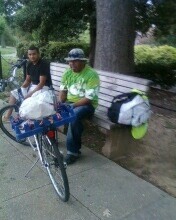
When it got violent with those words, I had to take his photo to submit to the street harassment sites. (He’s the turd in the green shirt.) That set him off even more.

“Fuck you, bitch! I’ll take your photo too!” he said, aiming his camera phone at me. I think I turned my head in time and he took shots of my back, but who knows. I’m nervous of what he’ll do with my picture if he did manage to get it, but as long as there’s no “Harassers Fight Back!: Keep Harassing Women” site that harassers use, I should be fine.

This drama had gone on long enough, so I walk away to call Park Police. He followed as if he was going to try something. The younger guy looked nervous and left, though he wasn’t the one harassing me. “I’m calling the police!” I yelled, and dialed them.

The harasser continued to yell, “Fuck you, bitch!” and acted like he was coming closer, but as soon as he heard me say, “I need Park Police to come to Meridian Hill Park since there’s a man saying ‘Fuck you, bitch!’ to me and acting like he’s going to start something,” he went to his bicycle and rode off. Damn, I thought, but I did get his picture, although my phone’s been acting up and the photo is small.

The wait for Park Police was the longest ever, and I felt so alone.

7. I waited at the 15th Street entrance near the northern end of the park, and this SUV with two guys stopped. Both leered at me. I roll my eyes. When were they going to leave?

“You can leave now…damn!” I said. I thought rolling my eyes and copping attitude would’ve been the hint to drive off, but the driver asked, “Girl, need a ride?”

I went off. “No, I don’t need a ride—damn! Fuck off!” and I flipped them the bird. They finally drove off.

8. When I went to wait at the middle entrance on the 15th Street side, a man with dreadlocks looked me up and down (don’t these harassers do anything original?) and said, “How you doin’, baby?” This was the last straw.

“Don’t call me baby,” I said, in a steely tone.

“Wha—?!” he said. “All I said was ‘How you doin’?'”

“There’s a HUGE fucking difference between ‘How you doin’?’ and ‘How you doin’, baby‘!” I snapped. He also tells me “Fuck you, bitch!”

I was riled up. If the police didn’t come soon I was going to leave. I felt vulnerable, I was on edge, and I was defensive. I caught myself even snapping at a kid who looked in my direction. “Don’t think about saying a damn thing to me!” I said, putting my hand up in the “talk to the hand” gesture. He looked nervous.

After 20 minutes, an officer finally arrived, apologizing for the delay. I relayed the story of the sixth harasser and show him the photo on my phone.

“Can you zoom in?” he asks.

“Unfortunately that’s the largest it is,” I said. But I remembered something about this harasser that made it easier to identify him.

“He has a nose ring,” I said. Since the photo was small, it was hard to see that.

“He does?” the officer said.

“The photo is small but he does have a nose ring,” I said. “Like a bull’s.”

As soon as I said that the officer told me he knew who this guy was, and would try to find him. Whether he did or not, I don’t know, but at least he seemed to care when it had seemed like no one did.

I felt that this barrage of harassment today set off other things, and my mood was just dour for hours. It also didn’t help that I got caught in the downpour when I finally was on my way home. During the worst harassment at the park, I was hoping someone would ask me if I was okay and act as a bystander ally, but none of that happened. This was either entertainment to some or people acted indifferently towards it. I was alone and felt vulnerable. If I came off as an angry and crazy, I have every right to be. That type of harassment can do that to a person.

I know what family and friends are going to say:

“You shouldn’t have overreacted.”
“You shouldn’t have argued with him.”
“You shouldn’t have taken his picture.”
“You should’ve just taken it as a compliment.”
“You should’ve ignored it.”

They’re going to tell me everything I was doing wrong instead of what really needs to be said: “Those men shouldn’t have said anything to you and should’ve left you alone.” But regardless of the reaction of my family and friend, I wouldn’t change a thing I did today and stand by my original actions 100%.

What I hate about the harassers is how they’ll flip the switch. You go from being “beautiful” to a “fucking bitch” for not accepting their unsolicited and unwanted “compliments.” They’ll try to deflect the blame on you, like for instance, if a minority harasser’s advances on a white woman are rejected, he calls her “racist” to try to make her look like the bad one and him the saint. Or with what I said above, the harasser tried to make it look like I had “low self-esteem” and needed someone like him to boost it. Harassers are living in a sorry world of complete illogic.

When back in my neck of the woods, I walked the trail to clear my head and get all of the stress from the earlier incidents out of my system. When I was heading back towards home, a guy riding his bike said, “Nice outfit” to me and I thanked him. This I took as a compliment because 1. he looked me in the eye, not up and down my body, and 2. he kept it moving. He, unlike harassers, didn’t have an ulterior motive or wanted anything out of it. So to those who say, “Learn how to take a compliment,” trust me, I know how to. What harassers do is not complimentary, it’s sick.

As I said earlier, I now live in a mostly-white suburb where I am almost invisible. While I feel it curbs the harassment greatly, I don’t like feeling invisible and being written off because the color of my skin. But going to DC it’s the complete opposite—I’m a walking target for street harassment, and most of my harassers have been black and Hispanic men. In this story, 1,2, 4, and 8 are black, and 3,6, and 7 were Hispanic. (I didn’t see who was in the car in 5 that made kissing noises at me.) I hate that these harassers have me on guard anytime I pass a black or Hispanic man on the street. I hate that these harassers have me lumping in good black and Hispanic men with them because I’d rather be safe than sorry. These idiots are ruining it for everyone. And I hate being seen as property by the harassers who are the same race as me—black—who think they can say anything to me because of a shared race.

I noticed a few white women running laps around the top level of the park but did these men try to talk to them? I doubt it. I feel as if minority harassers are scared to do this to white women because they know action will immediately be taken to protect these women (save for a few minority harassers bold enough to harass white women in the way I mentioned two paragraphs up), but black women and other women of color are fair game to these sorry excuses for men and I’m sick of it.

After all that went down at the park today, I didn’t want to go back. It was not fear, but embarrassment, remembering how people either ignored my being harassed or thought of it as entertainment. I didn’t want to return to the park as “that girl.” But then I thought, I love this park, this park has more character than any of the bland parks where I live. I see diversity, art, culture, and beauty in this park. I would love to return and hopefully catch a drum circle not interrupted by the rain. The park didn’t harass me—these men did!

I don’t like living where I feel invisible, but I don’t want to live in a place where I feel harassed either. I simply want respect. There’s got to be a balance somewhere.

– Anonymous

Location: Various areas in Washington, DC (listed throughout the post) on August 21, 2-3 p.m.

Share your street harassment story today and help raise awareness about the problem.
Find suggestions
for what YOU can do about this human rights issue.

Share

Filed Under: Stories, street harassment Tagged With: racial harassment, street harassment

“Hey Baby” Hurts | Psychology Today

August 20, 2011 By HKearl

Dr. Kathryn Stamoulis writes a column for Psychology Today and yesterday she poignantly wrote about why addressing street harassment matters:

“Leers and derogatory comments are familiar to many women, especially those who live or work in an urban environment. Blasé attitudes towards cat calls, with reactions such as, “it’s no big deal” or “take it as a compliment” act to downplay what is in actuality a form of sexual harassment. Recently I was confronted with the story of a young teenager whose experience reminded me of the serious psychological implications of street harassment.

14 year-old Sarah* was brought to my counseling office by her concerned parents who were worried that she wasn’t exhibiting enough independence for her age. Sarah, they said, was often hesitant to run errands on her own and wanted to be escorted when she walked to and from school. I met with Sarah one-on-one to get her reaction to her parents concerns, and after a few minutes she blurted out “I don’t like old men saying things to me”.

Sarah had been keeping a secret from her parents. On an almost daily basis, men were making sexual comments to her when she was on the street or taking public transportation. These comments ranged from “hey baby” to explicit remarks about her body. To cope with the harassment she had developed strategies such as wearing headphones or pretending to talk on the phone. Despite her resourcefulness, Sarah was forced to become aware of the sexual way in which some men viewed her, when she just wanted to go to her friend’s house or walk to school…..

The frequency of this form of harassment is both shocking and serious in its implications. In Sarah’s case, she was restricting her behavior and fearful of being alone. At a critical stage of development, this fear was hindering her ability to gain confidence by completing tasks independently. She even turned down a job offer to walk her neighbor’s dog, something that could have increased her sense of responsibility and self-esteem.

Aside from its effects on her independence, this harassment could also have an effect on how she views her own body. A study in the Journal of Social Justice Research found that street harassment was related to self-objectification. Self-objectification is a process by which girls learn to think about their own bodies as objects of other people’s desires. Instead of appreciating the body for its abilities, its strengths or its pleasures, a person sees it as something for other people’s enjoyment. Multiple studies have linked self-objectification with an increase in rates of depression, anxiety and eating disorders as well as lower academic achievement.

Harassment and self-objectification are linked to lower academic achievement because they rob a person of valuable cognitive resources. For example, the time Sarah spent being vigilant and pretending to talk on her cell phone was time not spent processing the events of the day at school or mentally preparing for an exam.

Aside from all the negative effects of harassment noted above, most simply the harassment Sarah faced made her enjoy her time less, and that alone is a tragedy….”

(Read the full article)

When I began researching street harassment for a book, it was when I realized just how much street harassment negatively effects women’s and girls’ lives that I decided to channel my passion for equality into this issue. It really is a big deal, especially when we think about its impact on teenage girls.

It’s time to change things.

Share

Filed Under: News stories Tagged With: kathryn stamoulis, psychology today, street harassment

« Previous Page
Next Page »

Share Your Story

Share your street harassment story for the blog. Donate Now

From the Blog

  • #MeToo 2024 Study Released Today
  • Join International Anti-Street Harassment Week 2022
  • Giving Tuesday – Fund the Hotline
  • Thank You – International Anti-Street Harassment Week 2021
  • Share Your Story – Safecity and Catcalls Collaboration

Buy the Book

  • Contact
  • Events
  • Join Us
  • Donate
  • Facebook
  • Instagram
  • Pinterest
  • Tumblr
  • Twitter
  • YouTube

Copyright © 2026 Stop Street Harassment · Website Design by Sarah Marie Lacy