• About Us
    • What Is Street Harassment?
    • Why Stopping Street Harassment Matters
    • Meet the Team
      • Board of Directors
      • Past Board Members
    • In The Media
  • Our Work
    • National Street Harassment Hotline
    • International Anti-Street Harassment Week
    • Blog Correspondents
      • Past SSH Correspondents
    • Safe Public Spaces Mentoring Program
    • Publications
    • National Studies
    • Campaigns against Companies
    • Washington, D.C. Activism
  • Our Books
  • Donate
  • Store

Stop Street Harassment

Making Public Spaces Safe and Welcoming

  • Facebook
  • Instagram
  • Pinterest
  • Tumblr
  • Twitter
  • YouTube
  • Home
  • Blog
    • Harassment Stories
    • Blog Correspondents
    • Street Respect Stories
  • Help & Advice
    • National Street Harassment Hotline
    • Dealing With Harassers
      • Assertive Responses
      • Reporting Harassers
      • Bystander Responses
      • Creative Responses
    • What to Do Before or After Harassment
    • Street Harassment and the Law
  • Resources
    • Definitions
    • Statistics
    • Articles & Books
    • Anti-Harassment Groups & Campaigns
    • Male Allies
      • Educating Boys & Men
      • How to Talk to Women
      • Bystander Tips
    • Video Clips
    • Images & Flyers
  • Take Community Action
  • Contact

Interview with organizer of Afghanistan anti-street harassment march

July 16, 2011 By HKearl

Noorjahan Akbar, 19, founder of rights group Young Women for Change is a huge inspiration to me. She’s taking on the taboo issue of street harassment in Afghanistan and as a first step, she organized a successful march of 50 women and men in Kabul on Thursday, garnering worldwide media attention.

She is a prime example of how most activism on this issue is by young women, the ones who are most impacted by street harassment. Young women around the world are learning to not be silent, to not ignore street harassment any longer, but rather to speak out and demand it’s end, even in a country deemed the least safe for women.

Via Reuters:

“The idea behind street harassment is that women should not be out of their houses,” said organizer Noorjahan Akbar, 19, founder of rights group Young Women for Change.

“We want to fight that mentality because we believe that these streets belong to us as much as they belong to the men of this country,” adding that she herself had suffered harassment so persistent it made her reluctant to walk anywhere.

International attention has often focused on the most extreme attacks on women’s freedom, including acid attacks on girls walking to school and mysterious gas poisonings at several girls’ schools, including in Kabul.

But Afghan women say they face a barrage of lower level persecution that can make daily life a challenge.”

Akbar graciously agreed to answer a few more questions about the march and efforts in Afghanistan to stop street harassment, including what people outside the country can do to support their efforts.

1- Stop Street Harassment (SSH): What was the mood of people who participated in the march?

Noorjahan Akbar (NA): The women and men who participated were very energetic despite the fact that the weather was hot and we were stared at in every step. Every one of us felt empowered by having other people by our side. It was so thrilling to see that none of us are alone in this fight and we are willing to stand up for each other.

2 – SSH: What were some of the messages on the signs people carried?

NA: “These streets are mine too.” “We will not tolerate harassment.” “Harassment is a sin and against the law.” “Islam forbids men from insulting women.” “We are equals. Treat us with respect.” “I have the right to walk freely in my city.”

3 – SSH: How did passersby respond or react?

NA: Most of the people who saw us were shocked given that they didn’t expect women and men to go out and speak about such a thing. Sometimes, they would call us names but the moment we would turn a camera towards them they would stop. Everyone stared at us. There were many who supported, asked questions, distributed copies of our flyers and walked with us as well.

4 – SSH: Do you feel the march accomplished your goals you had going into it?

NA: Definitely. We had a lot of press coverage. a large group of men and women showed up. the police’s performance in protecting us from harassment, stopping cars and blocking the streets was amazing. We wanted our campaign to be the start of a dialogue about sexual harassment and a step towards recognizing street harassment as a problem. Media helped us fulfill this goal.

5 – SSH: Do you have any other plans for addressing street harassment? If so, what?

NA: We are planning a press conference on the importance of media’s advocacy against street harassment in about two weeks. We also are working on a city-wide research in September during which thousands of women and men will be surveyed on how prominent the problem is in Kabul.

6 – SSH: What do you recommend people in Afghanistan do to help with this issue?

NA: We want everyone to begin talking about street harassment as a problem. We want women to take the harassers to police. We want the media to stop lending their microphones to religious leaders who blame women’s clothing for harassment and begin a dialogue where men, who harass women, are held responsible for it, not the women, who are victims.

7 – SSH: What would you like to see people who live outside Afghanistan do to help your efforts?

NA: Advocate for us using social media and public media and contribute to YWC and Hadia to help us become sustainable as a movement for progress in Afghanistan.

Share

Filed Under: street harassment Tagged With: afghanistan march, Noor Jahan Akbar, street harassment, young women for change

Fifty people marched against street harassment in Kabul today

July 14, 2011 By HKearl

Members of Young Women for Change at a June meeting

History was made in Kabul today when the first-ever public action against street harassment occurred.

An hour ago, Noorjahan Akbar, one of the organizers, wrote on her Facebook Wall:

“Today was so wonderful! Thanks to over fifty men and women and over fifteen media members who walked with us and the police that provided us with so much support in every step of the campaign. I am so moved and proud of being such a movement. Bravo Young Women for Change and Hadia-“

Congratulations to Akbar and the other organizers and participants! Way to share your voices and views and take action! I’ll be interviewing Akbar and another woman who participated later, so check back for more info.

For background, here’s why the young women decided to organize their action:

“The main reason we are holding this campaign is that despite the fact that women’s harassment is a serious problem that discourages many women from active participation in the society, it is not recognized as a problem. Women often remain silent when they are harassed and men believe it is normal to assault women, just like drinking water.

Harassment of women has gotten worse in the last couple of years as more women have started going out of their houses for schooling or jobs. However, that is not the only reason harassment has increased. Governmental regulations to restrict women’s behavior and clothing, for example the proposed wedding law that requires women to dress “modestly’ in weddings, encourages the people who think like the Taliban and believe women should remain in their homes to harass women as they exit their houses and use women’s “inappropraite” clothing as an excuse.

Through our campaign, we hope that sexual harassment will be recognized as a problem, discussed in the Afghan media and men, rather than the victims who are women, will be held responsible for their disrespectful behavior.”

For more on the march and street harassment in Afghanistan, see Akbar’s article for Al Jazeera and her interview for UN Dispatch.

Share

Filed Under: Stories, street harassment Tagged With: kabul, march Noorjahan Akbar, street harassment

Sri Lanka’s street harassment problem and the solutions

July 12, 2011 By HKearl

When more than 95 percent of women feel it’s unsafe to travel alone in public spaces in Colombo, Sri Lanka, it’s no surprise that one in four women report sexual harassment on public transportation in the country, according to a new report from the Transport Ministry.

Via the Daily Mirror:

“The Minister revealed that a large number of women are being subject to verbal and physical abuse in buses and trains each day. He said that this has contributed to the decline in the use of public transport by passengers in recent times.

The Minister said the issue needed to be addressed in order to ensure that women are afforded their basic rights and to ensure the public transport system does not spiral downwards.

‘Steps have already been taken to introduce new programs and workshops next month for both Private and SLTB bus drivers and conductors to better educate them on the importance of providing better services for women without being subject to harassment and abuse in buses,’ he said. Ministry sources said that such programs will also be introduced for railway services in the future.

Ministry sources said that if bus passengers are subject to harassment when using public transport they could make their complaints to 011 7555 555.”

It’s great that they are creating programs, workshops, and trainings to address the issue, as opposed to creating women-only transportation, as have governments in more than 15 countries. Guatemala is the most recent example.

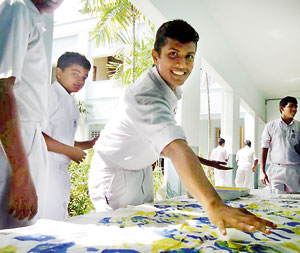
Via Sunday Times, Students pledge their support to end street harassment

More good news is that organizations in Sri Lanka called Reach Out and Beyond Borders are currently running an anti-street harassment campaign called Join the Fight Against Harassment. They recently held a “Man Up” event to engage boys and men in ending street harassment.

Here’s more about their campaign from the Sunday Times:

“Apart from consulting victims, psychologists and NGO’s, Reach Out took to the street and gathered research in a more dynamic way. ‘Reach Out, together with Beyond Borders (a youth led NGO), carried out various disruptive theatre performances at public places where we enacted scenes of harassment spontaneously in order to identify the public reaction. We even spoke to people on the streets and school children.’…

Reach Out’s approach is to instill moral values in the younger generation. ‘The whole problem in contradiction to the fight against harassment is the attitude and mindset that, harassment cannot be stopped. This needs to change. Harassment can be stopped, we just need to work hard and join against it.'”

Absolutely.

Share

Filed Under: male perspective, News stories, Resources Tagged With: Beyond Borders, Man Up, Reach Out, sri lanka, street harassment

Art project: Give street harassers your best Medusa Gaze

July 12, 2011 By HKearl

Are you tired of street harassment and do you have access to a video-recording device or a camera? Then how about participating in the Medusa Gaze Project?

How to participate:

“Send us your 15 to 20 seconds video file or jpg of your gaze, no text, no name, no photo manipulation, just your icy stare. For uniformity, standing like I am, cropped like in our tumblr pic. We will add the text ‘I will not be intimidated’ to it and add it to the projection loop. We will accept images & videos throughout the Summer 2011. We plan projections beginning this Fall (US and Europe) and will document them online. Also called for are your harassment stories, in writing or an audio clip.

Send images, audio, written texts and video files to: seekingkali(at)yahoo(dot)com“

What is the project?

“The Medusa Gaze Project is an art project conceived by Artist Collective Seeking Kali (William Evertson, Susan Shulman, Ria Vanden Eynde), to rage against public sexual harassment of women. Whether it be catcalling, obscene gestures, sexually explicit comments, cornering, following women. We want to protest against this kind of bullying by men of women in the public space.

Literally and figuratively unseen by bystanders, this kind of threatening behavior leaves women feeling insecure to walk the streets. Society, men AND women often perceive it as normal, a small annoyance , as a way of complimenting the women or they hold the women responsible as a kind of victim blaming.

Seeking Kali wants to artistically speak out against sexual harassment and raise awareness that it IS a problem. We created this project as a way to empower women and confront society with its responsability. We aim to do this by sharing stories and showing images/video of women expressing their reproval and their determination not to be intimidated. We want to claim the right for women to walk freely and safely on our city streets.”

I made my own Medusa Gaze Project contribution. If only I COULD turn street harassers to stone with it! What does yours look like?

Share

Filed Under: Activist Interviews, Resources, street harassment Tagged With: art projects, Medusa Gaze, street harassment

Indian organization passes resolution against “indecent” clothing

July 8, 2011 By HKearl

The number of reports of street harassment, rape, and murder against women are on the rise in Nagaland, India. In response, the Dimapur chapter of Naga Women’s Hoho has asked women to stop wearing “indecent” clothing so “that they do not attract or provoke crime.”

It feels like I’m reading The Onion. But I’m not. This is real life.

Via Indian Express:

“A resolution passed by the organisation in Dimapur last Sunday said it would take ‘suitable’ action against women seen wearing indecent dresses.

‘This is not just an advisory to young girls but for the attention of all women, young or old. Our resolution has clearly said that it is important to dress modestly and decently. That may not be the ultimate solution to prevent crimes ranging from eve-teasing to molestation, rape and murder, but is definitely one of reducing such crimes,’ Hukheli T Watsa, president of the Naga Women’s Hoho, said over telephone from Dimapur.”

This attitude is exactly why Blank Noise has an I Never Ask for it Campaign through which women show the clothes they were wearing when they faced harassment. The display demonstrates that they are harassed in “modest” clothes, too.

That kind of attitude is also one reason why there are SlutWalks across the world (including India), where women and allies can show that no one “asks” for harassment or assault just by dressing a certain way.

It’s crazy that we have to spend our time and energy noting that it doesn’t matter what we wear.

As long as there are harmful women-hating attitudes, a general disrespect for women, and a culture that doesn’t deter or punish perpetrators of gender-based crimes, those crimes are going to continue regardless of our clothing.

It may be more productive if folks in Nagaland spent their time and energy bringing the Parivartan program to their town instead of policing women’s clothing. The Parivartan program aspires to reduce gender-based violence by working with men and boys through India’s popular sport of cricket.

Let’s work to change gender attitudes, not articles of clothing.

Share

Filed Under: News stories Tagged With: eve teasing, Naga women's hoho, street harassment

« Previous Page
Next Page »

Share Your Story

Share your street harassment story for the blog. Donate Now

From the Blog

  • #MeToo 2024 Study Released Today
  • Join International Anti-Street Harassment Week 2022
  • Giving Tuesday – Fund the Hotline
  • Thank You – International Anti-Street Harassment Week 2021
  • Share Your Story – Safecity and Catcalls Collaboration

Buy the Book

  • Contact
  • Events
  • Join Us
  • Donate
  • Facebook
  • Instagram
  • Pinterest
  • Tumblr
  • Twitter
  • YouTube

Copyright © 2026 Stop Street Harassment · Website Design by Sarah Marie Lacy