• About Us
    • What Is Street Harassment?
    • Why Stopping Street Harassment Matters
    • Meet the Team
      • Board of Directors
      • Past Board Members
    • In The Media
  • Our Work
    • National Street Harassment Hotline
    • International Anti-Street Harassment Week
    • Blog Correspondents
      • Past SSH Correspondents
    • Safe Public Spaces Mentoring Program
    • Publications
    • National Studies
    • Campaigns against Companies
    • Washington, D.C. Activism
  • Our Books
  • Donate
  • Store

Stop Street Harassment

Making Public Spaces Safe and Welcoming

  • Facebook
  • Instagram
  • Pinterest
  • Tumblr
  • Twitter
  • YouTube
  • Home
  • Blog
    • Harassment Stories
    • Blog Correspondents
    • Street Respect Stories
  • Help & Advice
    • National Street Harassment Hotline
    • Dealing With Harassers
      • Assertive Responses
      • Reporting Harassers
      • Bystander Responses
      • Creative Responses
    • What to Do Before or After Harassment
    • Street Harassment and the Law
  • Resources
    • Definitions
    • Statistics
    • Articles & Books
    • Anti-Harassment Groups & Campaigns
    • Male Allies
      • Educating Boys & Men
      • How to Talk to Women
      • Bystander Tips
    • Video Clips
    • Images & Flyers
  • Take Community Action
  • Contact

Germany: Sign Petition to End Sexism on Public TV Channels

March 20, 2013 By Contributor

By ProChange member Hanna, SSH Correspondents

For better understanding of this post, German television is divided in public and private channels. The private channels are financed by adverts and the public ones by GEZ- fees. The public ones have the task by law to inform and educate.

Some weeks ago we drew up a petition on openpetion.de : “For our GEZ- fees: Our demands regarding the sexism debate.” After some time we united with initiators of another petition on change.org : “public and private channels: start to clear up the topic of sexism in our society in an appropriate way!”

The reason: We have the same aim and we want to give our demands more voice.

More than 1800 people signed by now to request the public TV channels to report and inform about the sexism in our society in an adequate manner. We will contact the directors and the television council as well to ask them for a statement. But we will not take down our petition so it can still be signed.

Our petition to the public channels:

For our GEZ- fees:

Public channels: Start to clear up the topic of sexism in our society in an appropriate way!!

After a journalist dared to speak in public about her experiences of sexual harassment causing more than 60.000 women to comment on twitter under the topic “aufschrei” , the daily sexism in Germany was in focus of media for several days. There are many reports and discussions on sexism and the reactions on “ aufschrei” also shows that we were in need of this debate.

BUT the way TV channels coped with this sensitive topic was horrible and simply inappropriate. It is not acceptable to handle this topic in such an uninformed manner.

There was kidding, joking, aspects were played down or were said to be unimportant. Facts were turned or neglected. It was more like entertaining and pleasing the audience.

But we missed good reports taking into account the importance of this sensitive topic.

The TV shows were not suitable for the task of the public channels to inform and educate. The result: sexism and sexual harassement still seem to be tolerated. The behavior of offenders seems to be accepted and they can go on like before.

Many people (more than 58% of woman , that is about a quarter of the population) suffer from the daily sexism in our society.

It is about sexual harassment and sexual violence. But that is not the only point. It is about structures of society. Structures that permit that half of the population is not taken fully serious. Structures that allow that this half of society is not paid equally. Structures that allow that these people are rather seen as objects of sexual desire than human beings. Structures that seem to be that fixed in society that the only argument counting seems to be “ women and men are like this. Nothing will ever change that. “

That is sexism.

People should be informed about that.

In an adequate way.

Dear public channels, That is your task. Your task is to inform and educate.

Then inform and educate! Inform and educate in an appropriate way. Question, break structures, present backgrounds and developments.

If there is a lack of knowledge: Invite experts. But true experts! And let them share their knowledge.

We are citizens paying GEZ-fees for that shows. Some cities already started to take judicial steps against the new GEZ-fee model. If we do not feel represented in public programms we will have to refuse paying our fees as well.

Stop joking about people that suffer enough from daily sexism. Do not make them feel small!!

Inform in an adequate manner about sexism in our society.

Our demand for our GEZ-fees:

  • We request the director as well as the TV councils of public channels to comment on sexist contents in their programs
  • We demand the public channels to fulfill their official task to inform and educate, also on sexism (e.g. about the contexts of sexism, street harassment, sexual harassment and sexual violence)

  • We demand to invite experts (who get enough time to mention facts!)

  • We demand sufficient research (no uninformed presentations)

  • We demand respect for the affected women (no joking, and making them appear ridiculous)

  • We demand not to blame victims for sexism

  • We demand to present women and men as equal in all programs and to avoid sexist content

If you support our demands, please distribute this petition. Every further person to sign, is a step to success.

The German-based group ProChange is comprised of women from Dortmund who are activists for women’s rights.

Share

Filed Under: correspondents, street harassment

Survey: Most Women In Edinburgh Experience Street Harassment

March 15, 2013 By Contributor

Cross-posted with permission from Hollaback Edinburgh.

We release our research today outlining the experiences of 100 young people aged 12-25 in Edinburgh, Scotland.

Key findings include:

The majority of the respondents were 18-25 (94%)

The majority of respondents self-identified as female (85%)

Almost all the respondents had experienced some form of Street Harassment, with the most common being an experience of someone whistling, shouting, or beeping their horn at respondents (86%)

The most common reaction to Street Harassment was a feeling of anger, seconded by a feeling of vulnerability

When asked who they told, the majority of respondents told friends

One respondent reported that the “Police invalidated my experience”

Many respondents highlighted that “banter” is often used as an excuse

Read the full report: hollaback report 2013

Share

Filed Under: Resources, street harassment

USA: All Women Deserve Safety

March 13, 2013 By Contributor

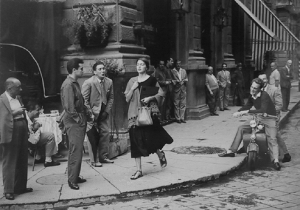
“American Girl in Italy” by Ruth Orkin (www.orkinphoto.com/photographs/american-girl/)

By Natasha Vianna, SSH Correspondent

It was the end of the night on Cinco de Mayo in Downtown Boston. After having a wonderful evening with friends, my friend Christina headed towards to subway so she could go home. On her walk, she passed a group of men standing on a corner. The group turned to face her as she walked by and began calling her by harassing nicknames and shouting at her. She walked without looking or responding, but as soon as she thought she was safe, she felt what she explained as the most dis-empowering moment of her life. One of the men reached out and slapped her ass. Not knowing how to respond, in shock, she thought of 100 things she could have done but chose to run off while the group of men laughed.

Looking back, there were so many things she wanted to say, she wanted to stand up for herself, she wanted to let those assholes know that they were horrible people who made her feel unsafe. But she couldn’t do that. She didn’t know them, what they were capable of, or what their intentions were. If she had stopped to shout back, a young girl to a group of men, who knows what could have happened. Her only concern was her safety.

When one man harasses a woman on the street, she is faced with a decision that could alter the course of her life.

After years of experiencing street harassment, I have become savvy when it comes to crossing the street at the right time and pretending I am deaf, blind, and mute. Yet, it should not have to be this way. I should not have to run across the street because a creepy man is making comments on the corner and I should not have to stay quiet in fear that my response could anger my harasser.

Women are faced with these challenging situations every single day on the streets. Somehow, the idea that women are objects for men’s visual pleasure is one that has been preserved during our evolution of women’s rights over the decades.

As a young woman in America, this is something I have experienced far too often and I know I’m not alone. These dis-empowering moments of gender-based violence, when men use their privilege to make us feel unsafe, is AWFUL and life changing. It’s infuriating; it’s horrifying, it’s unjustifiably wrong. I cannot walk down a street without worrying that at some point; someone might harass me or a woman near me.

When men harass women, I wonder if their mothers, their sisters, their daughters, or their nieces ever come to mind. Would they be okay with another man treating their loved ones this way? I’m sure they wouldn’t.

So men, rethink how you interact with women. The change we all want to see happen in our society has to start with you. Set the example. Show others how to respect women. Only then will you see a better future for your daughters and their daughters. Our future generation of girls depend on you.

Natasha Vianna, a fearless activist and young feminist, is a freelance writer and blogger based out of Boston, MA. Follow her on twitter!

Share

Filed Under: correspondents, street harassment

“My Mexican Manifesta against Gender-based Violence”

March 12, 2013 By Contributor

This article, by Yolí Sánchez Neyoy, is cross-posted with permission from the blog of the International Planned Parenthood Federation/Western Hemisphere Region.

There was a time in my life when I didn’t engage in critical thinking and receiving sexual comments about my body defined my level of self-esteem. Little by little, as I began to understand what makes men feel they have the right to comment on the look of my behind, I started to reject these “compliments” and respond to the men who made them. Eventually, this would be one thing that would convince me to leave Mexico, my country of origin.

Why do I take these comments so seriously? Because, despite their appearance as ‘good-natured’ or ‘playful’, these acts are on the same continuum as femicide and sexual assault.

Globally, gender-based violence takes the life of one in three women worldwide and is the leading cause of disability and death for women between the ages of 15 and 44. According to a 2012 Thomson Reuters Foundation poll on the best and worst G20 countries for women, Mexico ranked in the bottom five in quality of life for women. The objectification of women is so entrenched in Mexico (as well as in other places) that most people have no perception when violence is being exercised.

In Latin American countries, violence is considered to be only that which involves physical aggression, such as hitting, rape, or murder. Sometimes these acts are justified by popular culture and media that says a woman “deserved it” or even “asked for it.” These excuses would not apply if the violence was exercised against a man.

On the other hand, what happens to men and boys that experience gender-based violence? They are invisible or ridiculed by a culture that considers them to be a “lesser man.”

Government efforts to resolve gender-based violence are often reluctant and, therefore, weak. The result is that gender-based violence is normalized, femicide is accepted in many regions of the country, and several areas are completely overwhelmed by sex trafficking and exploitation. These crimes will never cease to occur in a society where everyone has rights over a woman’s body except herself, where women are not treated with equality and respect.

I hope these grievances emphasize the urgency of my petition: we need to integrate rights-based, comprehensive sexuality education into the school systems to encourage healthy relationships and gender equality. Teaching the biology of reproduction is not enough. Young people must learn and practice the skills necessary to have non-violent interactions, like empathy and resolving conflicts with dialogue. They also need to be able to identify and respect another’s emotional and physical boundaries. When our destructive stereotypes about masculinity and femininity are broken, we will be taking a big step forward.

Yolí Sánchez Neyoy is quality manager at dance4life, an organization creating a world in which young people are free from the stigma and discrimination of HIV infection. With a passion for equality and human rights, she adds her grain of sand by working on monitoring and evaluation.

Share

Filed Under: Stories, street harassment

Ru San’s Restaurant believes sexually harassing customers is “all in good fun”

March 12, 2013 By Contributor

Editor’s Note: This e-mail is published with permission from the author and his wife. Contact information for the restaurant is posted below if you’d like to call or write to them to voice your displeasure with their stance on the acceptability of employees harassing customers!!

My wife and I went to a local(Charlotte, NC) restaurant last evening and while we were waiting for a table my wife was sexually harassed by several members of the kitchen/wait staff.  The staff seemed to be almost completely male except for the woman taking names for tables at the front.

My wife used the restroom which is located very close to the kitchen area and is kind of open. On the way going in and coming out of the bathroom several male staff members whistled at her, made obscene gestures and made lewd comments(primarily in Spanish). My wife is Mexican and speaks fluent Spanish and I speak some myself. I don’t know if they didn’t realize she would understand or what but the whistling and gestures they made are pretty clear in any language.  I did not see this behavior as it happened but my wife indicated it was loud enough for other restaurant patrons to notice. Needless to say she was very shaken up.

I confronted one of the staff members she pointed out and asked him if he said the things she accused him of and surprisingly not only did he admit he did but told me he didn’t feel it was a big deal.  He left and within a minute or so much of the staff was grinning at us and purposely making things very uncomfortable. We obviously decided we would not be dining there anymore but I felt it important to let management know.  When I spoke to the manager his response was the most surprising of all. He explained to me that this happens regularly and while he was sorry we were offended it “was all in good fun”.  I asked him if he thought it was acceptable for male members of his staff to treat female customers in such a way and he responded that it was “just the way it is.”

He invited us to leave if we were unhappy with the way his staff behaved, which we did but are disgusted that such behavior would not only go on in the open at a public establishment but seemingly be encouraged by management.  We have dined at this restaurant before and had no such problems and this is not a bar or club or anything like that but a sushi restaurant.  Not that this is acceptable behavior in any setting.

I don’t think there is anything we can do but spread the word but I feel it is the least I can do to let others know who may be the target of harassment before they patronize such a place.
Below is the restaurant information:
http://rusanscharlotte.com/ | 704-374-0008 | Yelp Page
Ru San’s
2440 Park Rd
Charlotte, NC 28203
Editor’s Note: They do not seem to have a social media presence nor an e-mail address
Share

Filed Under: Stories, street harassment

« Previous Page
Next Page »

Share Your Story

Share your street harassment story for the blog. Donate Now

From the Blog

  • #MeToo 2024 Study Released Today
  • Join International Anti-Street Harassment Week 2022
  • Giving Tuesday – Fund the Hotline
  • Thank You – International Anti-Street Harassment Week 2021
  • Share Your Story – Safecity and Catcalls Collaboration

Buy the Book

  • Contact
  • Events
  • Join Us
  • Donate
  • Facebook
  • Instagram
  • Pinterest
  • Tumblr
  • Twitter
  • YouTube

Copyright © 2026 Stop Street Harassment · Website Design by Sarah Marie Lacy