• About Us
    • What Is Street Harassment?
    • Why Stopping Street Harassment Matters
    • Meet the Team
      • Board of Directors
      • Past Board Members
    • In The Media
  • Our Work
    • National Street Harassment Hotline
    • International Anti-Street Harassment Week
    • Blog Correspondents
      • Past SSH Correspondents
    • Safe Public Spaces Mentoring Program
    • Publications
    • National Studies
    • Campaigns against Companies
    • Washington, D.C. Activism
  • Our Books
  • Donate
  • Store

Stop Street Harassment

Making Public Spaces Safe and Welcoming

  • Facebook
  • Instagram
  • Pinterest
  • Tumblr
  • Twitter
  • YouTube
  • Home
  • Blog
    • Harassment Stories
    • Blog Correspondents
    • Street Respect Stories
  • Help & Advice
    • National Street Harassment Hotline
    • Dealing With Harassers
      • Assertive Responses
      • Reporting Harassers
      • Bystander Responses
      • Creative Responses
    • What to Do Before or After Harassment
    • Street Harassment and the Law
  • Resources
    • Definitions
    • Statistics
    • Articles & Books
    • Anti-Harassment Groups & Campaigns
    • Male Allies
      • Educating Boys & Men
      • How to Talk to Women
      • Bystander Tips
    • Video Clips
    • Images & Flyers
  • Take Community Action
  • Contact

Italy: Street Harassment in the Eternal City

January 3, 2016 By Correspondent

Sara Rigon, Italy, SSH Blog Correspondent
SSH_Rigon_DecPic2Recently a friend of mine tagged me on a very thought-provoking #genderviolence tweet about street harassment in Rome. She thought I might be interested in a startling video posted by La Repubblica online, an Italian newspaper that is second in national digital circulation, and she was right.

In the video, a woman walks down the central and beautiful streets of the eternal city, facing a wide range of unsolicited comments, catcalls and whistles.

Wait, this is not news and not even the “no news good news” kind of news. Street harassment is unacceptable and offensive, but sadly it is not surprising. Similar experiments have been done before in different cities around the world, producing more or less the same disturbing and upsetting outcomes.

Among the first videos about street harassment to go viral was the documentary “Femme de la rue” by Sophie Peeters. She taped her everyday walk to her university and other areas in Brussels, Belgium. It was a very disturbing glance into a woman’s life and an introduction to street harassment.

There was was the American-born filmmaker Colette Ghunim’s footage showing “what is like to walk the busiest bridge in Cairo as a girl,” showing it was not quite an enjoyable promenade. The film “10 hours of Walking in New York City as a Woman,” a walk made by Shoshanna Roberts in New York City, was unbelievably stressful. Roberts described how she felt to the Washington Post: “I wanted to break down in tears.”

After the NY City video went viral, the New Zealand Herald decided to try the experiment in kiwi land. Having lived in New Zealand, I was very pleased to discover that only two people spoke to beautiful model Nicola Simpson during her 10 hours of walking through the sunny streets of Auckland and one guy was asking for directions.

I personally do not recall any whistle or catcalling during South Pacific time, a very relaxing and fresh experience for me. However someone did throw a plastic bottle at me from a car while I was walking home on the beautiful Marine Parade in Napier. Yes, I admit it, I was reading a book and I am aware that walking and reading is not advisable or safe, but I still do not think that being hit by a (thankfully empty) plastic bottle on the head was the best way to remind me of that. But I doubt that was the message.

So back to the Italian video… what is startling about it?

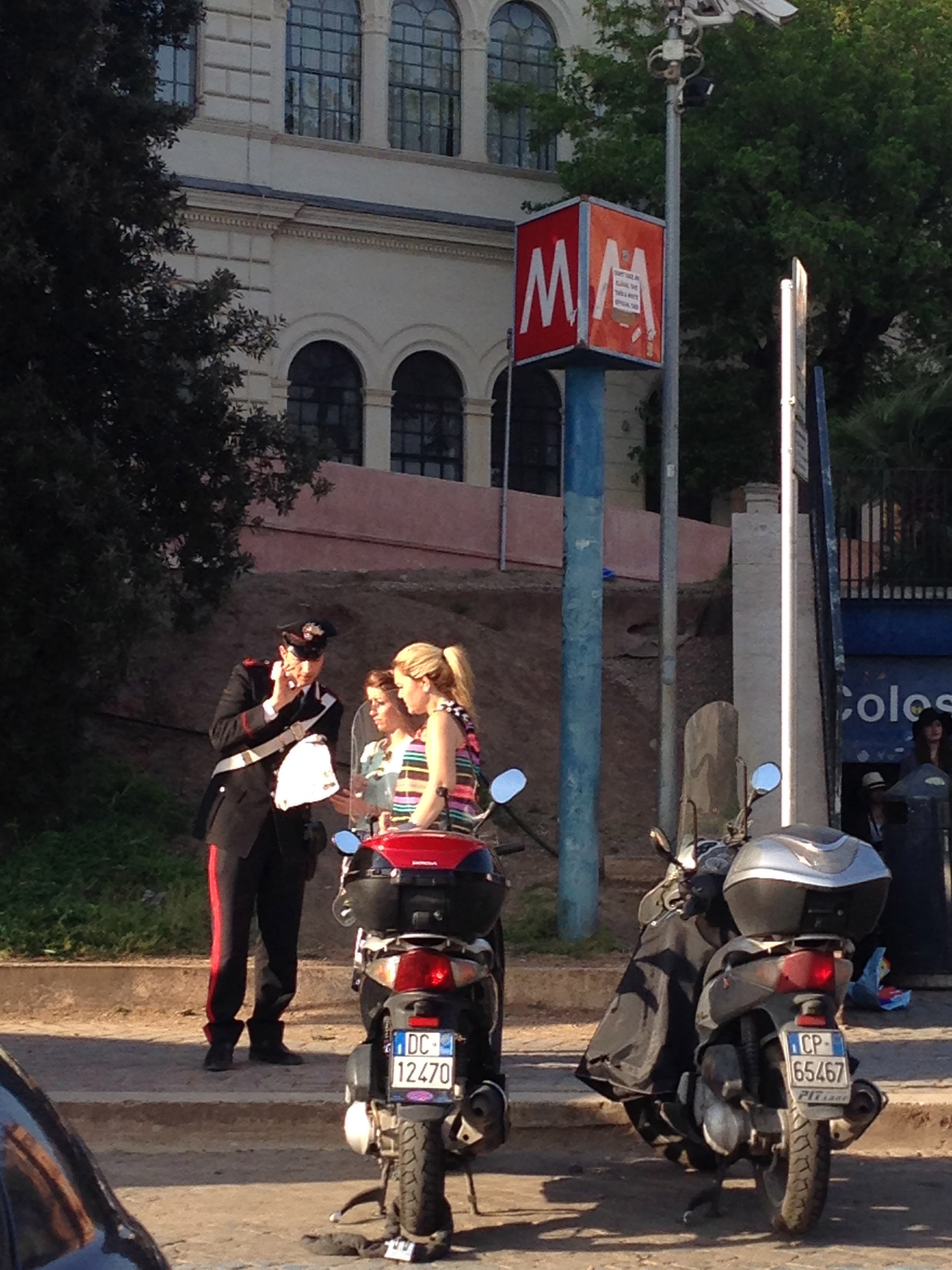
This is: The Italian newspaper experiment shows a particular population of offenders, policemen and law enforcement agents, in one of the 25 most visited cities in the world. The video is quite distressing to watch, at least for me it was. Seeing men in uniform catcalling a young lady passing by gives you a sense of disbelief and alarm. While out on the streets, law enforcement agents are expected to be constantly alert, patrolling neighborhoods, and serving as a public liaison. Police officers are given more privileges than the average citizen and usually with great power comes great responsibility.

It must be said that there are many upstanding and qualified law enforcement agents in Italy and around the world, several of whom are also specifically trained to deal with gender-based violence victims and crimes. Nevertheless, this Italian video is not the only account on police officers misbehaving while on duty, taking advantage of their power and authority. Ultimately, police officers are men and street harassment is a gender-based issue.

I do not want to discuss how policemen should behave better than ordinary men, nor do I want to explore the cultural differences between northern and southern Italy, I don’t have the proper and specific knowledge or expertise. I would rather mention the aim and methodology of such videos.

The creators of the videos call them experiments, however these videos have scarce scientific foundation, not that they claim to have it. They definitely do not intend to scientifically prove the existence of sexism or gender inequality. Instead, they are meant to raise awareness on a quite mortifying and disregarded form of men’s conduct. If they do suggest something, it is that misogyny might be a global principle that unifies mankind across borders, oceans and cultures.

Even as a woman of science, I consider such “experiments” very powerful and I wish some researcher would be inspired enough by these brave women to design a valid and solid research project on street harassment since it is a heinous mistreatment women endure every day. We need valuable evidence, verifiable data to study the phenomenon and hopefully find, if not a solid solution, small steps toward achieving a truly egalitarian society and street harassment-free world.

Sara is a registered General Practitioner in Italy and New Zealand. She is the founder and current lead of the newly established Equally Different group within the European Junior General Practitioners Organization, the Vasco da Gama Movement, branch of the World Organization of Family Doctors. Follow her on Twitter @rgn_sr.


Share

Filed Under: correspondents Tagged With: Egypt, italy, New Zealand, NYC, research, rome, videos

USA: My Suit of Armor

December 30, 2015 By Correspondent

Sara Conklin, Washington, DC, USA, SSH Blog Correspondent

WDK874CAKTIt’s finally starting to get cold this winter and I’ve breathed a sigh of relief. As a girl from the Sunshine State, throwing on winter apparel shouldn’t feel empowering – the idea of stuffing my body into multiple layers of fleece and faux-fur hooded parkas is about as foreign of a concept as the idea an apartment wouldn’t come with an air conditioner or saying “you all” vs. “ya’ll.” But, I’ve noticed an important change in my attitude when winter arrives that directly correlates to my experience as a woman walking in the city.

You see, I wear my coat like armor. It might not look like it conventionally, but I do. My armor protects me from unsolicited attention and non-consensual interactions that I so desperately try to avoid. Whether the feminist inside me screaming, “dressing modestly is a patriarchal concept of oppression!..” likes it or not, the more layers I wear, the less harassment I experience.

You cringed reading that, didn’t you? I cringed typing it. The hairs on my neck stood up at the thought of disappointing my peers who are working so hard to overthrow the policing of women’s dress and bodies. After all, shouldn’t a woman deserve respect regardless of a skirt versus a long coat? Ah yes, that would be the day. But, we currently live in a world where countless individuals believe that the more skin I show is a direct invitation into conversation and interaction. And so, for my entire life, I’ve been instructed to dress modestly, appropriately, and decently to fit a standard of dress that doesn’t attract attention; clothes that allow me to slip by unnoticed in a world that has standardized expectation for nearly everything in my life.

I live in Washington, DC and some days are hot like Hell. Summertime heat waves hit like a tidal wave and the whole city is sloppy with sweat. On these days, I, like everyone else, want to wear clothes that keep me cool. But, there is also a part of me that knows more skin means more attention and that means more unsafe situations. Is the risk worth it? The real issue is that this scenario is characterized as a “risk” in the first place.

Would you believe me when I told you one of the worst moments of my life was witnessing a mother on the subway whisper to her young daughter, “Cover her mouth when you yawn or else boys might get the wrong idea?” That was a horrible moment. Other horrible moments include the day I saw a young woman in a beautiful sundress which she clearly loved, lose her confidence in an instant when a man yelled something about her legs. Or, when I told my friend I was frustrated being repeatedly harassed by the same man on the sidewalk and he replied, “Honey, that’s what sunglasses and iPhone headphones are for.”

Because if it isn’t just the coat, it’s sunglasses to block my gaze, headphones to drown out sound, and a change of suitable clothes in my gym bag that act as tools to blockade the unsafe pieces of the world around me. I was unconsciously creating a physical barrier between the world and myself to gain back a little more control, or rather, any control at all.

I am embarrassed that I feel somehow responsible for reinforcing a dictatorial concept. Each time I change what I wear to be perceived as more modest I feel progressively more angry and resentful. When I pop in headphones to silence potential commentary, they’re getting away with it. We all deserve respect no matter what we wear. But, until I get that respect, I will wear my winter coat like armor, my sunglasses like a mask, and my headphones like a personal white noise machine.

Sara works in fundraising events at an organization that empowers women who face homelessness through recovery, wellness training, and housing. She runs her own photography company (saraconklinphotography.com) and a popular website that seeks to connect the world through pictures, sarapose.com.

Share

Filed Under: correspondents, street harassment Tagged With: clothing, coats, winter

USA: Bodies on the Threshold: Violence against Sex Workers

December 29, 2015 By Correspondent

Hannah Rose Johnson, Arizona, USA, SSH Blog Correspondent

P1090022AbPurple3“The body of the sex worker is one that does not have personal boundaries. Someone who people penetrate all the time. Just like air penetrating the skeleton’s body,” says Maggie Palmer of Hey Baby! Art Against Sexual Violence! in Tucson, AZ, of her latest art piece.

“The skeleton has no skin layer, which centers the mis-perception that sex workers can’t experience street harassment because they are not fully human.” The skeleton sculpture exists in liminal space, she says. “It’s not what we identify as a body, and is clearly a body.” This is symbolic of the ways in which communities deal with gender violence and the deconstruction of heteronormativity and compulsory heterosexuality.

Maggie started the piece for December 17th, the International Sex Workers Day of Remembrance. The purpose of the piece is to use the red umbrella, the chosen symbol of resistance for sex workers, and incorporate themes of invisible bodies through the use of the skeleton. The skeleton has dual meanings–violence against sex workers and intersectional identities such as immigrant, drug users, trans bodies, and people of color. She says, “It centers that violence against sex workers is violence against other marginalized identities. By invisibilizing violence against sex workers, violence is invisibilized against these other identities.”

DSC09143 (2)The cultural narrative built around sex workers is that their bodies are disposable and live in the margins. It is purposeful that Maggie hangs the skeleton in public spaces rather than enclosed buildings. Sex worker bodies are pushed to the margins and bringing the sculpture into the street recenters those margins. She says, “The skeleton’s boundaries are permeable. There is an idea that the dominant power structure is surveilling marginalized bodies…and that the marginalized body is fundamentally flawed. Flaw creates circumstance, as opposed to looking at institutionalized racism, transphobia etc. If you are not fully formed, you have created this. And if you conform to society’s expectations, you don’t have to live a marginalized experience.”

What I find so interesting is that thinking about circumstance invokes the value of choice. But choice is not a factor when we look and name systems and institutions that are built on racism, neoliberal economics and heteronormativity. Maggie and I agree that neither lived experience of survival sex and sex work as a choice is more or less valid. “The sex worker body loses the right to consent,” she says. When a body loses the right to consent, that body has no boundaries. If a body doesn’t have boundaries, acts of violence are justified. Social systems, the way we treat “normal” bodies versus “perserve” bodies reflect gender violence that is bound up in racism, neoliberal economics, citizenship status, HIV status, gender identity and sexual orientation. This is uncomfortable, which Maggie demonstrates in her sculpture.

“The way the sculpture moves in space is disorientating. It swings back and forth, it is a hanging piece. It blows around and does unexpected things you can’t control. This symbolizes how disorienting it is for communities to deconstruct heteronormativity,patriarchy, and gender violence. It forces us to get into a space of ‘unknown.’”

DSC09122Maggie says that street harassment, a form of sexual violence, is a way in which to subjugate and turn bodies into commodities for aesthetic pleasure. And street harassment sometimes punishes for not being aesthetically pleasing enough. This sculpture breaks that gaze, and shocks it. The viewer is reminded of what gender violence and sexual violence really is. She tells me that the skeleton is very exposed, and so is street harassment and sexual violence. Maggie says, “The skeleton is calling upon who has the right to privacy. Marginalized do not have access or the right to privacy.”  The viewer can see right through the skeleton, can see the landscape and city scape right through the ribs and behind the torso.

She says, “This piece is representative of the continuum of violence and social constructs that make violence against sex workers possible.”

The sculpture is currently back in a bag in a closet somewhere in southern Arizona.

Hannah Rose is writing from Tucson, Arizona and Lewiston, Maine (US) as she transitions from the Southwest to the Northeast for a career in sexual violence prevention and advocacy at the college level.  You can check her out on the collaborative artistic poetic sound project HotBox Utopia.

Share

Filed Under: correspondents Tagged With: sex workers, violence

Join our First 2016 Blog Correspondents Cohort

December 18, 2015 By HKearl

458_Volunteer_become1Do you feel passionately about ending street harassment and do you like to write? We need YOU!

Stop Street Harassment is one of the top street harassment websites in the world and we’re recruiting new members for our first Blog Correspondents Program cohort of 2015. This is an unpaid, volunteer opportunity. Build your resume and add your voice to the global conversation about this important topic!

Your words will be read: the SSH blog receives up to 30,000 unique readers per month.

Assignment:

From January to April 2016, correspondents in our first cohort of 2016 must commit to writing one blog post per month about street harassment issues in their community, region or country, for four posts total. The topics could include incidents of street harassment covered in the news, activism to stop it, interviews with street harassment activists, and street harassment in popular culture, traditions or the news. You can also write pieces that tie street harassment to relevant related issues (such as racial profiling/racism, online harassment, and campus rape).

We aim to have geographic diversity among our cohort members. People of all genders, ages, regions are welcome to apply.

Applying:

If you would like to join our final Blog Correspondents cohort of the year, please complete this short application form by January 6 and the selected cohort will be announced on January 11.

Note: If you prefer to write in a language other than English, please also indicate what language is most comfortable for you and you can send your writing sample in that language.

Please apply and/or share with others who may be a good fit!

Share

Filed Under: correspondents, SSH programs, street harassment

The Netherlands: The Revolution Will be Tweeted

December 16, 2015 By Correspondent

Eve Aronson, Amsterdam, the Netherlands, SSH Blog Correspondent

What’s in a word? In a character?

During last February’s Super Bowl Sunday in the US, presidential candidate Hillary Clinton found out.

hillaryclintonWith her excruciatingly ordinary tweet about American football and politics, Clinton unintentionally showed the power of 140 characters broadcast to 4.9 million vaguely- connected social media followers.

According to blogger Bridget Coyne, the tweet was retweeted over 57,000 times and prompted 33,600 new followers, ten times Clinton’s average daily follower growth.

While there are plenty of social media critics out there (and there are many), there is no denying the powerful potential of social media platforms to provoke engagement and build interest in everything from funny cats to presidential debates.

In the sphere of anti-street harassment, social media is being used to not only quickly broadcast people’s experiences but to connect and empower folks with shared experiences.

Not unlike Clinton’s wildly popular tweet, more and more people are engaging with social media platforms like Twitter, and important issues like street harassment are gaining some serious momentum.

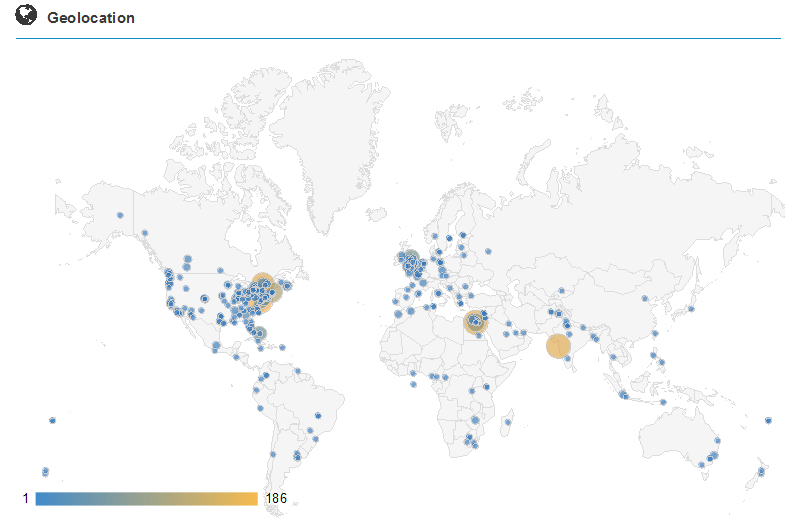
The figure below maps the global conversation about street harassment using the hashtag #endSH from 2014-2015:

endsheweek

(Source: Followthehashtag 2015)

With a reach of over 13 million, the above map speaks not only to global experiences of street harassment, but also to individuals around the world collectively exposing the phenomenon and, in doing so, working to unsettle and resist the power structures that sustain it.

Towards Sousveillance

We can also look at simple actions like tweeting as a means to empower those targeted in street harassment interactions— like women of all backgrounds and people of color or LGBTQ folks of all genders— by turning what is conventionally known as the “gaze” back onto harassers.

This practice of using social media to do this— either by sharing a story, an opinion or by offering virtual support to someone else posting about their experience— is what is called “sousveillance”.

Coupled with digital technologies like mobile phone apps, geo mapping or online platforms for sharing experiences about street harassment, what ‘sousveillence’ does is put the ball back into the court of the individual who experiences street harassment.

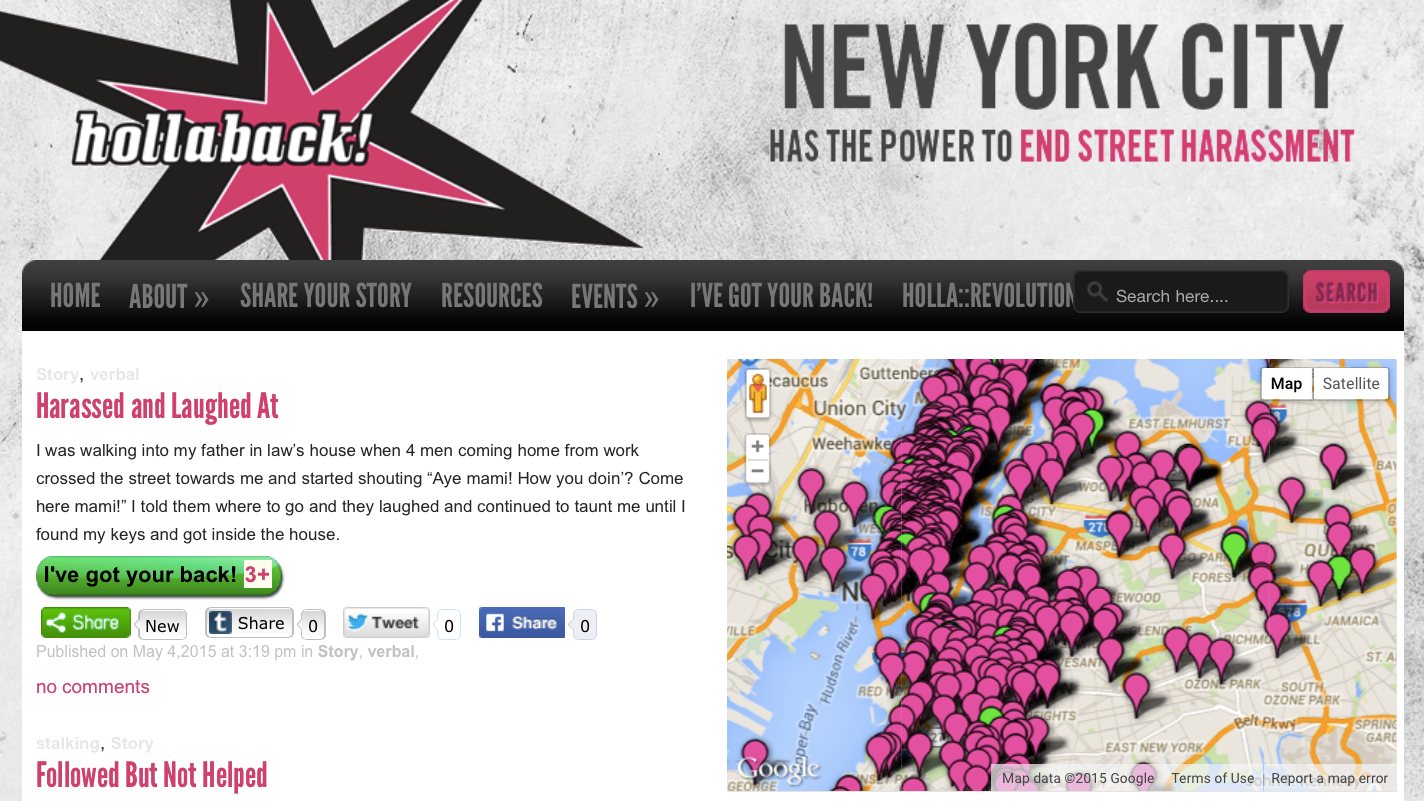
We can see in the map below how, for example, Hollaback! New York embeds geo mapping into its site to “sousvey” harassers as well as to visualize and map bystander presence. On the map, red dots represent reports of street harassment, while green dots represent individuals reporting bystander presence:

hb nyc

(source: Hollaback! NYC)

The image above isn’t just a bunch of red and green dots— each dot represents an experience of street harassment like hissing, leering or groping. And having experienced street harassment and knowing that you’re not along has a greater impact than you might think.

“[I]t makes me feel better to know that there are other women going through the same thing,” stated an anonymous submitter to Hollaback!. “I know I can be a little star on the map for someone else so they know they are not alone either”.

In the Netherlands Online

Although most Amsterdam survey respondents in my research earlier this year had not visited a specific website dedicated to combatting street harassment, almost half have tweeted or posted their thoughts or experiences of street harassment on social media. This finding is huge and signals a need that, for example, engaging more with these technologies could help to fill.

When searching for online platforms and digital technologies in the Netherlands being used to map and resist street harassment, Straatintimidatie (Street intimidation), an online campaign in the Netherlands that is vying for a law against street harassment, was the only online presence that I came across.

Straatintimidatie does not have a space—online or off—for community members to share stories and strategies about street harassment. Nevertheless, the campaign’s Twitter feed has a combined reach of over 52,000 people, which is considerable and indicates that engaging more in online activism about street harassment in Amsterdam and throughout the Netherlands could gain significant momentum with the introduction of more diverse online platforms.

As we saw with the hashtag campaigns above, there are evidently immense pools of people using these online platforms, which can be tapped into in the fight against street harassment in the Netherlands.

If a single tweet like Clinton’s can instantly engage tens of thousands, imagine the disruptive potential of billions of virtual voices— in the Netherlands and beyond— demanding an end to street harassment.

Hashtag activism is not only a lot of people talking; it’s a lot of people talking about specific issues that gain momentum over time and have the potential to effect change on unprecedented scales.

So the next time you sign onto your social media account, get excited. Get excited about the incredible amount of power at your fingertips; the millions of people ready to answer your call to action; and, one character at a time (but not more than 140!); it’s time to turn the tide against street harassment together.

You can find the full analysis of the Amsterdam survey results here or by contacting Eve atevearonson@gmail.com. Follow Eve and Hollaback! Amsterdam on Twitter at @evearonson and @iHollaback_AMS and show your support by liking Hollaback! Amsterdam’s Facebook pagehere.

Share

Filed Under: correspondents, street harassment Tagged With: EndSH, social media, twitter

« Previous Page
Next Page »

Share Your Story

Share your street harassment story for the blog. Donate Now

From the Blog

  • #MeToo 2024 Study Released Today
  • Join International Anti-Street Harassment Week 2022
  • Giving Tuesday – Fund the Hotline
  • Thank You – International Anti-Street Harassment Week 2021
  • Share Your Story – Safecity and Catcalls Collaboration

Buy the Book

  • Contact
  • Events
  • Join Us
  • Donate
  • Facebook
  • Instagram
  • Pinterest
  • Tumblr
  • Twitter
  • YouTube

Copyright © 2026 Stop Street Harassment · Website Design by Sarah Marie Lacy