• About Us
    • What Is Street Harassment?
    • Why Stopping Street Harassment Matters
    • Meet the Team
      • Board of Directors
      • Past Board Members
    • In The Media
  • Our Work
    • National Street Harassment Hotline
    • International Anti-Street Harassment Week
    • Blog Correspondents
      • Past SSH Correspondents
    • Safe Public Spaces Mentoring Program
    • Publications
    • National Studies
    • Campaigns against Companies
    • Washington, D.C. Activism
  • Our Books
  • Donate
  • Store

Stop Street Harassment

Making Public Spaces Safe and Welcoming

  • Facebook
  • Instagram
  • Pinterest
  • Tumblr
  • Twitter
  • YouTube
  • Home
  • Blog
    • Harassment Stories
    • Blog Correspondents
    • Street Respect Stories
  • Help & Advice
    • National Street Harassment Hotline
    • Dealing With Harassers
      • Assertive Responses
      • Reporting Harassers
      • Bystander Responses
      • Creative Responses
    • What to Do Before or After Harassment
    • Street Harassment and the Law
  • Resources
    • Definitions
    • Statistics
    • Articles & Books
    • Anti-Harassment Groups & Campaigns
    • Male Allies
      • Educating Boys & Men
      • How to Talk to Women
      • Bystander Tips
    • Video Clips
    • Images & Flyers
  • Take Community Action
  • Contact

USA: Keep Running Outside

September 24, 2015 By Correspondent

Chelsea Cloud, Michigan, USA, SSH Blog Correspondent

Run!
Image via Flickr

Every day that I suit up for running I am mentally preparing myself for what I am going to encounter out on the streets. No, I’m not worried about my route or the looming danger of shin splints. I am concerned about what street harassment I am going to face. As a solo runner, I often ask myself, “How am I going to respond?” or, “What if it turns physical?” Over the past year I have added pepper spray to the plethora of accessories I wear during a jog, just in case. Thankfully, it’s only served as a safety blanket, but how do I protect myself mentally and emotionally from the attacks that come in the form of honking, yelling and sexually explicit comments? I started running three years ago in response to major life changes. I quickly realized that running made me feel alive and in control of my life. I felt strong. Resilient.

Then I moved to a slightly more urban locale and began running in downtown Kalamazoo, Michigan. The harassment amped up considerably. My internal responses range from disgust to rage. On a good day, I am fueled by the harassers. I go faster, farther even. If the main source of street harassment comes from the harassers need to dominate and take the power away from women, than I will show them how powerful I can be. But on the bad days, I feel defeated. By the third honk or heckle I am ready to burst into flames from anger. I’m left wondering how other women do it. Especially women in a considerably larger city, with packed streets and sidewalks. There are horror stories all over the internet and in message boards about the harassment that is subjected upon runners in large cities. I am reminded of an article that went viral earlier this year by Katie Prout for The Toast.com in which she describes her worst experience with street harassment while running in Chicago, when a group of pre-teen boys threw debris at her head while telling her to suck their dicks.

Running in the city, Chinatown, San Francisco
Image via Flickr

So what advice are runners being given to combat street harassment? Women who run solo are often told to run in groups. But what if they don’t like to run in groups? And why should a runner have to change their routine? Victims of street harassment are often naively asked, “What were you wearing?” and the same goes for female runners. Personally, I’ve been harassed in the dead of winter, completely bundled up with a mask covering most of my face. The tumblr page But What Was She Wearing? is a place where women are submitting their actual outfits that they were wearing when they were catcalled. It’s become glaringly obvious that choice of outfit does not make or break whether or not you are harassed. I’ve read blog posts by women and members of the LGBT community that don’t want to wear bright colors for fear of harassment. Runners are told to wear bright colors so drivers can see them, but many may be opting to wear drab colors so they don’t stick out to potential harassers.

Women may also be choosing to run more trails to get off the streets, but this comes with another set of dangers. Just last month, a young woman in my community was dragged off of the Bicentennial Trail in Portage, Michigan and into the woods by a male attacker. Thankfully, she escaped and got help (runners are a tough bunch). This incidence just adds to the growing list of worries that come with the decision to run outdoors.

There is also much debate over HOW to respond to catcalls. If you read the comment section in most articles about street harassment you will see that there are many conflicting views on not only how to respond, but how we should feel about being harassed. I am shocked when people say, “Just ignore it”, “It’s just life” and “You’re too sensitive.” While I can physically ignore verbal harassment, and usually do, I cannot forget the man who pulls over to honk at me or the young boy who comments on my body as I run past him. These little everyday harassment incidents are insidious. We cannot ignore the fact that we are being treated like public property.

So what is a runner to do?

Remind your friends and family that you are dealing with harassment on your runs and you need some support and solidarity. Download a safety app, or buy a TigerLady. But maybe most importantly, keep running outside. You are in control of your own run and every time that you lace up your shoes you’re running with countless others that won’t let street harassment put them on a treadmill.

Chelsea is a full-time sales assistant for an advertising company in West Michigan and a part-time Graphic Design student. She is proud to call herself a feminist and feels passionately about speaking up for women’s rights. You can find her on twitter @LitSmitten.

Share

Filed Under: correspondents

The Netherlands – Amsterdam: Haven of Sex, Drugs and Rrr…Catcalls?

September 24, 2015 By Correspondent

Eve Aronson, Amsterdam, the Netherlands, SSH Blog Correspondent

When people think about Amsterdam, what usually comes to mind is a fantastical world of marijuana, Red Light Districts and lots of gorgeous canals running through the city.

The Netherlands is not really an obvious place to look at street harassment. Ranked fourth in Europe by the European Institute for Gender Equality, and ranked 14th in the world according to the World Economic Forum’s Global Gender Gap Index, the Netherlands at first glance appears to be doing fairly satisfactorily in terms of promoting gender equality.

But there’s also a lot of people here and, consequently, a lot of room for mischief. There’s over 4,000 people per square kilometer in Amsterdam to be precise, which is about twice the amount of people in the same amount of space in New York and London.

So many humans sharing so little space doesn’t only lead to horrendously clogged roads (and bike paths) during rush hour, but also inevitably to more catcalls, more groping and to more instances of harassment in these overcrowded public spaces.

In January and February, I conducted a detailed survey of people’s experiences with street harassment in this ‘great small city’.

In just two weeks, I received a flood of over 150 responses from women, men, LGBTQ-identified folks and people of color. What their experiences underlined was that street harassment was happening in Amsterdam and that people were itching to talk about it.

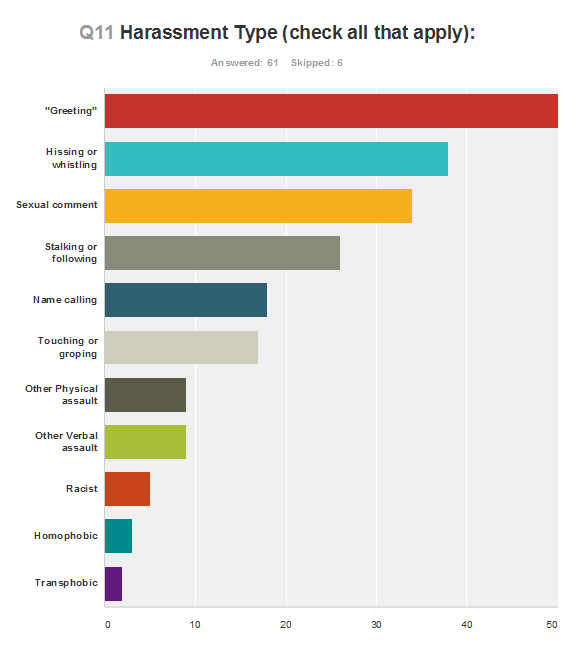
The three most popular types of harassment reported were ‘Greetings’ like Hey baby and Hi sexy, Hissing or Whistling and Sexual Comments. Below is a chart of all reported types of harassment by the survey respondents in Amsterdam:

hollaback! amsterdam street harassment surveyAlong with the types of harassment listed above, a significant number of people also reported experiencing non-verbal forms of harassment like leering, or smirking. One respondent described their harasser(s) as, “Looking at me with their eyes like they are already ripping my clothes off and raping me very violently. Looking at me like me fighting back would only turn them on more”.

What do these and other forms of street harassment do to those who experience it? What are the effects and long-term consequences, if any? To some survey respondents, the answer to these questions was that there were none, and described their experiences as ‘benign’ or ‘normal’.

Some respondents described their experiences as complimentary. Last year, New York Post writer Doree Lewark spoke to such interpretations, pointing to the euphoric nature of catcalls: “[W]hen a total stranger notices you, it’s validating…What’s so wrong about a ‘You are sexy!’ comment from any observant man?… For me, it’s nothing short of exhilarating, yielding an unmatched level of euphoria”.

But for many people in Amsterdam, what they experienced was far from euphoric. One respondent explained that she has been diagnosed with PTSD (post traumatic stress disorder) as a result of years of street harassment in Amsterdam, a recent encounter of which left her with a broken nose after she called her harassers out.

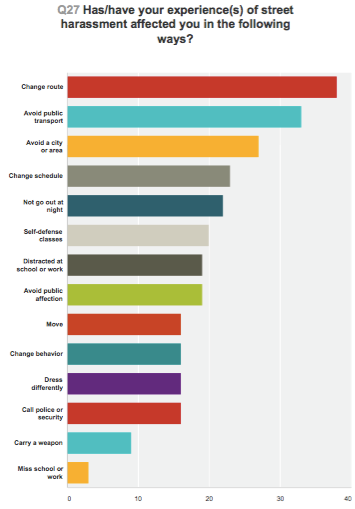
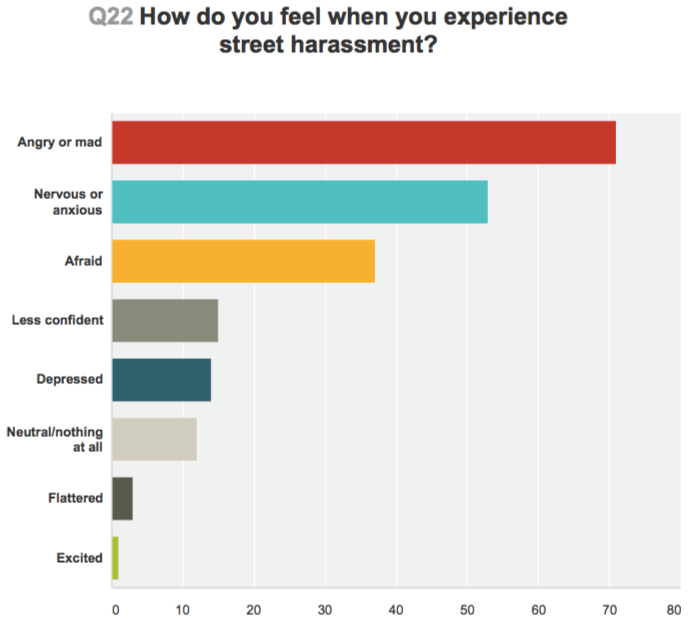
Below are two figures illustrating the extent of the effects of street harassment on the folks like the respondent above. The first shows 14 different effects that street harassment has had on people’s day-to-day lives in Amsterdam. The second gives a glimpse into some of the emotional effects that street harassment has on people who experience it:

Hollaback Amsterdam street harassment surveyhollaback! amsterdam street harassment survey finding
Survey respondents used words like “suspecting”, “fearful”, “frustrated”, “depressed” and “angry” to describe how they felt after being harassed in the streets or on public transport in Amsterdam. The experiences of these respondents were far from euphoric—rather, they are red flags that what is understood as ‘harmless’ or ‘playful’ to some is in actuality having a huge impact on how people move through public spaces and interact with others.

In April, I launched a local Hollaback! chapter in Amsterdam to provide an outlet to folks who have experienced street harassment to post their stories, get resources and mobilize on-the-ground actions. A local partner, StraatIntimidatie, is also currently running an online petition, vying for a nationwide law against street harassment.

One story told and one signature at a time, street harassment is being named and fought here in Amsterdam and around the world. Next time, I’ll talk about some cool new ways that online and digital technologies are being brought into the fold to really shed light on the pervasiveness of street harassment in Amsterdam and beyond. I’ll also talk about some important challenges that come with using these newer forms of activism and how they risk perpetuating certain racial and ethnic stereotypes about who harasses, who is harassed and why. See you next month!

You can find the full analysis of the Amsterdam survey results here or by contacting Eve at evearonson@gmail.com. Follow Eve and Hollaback! Amsterdam on Twitter at @evearonson and @iHollaback_AMS and show your support by liking Hollaback! Amsterdam’s Facebook page here.

Share

Filed Under: Activist Interviews, correspondents, hollaback, street harassment

UK: Making Gigs Safer!

September 22, 2015 By Correspondent

Tracey Wise, London, UK, SSH Blog Correspondent

Safe Gigs for Women logoIt’s 1991, and Courtney Love, performing with ‘Hole,’ stage dives in Glasgow.  It’s 1991 and Love stage dives and is violated by the crowd. It’s 1991 and I am 10.

It’s 2015 and Iggy Azalea gives an interview saying she had to stop crowd surfing because “Fans think it’s funny to finger her.” It’s 2015 and I am 34. In 24 years it appears nothing has changed.

Fandom, proper, all consuming fandom that devours your being and speaks to your soul, whether that be sport, cult TV or music, takes effort. My friends and I have repeatedly travelled the British Isles to see “one more gig” by that special artist – the ones that make life complete. Safe to say I don’t just like music, I am obsessed with it. So when the thing I love comes to represent something seedy, it breaks my heart.

Over the years I have been doing that “one more gig” or spending some of the best days of my life in a muddy field, at a festival. I have more than my fair share of harassment stories. I have been groped on more than one occasion, cornered, cat called, told by a male security guard – someone employed with the purpose of keeping festival goers safe – that the theft of my tent was nothing to worry about because “I could always sleep in his tent”. So fast forward to June 2015, I’m watching my favourite band play a career-defining gig and I‘m groped again by a complete stranger, no small talk first or even an introduction. A two handed full on grab, passed off as acceptable because “it’s the last song.” I’ve now finally had enough.

A blog written in haste the next day provokes a huge response – women telling me similar stories, and worse. Stories telling of how worryingly common harassment is happening in the background of dark, sweaty, packed-in music crowds. Some women tell of multiple experiences. Some tell of how this has impacted their own behaviour, like choosing to not go on their own to gigs or even not going at all. The music obsessive in me hates this. How can the thing I love be reduced to this?

In response, I established the ‘Safe Gigs for Women’ Twitter account, as a way for women to share their stories in an anonymous way, in order to highlight the harassment being experienced by women at gigs. This has been picked up on by a local authority in London that is well known for its music scene. Together we will be looking at improving the gig going experience with venues, gig goers and bands, in order to ensure all people, male and female get to enjoy live music, for the enjoyable, beautiful thing that it is.

You can join us! Please find us at www.sgfw.org.uk.

Born and raised in London, Tracey is a graduate of City University. She has spent the best part of her life at gigs and festivals and obsessing about music and created the “Safe Gigs for Women” project.

Share

Filed Under: correspondents, public harassment, Stories

Italy: When Playing it Safe is Your Only Option

September 17, 2015 By Correspondent

Sara Rigon, Italy, SSH Blog Correspondent

SSH_Rigon_Pic1For the past two years I lived the life of an expat. I left my hometown in northern Italy to live and work in New Zealand first and then Denmark. It was an incredible adventure personally and professionally, with unexpected side effects.

Usually, the first question people generally ask when they learn I’ve lived in Aotearoa, the land of the long white cloud, all by myself for more than one year, is: “Why New Zealand?”

I can perfectly understand the puzzled tone of voice and curiosity, Oceania is so far away and Kiwi land is not the most popular destination in the South Pacific. I wonder if people would ask me: “Why Australia?” I’ll never know, but I doubt it.

I have a standard reply. I’ve been saying this so many times, that at one point I didn’t have to think about it and I started listening to what I was saying, it was a revelation.

So, why NZ? “Well, I was looking for an English-speaking country, nice sunny weather most of the year and beautiful landscapes (I was leaving Italy, after all), and most important I needed a safe place for a single woman to travel and move around.”

A safe place. In the life of a woman, safety is an everyday concern, one that pervades your existence in almost every aspect and in the end regulates the course of your life. On top of that, you know, safety is YOUR problem, as in the unfortunate case something happen, people will kindly remind you that “you should have known better.” Meaning that you shouldn’t have worn such a short skirt, walked home at such late hour or taken that lonely walk on the beach at night. Victim-blaming is so incredibly common, almost expected, sometime I wonder if women change their behavior for safety reasons or simply to avoid the humiliating and shaming reprimand.

As a woman, you are well aware that safety needs to be taken into account, it will always be part of the equations, a fundamental component of most of the choices you’ll make through out your life.

Safety will determine your outfit, it doesn’t matter the occasion, it could be work, a party or the gym, you just want to keep the wolf whistles at the minimum (as if you could control them). For safety reasons you will leave the pub at a “decent hour” (I wish I could tell you what time is that) on a Friday night and you will not have “too many” drinks at a party. You know you always need to be aware of your surroundings and you shouldn’t lose control. Safety will also help you choose your travel destination for that trip you want to take on your own or with your girlfriends and which country you are moving to as a professional medical doctor. You might have one of the most powerful passports in the world, but as a woman you still can’t go everywhere you want, not without consequences.

You know all that, it’s normal, it’s the way the world turns. Moreover people say equality is already a reality so this must be it, it can’t get better than this: catcalling is a complement and victim-blaming is a useful reproach to suggest you the appropriate behavior. You might get used to this, it is your life, after all. Nevertheless, it is not okay; in fact, this is structural violence.

Structural violence, has described by the Norwegian sociologist and mathematicians Johan Goltgun who first used it in the article “Violence, Peace and peace research” (1969), is “avoidable impairment of fundamental human needs or.. the impairment of human life which lower the actual degree to which someone is able to reach their needs below that which would otherwise be possible”. In other words, systemic ways in which social structures harm or disadvantage individuals or groups by preventing them from reaching their full potential.

Embedded in longstanding “ubiquitous” social structures – economics, political, religious and cultural – as well as normalized by stable institutions and regular experience, structural violence is often invisible at our own eyes. This is how we all perpetrate and be subjected to adultism, ageism, classism, ethnocentrism, nationalism, racism, sexism without even knowing it. This is the odious power of structural violence.

When I first realized I was a victim of such violence and discrimination in a society that proudly proclaims itself fair and egalitarian, I felt deceived and helpless. With a wolf whistle after another I started thinking it was better in the old days, when men were gentlemen and you just knew you were not allowed certain behaviors or privileges. It was the rule and everybody knew it and lived accordingly. Yet this is can be the answer. Violence and injustice may apparently hurt less if they are institutionalized and regulated by law, but in fact they don’t.

I feel privileged to live in a world where I have civil rights that other men and women fought injustices to secure. It is my turn now and I want to do my part to create a future where women will be able to walk down the street with no risk of being shouted or whistled at or assaulted.

What to do then? The shocking murder of Mary Spears reminds us that safety is still an issue, standing up for your rights, speaking up and saying no have a price and it can be very high. I wish I could be brave enough to ignore conventions, shaming and victim-blaming everyday to be myself and live my life at its full potential. Instead, at times I play it safe and choose to move to New Zealand over other possible destinations. Nonetheless I’m not giving up, today I wrote this post.

Sara is a registered General Practitioner in Italy and New Zealand. She is the founder and current lead of the newly established Equally Different group within the European Junior General Practitioners Organization, the Vasco da Gama Movement, branch of the World Organization of Family Doctors. Follow her on Twitter @rgn_sr.

Share

Filed Under: correspondents

Croatia: “Raise Your Voice!”

September 14, 2015 By Correspondent

Marinella Matejcic, Croatia, SSH Blog Correspondent

One time I was going home from a club in Zagreb, a capital of Croatia, with a couple of friends. Two guys stopped us, asked us for directions, and when we continued our way, one of them slapped me on my behind. As I was the unfortunate one to be addressed in such an obnoxious way, I returned to them and asked them politely who did it, told the perpetrator to take off his motorcycle helmet – and slapped his face pretty hard. Sure, there is no need to answer violence by perpetuating violence, but something just snapped and I was beyond irritated. And I was lucky: nothing serious happened after this incident. That guy just asked us out, we, naturally, declined and that’s it.

But I’ve rejected being the object and the victim.

Downtown Zagreb, image via enviropau.wordpress

According to the research conducted by Hollaback Croatia in 2012, as much as 70 – 90% of women have experienced some form of a verbal encounter from a stranger in public space at least once in their lifetime. The harassment ranged from swearing to comments about their appearance. A fair percentage of women have been flashed, have seen public masturbation, been groped or followed. Every third woman was physically attacked at least once in her lifetime. Every second woman in Croatia will experience some form of street harassment by the age of 18.

Since street harassment is so hard to itemize, there are no official data, just this research done by the Hollaback Croatia initiative. The thing with this research is that most of the women who participated in it are living in the biggest city in Croatia, where is it somehow expected for this to happen. It’s not justified, it’s just expected. If there was any research conducted on the national level, the results would provide a better picture.

Just to be sure about the lack of institutional statistics on the subject, for the sole purpose of this blog post, I contacted the Croatian Ministry of the Interior, asking them if there are any data that could be used. They responded surprisingly quickly, asking me for the clarification of the query. They didn’t know what I meant by the term “street harassment”. The whole situation gets even more absurd when you realise that Croatia basically has the legal frame that puts (sexual) harassment in the penalty code.

When being harassed, most women just stay passive, ignore it or try to move away. It is this society that we’re brought up in, that’s something we learn to do: if you’re a woman (or any member of the LGBTIQ community) you’re not allowed to raise your voice, to fight back. If you’re witnessing that kind of event and not doing anything about it, you’re helping the perpetrator. That’s something most of us are very aware of while debating or chitchatting but have you ever actually stood up and stopped the harasser from harassing?

The fact that in most cases street harassment does not include “more” than “just words” is just not enough to justify it. Not in any community. That’s not the matter of culture, but patriarchy and male domination. We shouldn’t just let it be. We have to act. Stand up. As with any other form of violence, it is never the victim’s fault. Don’t judge, act (but think on your own safety). Raise your voice!

Marinella is a freelance journalist/writer, feminist activist, and soon-to-be administrative law student. She writes for Croatian portal on gender, sex and democracy called Libela.org and covers CEE stories for globalvoicesonline.org. Follow her on Twitter @mmatejci.

Share

Filed Under: correspondents, Stories, street harassment

« Previous Page
Next Page »

Share Your Story

Share your street harassment story for the blog. Donate Now

From the Blog

  • #MeToo 2024 Study Released Today
  • Join International Anti-Street Harassment Week 2022
  • Giving Tuesday – Fund the Hotline
  • Thank You – International Anti-Street Harassment Week 2021
  • Share Your Story – Safecity and Catcalls Collaboration

Buy the Book

  • Contact
  • Events
  • Join Us
  • Donate
  • Facebook
  • Instagram
  • Pinterest
  • Tumblr
  • Twitter
  • YouTube

Copyright © 2026 Stop Street Harassment · Website Design by Sarah Marie Lacy