• About Us
    • What Is Street Harassment?
    • Why Stopping Street Harassment Matters
    • Meet the Team
      • Board of Directors
      • Past Board Members
    • In The Media
  • Our Work
    • National Street Harassment Hotline
    • International Anti-Street Harassment Week
    • Blog Correspondents
      • Past SSH Correspondents
    • Safe Public Spaces Mentoring Program
    • Publications
    • National Studies
    • Campaigns against Companies
    • Washington, D.C. Activism
  • Our Books
  • Donate
  • Store

Stop Street Harassment

Making Public Spaces Safe and Welcoming

  • Facebook
  • Instagram
  • Pinterest
  • Tumblr
  • Twitter
  • YouTube
  • Home
  • Blog
    • Harassment Stories
    • Blog Correspondents
    • Street Respect Stories
  • Help & Advice
    • National Street Harassment Hotline
    • Dealing With Harassers
      • Assertive Responses
      • Reporting Harassers
      • Bystander Responses
      • Creative Responses
    • What to Do Before or After Harassment
    • Street Harassment and the Law
  • Resources
    • Definitions
    • Statistics
    • Articles & Books
    • Anti-Harassment Groups & Campaigns
    • Male Allies
      • Educating Boys & Men
      • How to Talk to Women
      • Bystander Tips
    • Video Clips
    • Images & Flyers
  • Take Community Action
  • Contact

USA: Street harassment and the generational divide

June 23, 2015 By Correspondent

Laura Voth, USA, SSH Blog Correspondent
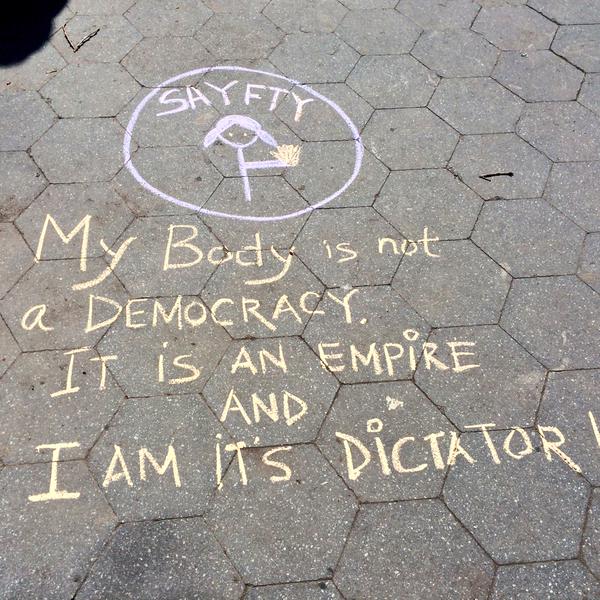
Sayfty in NYC, April 2015
By Sayfty in NYC, April 2015

On my drive to work the other day, I caught a news segment in between pop songs. The hosts were two middle-aged individuals, one a man and the other a woman. They began chatting about the 90% statistic—that 90% of women worldwide report having experienced what the hosts referred to as catcalling. They defined catcalling as “whistling” and, more vaguely, “comments.”

The male host didn’t have much to say on the subject, but I was interested to hear the woman’s take. To my surprise, she said, “I wish someone would catcall me! It’s like I’m invisible since I got older! It would be a compliment.”

When I hear older women make claims such as this—that they miss being catcalled on the street—I always wonder what harassment they experienced when they were younger. Surely they never had obscene words and gestures thrown their way, as women do now. Surely they were never followed, grabbed, groped, or photographed by strangers.

I can’t speak to any woman’s experience other than my own, but I don’t think anyone truly takes a stranger’s yell of “come suck my d*ck!” as a compliment. And perhaps that’s the root of the generational disconnect where street harassment is concerned. Maybe today’s women were raised with the belief that they are deserving of respect not in spite of their gender, but because of their humanity.

The truth is that, whether or not street harassment is frightening, it is harmful and demeaning. It sends the message that women—not only the woman involved, but others—are not welcome in whichever space and that they do not deserve to be viewed as people. It reinforces the idea that woman’s worth is based on her perceived f***ability. If someone gets that message often enough, they will start to believe it.

The idea that women over a certain age aren’t worthy of being acknowledged—acknowledged, mind, not harassed—is a continuation of that idea. Once a woman doesn’t look a certain way, she almost disappears. And despite the negativity of the attention she once received, she might in a way miss the whistles and catcalls, because at least they affirmed that she had some kind of worth.

Would you rather be invisible or devalued? Unseen or disrespected? Knowing that you don’t matter to strangers, or aware that the men who pass you by don’t even think of you as a person?

We deserve to be afforded respect and recognition for who we are as people—for our actions, our strengths and weaknesses, and our humanity—not for our looks.

If women have come from a point when they weren’t able to take a stand against street harassment to today, when blogs like this one show that we feel comfortable with speaking out, there must be a way to get to a point where women’s bodies and selves are not seen as objects reduced to whether a stranger believes they are worthy of unsolicited commentary.

We all want to be seen as who we really are—people. A comment from a stranger on the street serves as a vicious denial of our personhood, and eventually we start to believe it. A little respect goes a very long way.

Laura is an emerging adult-slash-college student studying to enter a healthcare profession. In addition to studying and writing, Laura works at her university’s women’s center where she helps design and implement programs on all things lady. 

Share

Filed Under: correspondents, street harassment

France/Brazil: “I Still Feel the Same Terror”

June 15, 2015 By Correspondent

Luiza Pougy Magalhaes, France/Brazil, SSH Blog Correspondent

The very first time I witnessed street harassment, I was very young. I was so young that I didn’t really understand what a passing taxi driver meant when he called my mom a “yummy mommy”, when he looked right at her and said, “Oh mother may I.”

He was stuck in traffic right by my house; his collar opened all the way down to his chest, his arms out of the open window of his taxi. We walked by, completely unaware of his existence. Upon hearing his words, my mom stiffened, her back straightened, she held my hand tighter, and pulled me closer. I remember how I could feel her discomfort, and how I felt uncomfortable myself. I couldn’t understand why he had chosen to direct those words at her. I remember I wanted to protect her. I hated that man and I wished no one would ever speak to my mother like this again.

Today, I can still feel the terror I felt when he stared as we walked away. Now I know that she must have shared that terror. Probably more so than that; she must have felt violated and disgusted, shameful even – ashamed to be spoken like this in front of her daughter.

While I recall every detail of this particular scene, I doubt my mother remembers it at all. When street harassment becomes a daily struggle, we tend to block it out, rather than have it engraved on our memories. Nonetheless, I have a few stories worth sharing.

A couple of years ago, while wandering the streets of Brazil, I got lost. Knowing Brazilian men, I was very careful when asking for directions. I approached a couple of women, but had no luck. I saw a man; middle-aged, a clean-shaved face, impeccable posture, well-fitted suit, and glasses. Surely a well-educated man like himself would do no harm. I walked towards him with a shy smile. Before I could even say anything, he started calling me things; made comments about my legs, said he would pay money for me. Shocked and terrified, I left; mouth wide-open.

That day I learned that street harassers are not exclusive to certain demographics.

A few years after, I walked by a man with a toddler. The little boy lovingly leaned against the man’s chest. Just as they left my eye-sight I heard a whistle and a malicious comment. I turned around. The man was grinning and nodding, his boy looking at me, wide-eyed. Usually, street harassment makes me angry. Then, I just felt sad. Sad thinking about how this boy would be raised, what misogynistic values would be passed on to him.

Sad to realize that there was still a long way to fix society.

Living in France, street harassment also occurs regularly – once, at a supermarket I go to with frequency. The cashier’s line was long and I got distracted on my phone. The sound of a quiet giggle in my ear woke me from my trance. I turned around. There was a guy behind me, doing obscene, sexual gestures. I pushed him off, screamed at him and his friends – his audience. What really shocked me was that none of the cashiers, security, or general staff – who knew me well, I must say – did anything about it. They just looked at me; frowned faces at the foreigner girl who was making a scene.

That day I realized that people don’t think street harassment is a big deal, that street harassment is not taken seriously.

Months later, walking by my university, also in France, I crossed paths with a student; his gaze fixed on me. He licked his lips, hissed, and growled when we locked eye-contact. I called him a creeper and continued my way. He freaked out; started yelling that I “better watch out and have some f***ing respect, bitch.” In disbelief, ashamed, and also terrified, I picked up the pace and pretended like I wasn’t the one he was yelling at.

That day I realized that harassers see their victims with such tremendous inferiority that just the thought that they could stand up for their selves, pushes them over the edge.

You would think that years in the receiving end would have made street harassment any easier to deal with. However, I still feel the same terror that little girl felt when her mom was catcalled by that taxi driver. I feel my back straighten and stiffen just like hers did. I feel uncomfortable, violated, and ashamed, just like she must have felt. After all this time, I still don’t understand why the taxi driver stared, why the man commented, the father whistled, the boy hissed, the guy gestured. And to be honest, I don’t think I ever will.

Luiza is a 20-year-old from Brazil who considers herself a citizen of the world. As a teenager she moved to Singapore and now she studies International Business in France.

Share

Filed Under: correspondents, Stories, street harassment

UK: Wouldn’t It Be Nice…

June 15, 2015 By Correspondent

Ruth Mair, UK, SSH Blog Correspondent

I sometimes find myself wondering what kind of a person I would be, or how my view of the world would change, if I wasn’t always on my guard with strangers. I don’t mean this in a Hollywood rom-com dramatic sense of “I can’t let anyone in”, which is an entirely separate problem for some of us.

I mean it in the sense of how I actively avoid making eye contact with men that I don’t know in the street in case they interpret it as me giving them the “come-on.” I mean it in the sense that if I see a cute dog I smile at the dog, not the owner, in case they think the same thing (or in case they think that I am coming on to them, no buddy, I just want to pet your dog). I also mean it in the sense that if a stranger strikes up a conversation with me, in ANY situation, I am almost instantly put on my guard. Particularly if they are of the opposite sex.

I’m not talking about situations when I clearly do not want to be spoken to (there are some helpful diagrams on the internet about when to speak to strangers especially men speaking to ladies, addressing the culture of interrupting girls reading books or working in coffee shops to try and casually chat), I’m talking about EVERYTHING.

When it was the beginning of the second year of my master’s program, I had to give myself internal pep-talks about actively making an effort to converse with new people at uni, particularly if they spoke to me, because I have to try so hard to fight the assumption that strangers talking to me = bad, danger, harassment and any other number of alarm bells.

For me, this is inherently connected to the experiences I have had of street harassment, ranging from being under 16 and still in my school uniform and having adult men ask for my number on the bus (simultaneously having trapped me in to my seat), to me taking an earphone out whilst running because I thought someone was asking for directions (d’oh, silly naive me!) and receiving unsolicited sexual advances. These experiences have certainly changed my approach to the world, and I would be surprised if there were not others that feel the same.

See, I wonder, if there were no street harassment, would we be so guarded?

I fantasise about being perfectly happy to stop to give someone directions, tell them the time, even smile at them because it’s a sunny day and their dog looks really happy, without having to do the threat assessment of which you are probably familiar: deciding if you could out run them, deciding if they are stronger than you, and thinking about what pithy remark to spit out if they say something inappropriate.

In that world we might make friends more easily, without assuming that if a stranger on the street is talking to you they have an agenda or pose a threat, and without having these calculations leech away at your confidence in situations where you ARE actively socialising, and aiming to meet new people. I wonder if, in the same vein, I would look forward to summer more without having to worry about dressing in a way that won’t draw attention or if my life would be different if I didn’t have to psych myself up to go out of the house wearing lipstick.

Everyone has these different calculations to make, and although they are relatively minor for me as a cis-gender, white female, such calculations are still symptoms of the bigger problem, which is that on the streets, interaction with everyone else is dominated by a culture of unsolicited commentary which can come from any direction, and can range in threat-level.

I long for a world where such threat assessment before we walk out the door are largely unnecessary. However, whilst musing about this thought, I was reminded of an episode of the Simpsons’ Tree-House of Horror, where Lisa wishes for world peace, everyone throws away their nukes, and then aliens invade and they can’t defend themselves. And I do wonder, if were we not on our guards constantly, and did not have to contend with street harassment in all its various forms, there wouldn’t be another threat to calculate for, and defend ourselves from.

It is generally agreed that street harassment is but one symptom of patriarchal society so I am inclined to believe that if it were to be removed, something else would pop up in its place. But, as a result yet again of my own experiences of harassment, am I being cynical? Or is this just my own internalisation of harassers the world over, calling people like me feminazis?

It is this second guessing of oneself that remains, in my opinion, one of the most poisonous parts of street harassment and one of the reasons why even the most confident among us are left with a bad taste in their mouths when they are harassed.

The next step, and one which I have not yet been able to come up with a solution to although I think that many of us have been trying, is how to solve this problem.

Ruth is a human rights MA student finishing her MA dissertation on the legal and normative rights of terror suspects in the UK (spoiler alert: rights are being violated). She also plays bass in a band called Kinshot, sews as often as she can, and spends time getting annoyed at the cat sleeping on top of her computer.

Share

Filed Under: correspondents, street harassment

USA: Andrea Gibson’s Powerful Poem That’s Meant to Be Used

June 4, 2015 By Correspondent

enhanced-28939-1430922447-6.png
Via www.tayloryo.com

Michelle Marie Ryder, USA, SSH Blog Correspondent

In the United States, 65% of women have been harassed in public. Each wolf-whistle, obscene gesture and violating touch has the power to transform our world. For many of us it’s hard to forget the first time we were harassed, as evidenced by a recent popular hashtag #FirstHarassed.

No matter how confident we might start the day, we struggle to keep an ocean of fear at bay the moment we step outdoors. Everyday we navigate a sea of uncertainty that limits our mobility and sense of safety. Short of a cure, we find ways to cope.

Personally, I never leave the house without putting on my best Wednesday Addams resting bitchface. I evade eye contact with strangers to avoid being perceived as flirty; my gaze is restricted, my interaction with the social world strained and limited, some of its richness lost.

When I feel safe enough I speak up, tempted by the peace of mind assured by an effective counterattack. The first time I did I shouted a simple, liberating FUCK YOU! – drawing in a deep breath of air between the two words for extra effect. That was really all it took to shut up a clot of men (who hang out in groups of five because they each have one fifth of a personality, jokes comedian Eddie Izzard, who is frequently harassed in public for cross-dressing). At the time I had been walking alone, but thankfully had the anonymity of a crowd to slip into for protection.

But there are times when our friends, family members or lovers are with us, putting them in the awkward position of wanting to defend us but also being well aware of the threat of violence, of how easily catcalls can escalate into something more serious. So they, too, often feel compelled to suppress their anger and frustration.

Renowned slam poet Andrea Gibson speaks to these feelings of powerlessness with high-octane eloquence in her poem “To The Men Catcalling My Girlfriend as I’m Walking Beside Her.” Co-performed with Katie Wirsing, Gibson addresses the subject of the poem, the street harasser, directly, making this quite possibly the finest the-reason-you-suck-speech to ever grace the earth.

Gibson says this is the first poem she’s ever written that’s meant to be “used in the real world.” Carried like a weapon in our consciousness is what I imagine she meant by that. Carried like “Wolverine keys” girded for battle between clenched fists, “because what men fear most about going to prison is what women fear most about walking down the sidewalk,” proclaims a popular #YesAllWomen tweet.

Whether we’re carrying mace, a rape whistle, switchblade or scythe (I’ve considered them all), these weapons, like Gibson’s dagger-sharp wordplay, are symbols of the violence women face daily. They evoke with forceful lucidity our second-class citizenship. There is significant risk in defying this system, in defying the will of the harasser, even for those who might try to intervene on our behalf.

A 31 year old San Franciscan man, Ben Schwartz, was savagely attacked in 2014 when he asked a catcaller to stop making lewd comments to his girlfriend. He was stabbed nine times, the knife narrowly missing his major arteries and spinal cord. Michael Tingling, a Chicago father, wasn’t so lucky. He was killed shielding his 15 year old daughter from sexually degrading treatment on the street after picking her up from school.

Street harassment is not flattering, it is frightening. It is a barrier to true equality and a denial of liberties, writes Holly Kearl, founder of Stop Street Harassment. But the good news is there’s a lot we can do to fight back, to stop from sinking in the ocean of fear that greets us daily. From speaking up to taking to the streets to pressing for policy change, the fight is only just beginning.

Michelle is a freelance writer and community activist. She has written for Infita7.com, Bluestockings Magazine, and The New Verse News on a range of social justice issues, and shares her poetry regularly at poetrywho.blogspot.com.

Share

Filed Under: correspondents, street harassment

“I was harassed here. No one helped me. Don’t stand by. Stand up.”

June 2, 2015 By Correspondent

Alicia Wallace, the Bahamas, Former SSH Blog Correspondent

Riverside – via Seizing Our Destiny

It can be tough to explain to people that street harassment, though normalized, is not normal, and the practice is not linked to the culture of any country. It happens everywhere, and affects a broad spectrum of people.

Street harassment looks, sounds, and feels different depending on identity, location, time of day, and any number of other factors. The harassment I experience on a daily basis in Nassau is unlike harassment in any other place I’ve visited. I’m accustomed to the go-to names, phrases, and gestures of people in my city, but placed in an unfamiliar city, I don’t know what to expect, or how to respond. Language barriers prevent me from making assessments with the same accuracy as when I completely understand what is being said. Having limited knowledge of a place can be disempowering, changing the way I respond to harassment.

A few months ago, I went to Los Angeles for a conference. I was on a tight budget, so I stayed about 90 minutes away from the conference location and spent a lot of time walking and using public transportation. My experiences of harassment were less frequent than in Nassau, but put me on edge. I constantly thought about how desolate the bus stop near my hostel looked and felt at six o’clock every morning, and the fact that I couldn’t change my routine. Harassers could easily determine my routine the next day – or night – and find me there, alone and vulnerable. I thought about the long wait I had, every night, on the bus stop near the conference location. It didn’t get much pedestrian traffic, so even in the dark of night, I felt safer there than I did at the one near the hostel.

After the conference, I decided to visit a friend in Riverside. Everything I’d heard about Riverside suggested that it was pretty quiet, conservative, and, quite possibly, boring. I was fully prepared to wander around, aimlessly walking up and down streets, peeking into small stores, and hanging around the university area. I found that most people kept to themselves, not really bothering to pay much attention to anyone else. I was quite confident that I was in a relatively harassment-free zone. That changed on my birthday, when I decided to venture out a little further. I had to go through the main public transit hub.

As I made my way from a bus stop to the hub, I approached a group of middle-aged women who were hanging around a food truck. One was laughing and talking with the person in the truck, and the other women sat on the ground with their backs against a building on the other side of the sidewalk. As I got closer, the woman by the truck turned to face me, and looked me up and down repeatedly. She spoke rapidly in another language to the other women, making broad gestures toward me. As I walked between her and the other women, she turned the sidewalk into a catwalk. She kept saying things like, “That is nice!” and “You are so sexy!” For the first time, I felt conflicted about my response. This was a woman, clearly my senior, telling me she loved my ensemble, but what about all the other things she said? Should I smile? Say “thank you”? Pick up my pace? I didn’t know what to do, so I did all three. Even when I was well past her, she kept calling after me. It felt odd and uncomfortable.

Just when I started to feel a bit less weird, I approached a group of men in their early thirties, offloading a truck. They stopped to hoot and holler at me. Never before have I had to walk through the people who make me feel uncomfortable and at-risk of sexual assault. Generally, I can safely cross the street at any point in Nassau, but bigger cities don’t give that option. The only way was through, and I made it.

It was another twenty steps before I got to the main hub where a man in his twenties kept asking me for my number, where I’m from-from, and if he could go with me. It didn’t take long to shake him. I quick-walked to the furthest end of the station and sat on an empty bench. I put my earphones in and played an audio book.

Within a few minutes, another man – approximately 40 years old – came to the bench where I sat alone. He talked at me for about five minutes before he got angry. He aggressively questioned me about my reasons for not responding to him. He asked me if he was too ugly, or if I thought I was too good for him. Eventually, he came to the conclusion that I thought he had no money. He took out his wallet, crumpled up bills and threw them at me. He pelted me with money as no less than a dozen people looked on, silently.

In Nassau, I would have read him the riot act. I would have addressed that crowd, and told them they had just witnessed assault. I would have explained to them that they perpetuated that act of violence against me by remaining silent. I would have told them what it means to be a good bystander. I would have told that man that he should have been ashamed of himself, and that I am not object for sale. I am not a problem he could literally throw money at to solve or dissolve. Because I was in Riverside – a city I really didn’t know – and an area I had not explored before, I did none of these things. I didn’t know the culture of the place or its people. I didn’t know where the nearest police station was. I didn’t know how to call for help with internationally roaming. I was a sitting duck – the perfect target for street harassment. It was later that day that I returned to the spot with chalk. “I was harassed here. No one helped me. Don’t stand by. Stand up.”

Street harassment is a reality in every part of world, and there’s no way to identify potential harassers. They can be of any gender, race, or age, and could speak any language. They could feel deprived or entitled. They can talk at you and let you walk on, or may want to escalate the situation, causing you physical harm or public shame. These things can’t be predicted, especially if you’re in an unfamiliar space. While it’s empowering to respond, it’s important for people experiencing harassment to be mindful of cultural differences, deficiencies in knowledge of a place or people, and overall safety. Sometimes the safest thing we can do is walk away. We can always hollaback later.

Alicia is a freelance writer and public educator in Nassau, Bahamas. You can connect with her on Twitter (@_AliciaAudrey and on her blog.

Share

Filed Under: correspondents, Stories, street harassment

« Previous Page
Next Page »

Share Your Story

Share your street harassment story for the blog. Donate Now

From the Blog

  • #MeToo 2024 Study Released Today
  • Join International Anti-Street Harassment Week 2022
  • Giving Tuesday – Fund the Hotline
  • Thank You – International Anti-Street Harassment Week 2021
  • Share Your Story – Safecity and Catcalls Collaboration

Buy the Book

  • Contact
  • Events
  • Join Us
  • Donate
  • Facebook
  • Instagram
  • Pinterest
  • Tumblr
  • Twitter
  • YouTube

Copyright © 2026 Stop Street Harassment · Website Design by Sarah Marie Lacy