• About Us
    • What Is Street Harassment?
    • Why Stopping Street Harassment Matters
    • Meet the Team
      • Board of Directors
      • Past Board Members
    • In The Media
  • Our Work
    • National Street Harassment Hotline
    • International Anti-Street Harassment Week
    • Blog Correspondents
      • Past SSH Correspondents
    • Safe Public Spaces Mentoring Program
    • Publications
    • National Studies
    • Campaigns against Companies
    • Washington, D.C. Activism
  • Our Books
  • Donate
  • Store

Stop Street Harassment

Making Public Spaces Safe and Welcoming

  • Facebook
  • Instagram
  • Pinterest
  • Tumblr
  • Twitter
  • YouTube
  • Home
  • Blog
    • Harassment Stories
    • Blog Correspondents
    • Street Respect Stories
  • Help & Advice
    • National Street Harassment Hotline
    • Dealing With Harassers
      • Assertive Responses
      • Reporting Harassers
      • Bystander Responses
      • Creative Responses
    • What to Do Before or After Harassment
    • Street Harassment and the Law
  • Resources
    • Definitions
    • Statistics
    • Articles & Books
    • Anti-Harassment Groups & Campaigns
    • Male Allies
      • Educating Boys & Men
      • How to Talk to Women
      • Bystander Tips
    • Video Clips
    • Images & Flyers
  • Take Community Action
  • Contact

Bulgaria: Harassment-free schools: Whose responsibility is it anyway?

October 16, 2014 By Correspondent

Diana Hinova, Sofia, Bulgaria, SSH Blog Correspondent

Public schools are public spaces. Schools are also one of the places where we learn, ‘by doing’, about what public space is and what behaviors are acceptable in it. It is no secret that there can be serious problems with bullying and harassment in schools. In Bulgaria, though, teachers and school officials –underpaid and often burned out – tend to ignore anything that is happening between students and does not lead to serious bodily injury. They try to just focus on their job, insisting that they are responsible for educating, not protecting or disciplining the students.

So, a lot goes on in Bulgarian schools to ‘teach’ girls that they cannot count on their bodies being respected or their rights protected. Being groped and verbally harassed by classmates on a regular basis just seems to be part of the public school experience. When Bulgarian women who had experienced physical or sexual violence since age 15 by someone other than their partner were asked details about the most serious such incident, 22% cited someone from a school context as the perpetrator (European Study on Violence Against Women, 2012).

The message that girls cannot count on their bodies being respected or their rights protected is reinforced by street harassment. Bystander passivity compounds it. When they experience and witness street harassment, in their daily commutes to school and other activities, girls come to understand that this behaviour is seens as tolerable not only for their rowdy peers, but for any man. Boys similarly see that there is no incentive to stop harassing women.

As long as sexual harassment goes on between classmates, school officials will turn the other way and focus on their ‘educating’ work. This realization was certainly part of my stints in Bulgarian public school, and one of the most memorable at that. Is it any wonder then that some of these boys carry the same attitudes and behaviors out into the street? Or that we continue not to talk about gender-based violence as adults? A huge opportunity to break the cycle of tolerated harassment is missed.

A small proportion of cases though, in public school settings, are such where the perpetrator is not another student. An alleged case of this variety captured Bulgaria’s attention this week: the parents of a 13-year-old girl became aware that there was misconduct by staff against their daughter, probably of a sexual nature, at a special-needs school in Sofia. The immediate response by school officials was, in essence, ‘[shrug], I don’t know, I wasn’t there, and, nobody would believe an autistic kid, anyway’. The parents filed complaints with the relevant child rights agencies and the Ministry of Education, public protests and press statements ensued.

What bitter irony that this year the State Agency for Child Protection, along with similar national authorities elsewhere, marks “2014: Year of Child Rights”! It is on the occasion of the 25-year anniversary of the Convention of the Rights of the Child, ratified by Bulgaria in 1991. The Convention guarantees children, among other things, protection from physical and sexual violence and exploitation. In addition, while many school officials may not be aware of this fact, a coordination mechanism between the SACP, Ministry of Education, and law enforcement institutions, stipulates that anyone aware of potential violations of these rights bears responsibility for reporting these concerns to the relevant authorities.

As it turns out, there are (on paper) fairly adequate systems for dealing with sexual harassment and more serious offenses in Bulgarian public schools. It’s just that no one wants to take on the added responsibility for using these means.

There is a movement among young parents in Sofia to consider various forms of alternative education. How to educate your children is a huge decision – these people take it quite seriously. And they find themselves pushed away from the public school system not only because of what they perceive as poor quality education, but to a large extent also because it does not provide a safe environment.

They do not want their children to become either victims or aggressors by default, or to internalize the norms tolerant to violence. But Bulgarian public schools at present pretty much guarantee that they would.

Diana has a Master’s in Public Policy from Georgetown University and works as a consultant to INGOs. Follow her on Twitter @dialeidoscope or letnimletni.blogspot.com.


България: Училище без тормоз: Чия е отговорността?

Държавните училища са публични пространства. Училищата са и места, където научаваме, ‘от опит’, що е то публично пространство и какво поведение се приема в него. За никого не е тайна, че в училищата може да има сериозни проблеми, конфликти и насилие между връстници. В България, учителите и персоналът – обикновено с недодстатъчно заплащане и претръпнали – не обръщат внимание на отношенията между учениците, стига да не се стига до сериозни физически наранявания. Стараят се да се концентрират в работата, като настояват, че те трябва да обучават, а не да защитават или възпитават учениците.

Така много неща в училище “обучават” момичетата, че не могат да разчитат телата им да бъдат неприкосновени или правата им да бъдят защитени. Това съучениците ти да те опипват, задавят нежелано и обиждат, редовно, е просто част минаването през държавното училище. От българките изпитали физическо или сексуално насилие извършено от друг, а не техен партньор, 22% са посочили извършител от учебната си среда (Европейско Изследване на Насилието над Жени, 2012).

Идеята, че момичетата не могат да разчитат на уважение, заради телата си, или на правата си, се подсилва от уличния тормоз. Апатичните наблюдатели я потвърждават. Когато биват тормозени на улицата или наблюдават такива случки в ежедневното си придвижване, момичетата осъзнават, че такова поведение се толерира не само сред бурните им връстници, но от страна на всеки непознат. Момчетата също не виждат пример и причина да противостоят на такова поведение.

Стига сексуалният тормоз да се случва между учениците, персоналът на училищата извръщат поглед и се концентрират да ‘образоват’. Това прозрение със сигурност го изпитах лично в държавните училища и то остава най-яркият ми спомен от времето прекарано там. Да се учудваме ли, че момчетата после излизат на улицата и в обществото със същите нагласи и поведение? Или че продължаваме да не говорим за половото насилие и като възрастни? Пропускаме огромна възможност да спрем цикъла на толериран тормоз.

В малък процент от случаите на сексуален тормоз в училищна среда, все пак, извършителят не е друг ученик. Такъв е случаят на 13-годишната Ана-Мария, чиито родители повдигат въпроса за сексуален тормоз извършен от служител пред настоятелите на училището. Сблъскват се първоначално с отговора “Не зная какво е станало, не сме били там, а и никой няма да и повярва, защото е аутист”.

Каква горчива ирония – Държавна Агенция за Закрила на Детето (ДАЗД) в момента отбелязва “2014-та: Година на правата на детето!” по случай 25-годишнината от Конвенцията за правата на детето, която България ратифицира през 1991-ва. Конвенцията гарантира на децата, наред с други права, закрила от физическо и сексуално насилие и експлоатация. Освен това, въпреки нехаенето на болшинството служители в училищата, координационният механизъм на ДАЗД, Министерство на Образованието и Науката и органите на съдебната власт, задава задължение на всеки информиран за потенциално нарушение на тези права да сигнализира компетентните институции.

Излиза, че (на хартия) има сравнително адекватна система за сексуален тормоз и други сериозни нарушения в Българските училища. просто никой не желае да поеме отговорността да я използва.

Има една тенденция сред младите родители в София да търсят алтернативни методи за образование за децата си. Изборът на образование е много значимо решение, което тези хора приемат съвсем на сериозно. И се усещат отблъснати от държавната образователна система не само защото оценяват образователната програма като некачествена, но и до голяма степен защото не смятат, че осигурява безопасна среда.

Те не искат децата им да се превърнат в жертви или агресори по предопределеност, или да възприемат толерантността към насилието, на която българските държавни училища почти гарантирано ще ги научат.

(Развития по случая на Ана-Мария offnews и резултати от проверката на ДАЗД)

Следвайте автора в Twitter @dialeidoscope или на блога letnimletni.blogspot.com.

 

Share

Filed Under: correspondents, public harassment, street harassment

Cameroon: Street Harassment is an Attack on Women

October 13, 2014 By Correspondent

Ngwentah Berlyne Ngwalem, Buea, Cameroon, SSH Blog Correspondent

My younger sister recently told me that she never really understood what harassment meant. Not that she doesn’t have to deal with it on a daily basis, but that she had not found a name before to describe the repulsive rude behavior committed by men towards her. She found it hard articulating her feelings as she sadly said to me:

“I mean sometimes you just want to be left alone but these men don’t get it. Is it harassment when you get in a taxi and a guy starts narrating the story of his life, even though you show no interest? They immediately jump into chatting you up, and you don’t respond, but they keep talking and try to teach you how you should act back? I feel really irritated by what these guys do.”

I listened and felt how difficult it was for her to explain what happens to her and a lot of other women on a daily basis. I told her that it was harassment.

As these things are now being talked about, a lot of girls are realizing that what happens to them — what hurts them so much, but they couldn’t find words to explain it — is actually called “harassment.”

To many men, toying with women’s lives is like a game, or like a remote controller in their hands and they can press any button and expect women to dance according to their tune. The acceptance of harassment in the culture encourages men to see women as play things.

One of the biggest causes of harassment I’ve seen is the permission society gives to men to be the primary and sole initiators of “chatting”. Playing the main role in chatting gives men the power to be in control. When street harassers want you to act nice you have to be subservient whether you approve of what they do or not. Many men have been groomed to focus on what they want and not what women want.

Recently, in response to one of my Facebook posts teaching people about the difference between a compliment and harassment, one of my friends whom I viewed as someone who is very accepting and open to compliments complained to me after reading my posts that she felt insulted about the way guys on the streets treat her.

This made me think differently. I started asking myself if sometimes these women I deem as being open to compliments smile at these aggressive random men out of fear or due to the fact that they are tired of being harassed and have no other choice than to act like they love what these guys say to them?

She had talked about how groups of guys jumped into insulting her after being in her face, demanding that she accept their harassment as complimentary words about her beauty. I could feel in her writing how insecure and insulted she felt.

Talking about harassment is a way for the Cameroonian population to know what harassment is and its impact on women’s peace and security in our society. Talking about street harassment unceasingly acts as a motivator for other women to speak out, to share their stories and frustration at the fact that nothing, or very little, is being done by the Cameroonian society and law enforcement to stop this demeaning disturbing madness.

I have heard cries from young women saying street harassment needs to be addressed. One of my former classmates Melvis Loh, an English Language master’s student at the University of Buea, explains what happens to certain women when they do not act according to the demands of men in her community in Sandpit, Buea;

“Some guys even go as far as trashing up girls who turn down their advances to chat up or date them”

Melvis recounted painfully how her younger sister was continuously molested psychologically and severely beaten by a young guy who could not stand the fact that this young lady turned down his continuous approach to be his lover. He had made it clear to her that he would not take no for an answer. If not for the help of passersby, this girl would have probably have lost her life. She had to be pulled out of the grips of this young man who felt insulted being turned down by this young lady.

It has to take persistence, severe brutality or even death for law enforcement to respond to acts of harassment with will and desire to protect the women involved. If you come from a family where there is not much status, education or wealth, that family might find themselves negotiating with harassers to no avail to make sure the harassed is safe.

Young boys are being taught how to chat up a woman, but how many of them are taught to chat up a woman or compliment them the right way? I strongly think if our society creates a balance in the milieu of who gets to ask who out, propose to whom, how and when, there might be a reduction in female street and sexual harassment.

Berlyne is a Cameroonian-based women’s human rights activist, passionate and determined to put an end to social injustice of any kind. You can find her on twitter @Luvequalityrule and Facebook.

Share

Filed Under: correspondents, street harassment

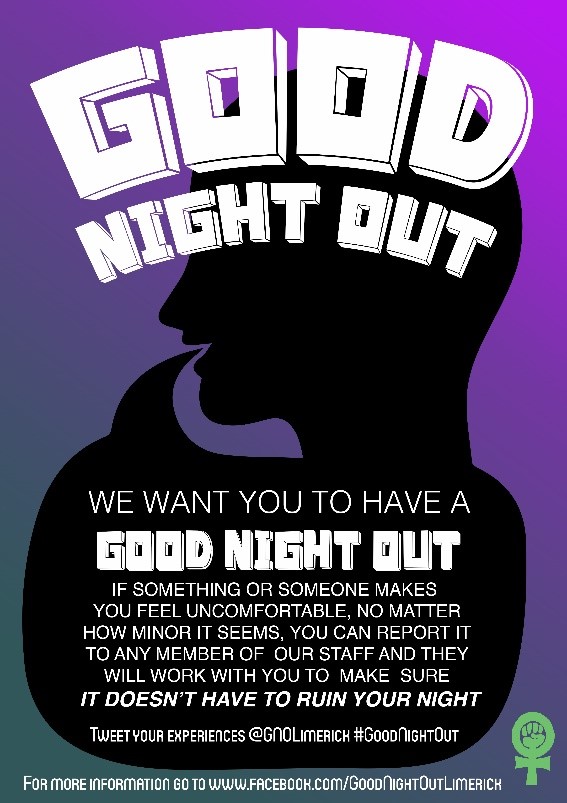
Ireland: Have a Good Night Out!

October 10, 2014 By Correspondent

Yvonne Ní Mhurchú, Limerick, Ireland, SSH Blog Correspondent

Credit: Colin Doherty

Harassment isn’t something that just happens on the street.  It isn’t just confined to ‘outside’, it is something that happens everywhere; outside, inside, work, school, university, bars, concerts, sporting events and nightclubs.  It is happening everywhere in every city and every country around the world.  For proof of this, look no further than the Stop Street Harassment blog, it has stories and reports of harassment by various people from across the globe.

Last month I wrote about how I walked home for the first time ever without any fear of street harassment.  This month I want to write about socialising without being subjected to harassment.  I currently run a feminist group in my town, we frequently liaise with other likeminded groups.  It is through this communication I heard about the Good Night Out Campaign.

Originally the brain child of Hollaback London, the premise of the Good Night Out Campaign is simple: we want nightlife venues to adopt and promote a zero tolerance policy when it comes to the harassment of their patrons – particularly female and those from the LGBTQ community.  Venues show their commitment by displaying official GNO posters around their establishment and training staff to deal with any complaints that might arise.

The reason I feel so strongly about this campaign is because I am all too aware of how problematic nightlife harassment can be.  My feminist group had a meeting to discuss the campaign.  I shared some of my own experiences as did the group, and the stories just kept on coming.  Comments, groping, sexually aggressive behaviour, being followed, yelled at and assaulted.  It is difficult not to get angry after hearing what all of these people had to put up with.  So, we decided to channel our anger positively and bring Good Night Out to Limerick.

The support we have received so far has been amazing.  Local newspapers have written about it and a local radio station did a short piece on it too.  Two weeks ago we asked the public to share their stories with us to help highlight just how serious a problem harassment in nightlife venues is.  Here is an example of two incidents that people were kind enough to share with us (TW):

“I was on a night out with some friends, a few of them were dancing while I was minding the drinks. I saw a guy on the dance floor start to follow one of my friends around, he was trying to grind up against her and touch her. She was not interested in the slightest but he wouldn’t leave her alone, eventually she got fed up and left the floor, as she did he pulled up her skirt. My ass was grabbed 3 times that same night.”

“I was in _____ during my freshers week. I didn’t know many people, but I was there with a solid group of people. I was upstairs dancing and some guy started grinding on me. I tried to back away and he and a friend pinned me up against a wall. They were laughing, I was shouting at them to let me go. A friend of mine was also pulling at them to get them off me, to no avail. I ended up biting one of them so he’d take his arm off me and running outside, closely followed by my friend who hugged me while I hyperventilated. To this day I regret not going up to security or something, because I doubt those guys even realised how much they terrified me.”

Stories like these are regular occurrences for a majority of people when they go out.  Not only can harassment completely ruin a person’s night out, it can also leave a lasting negative effect on them.  We want venues and patrons of these venues to send a message that this sort of negative behaviour won’t go unchallenged and will not be tolerated.  The more people that get involved the louder that message becomes.  If you would like to bring Good Night Out or a version of it to your town/city please feel free to contact me via twitter and I will do what I can to help get you started.

Yvonne volunteers as a SATU (psychological support) worker for her local Rape Crisis Centre and is an advocate for women’s issues and equality. You can follow her, her feminist group or her anti-harassment campaign on twitter: @YvonneNiMhurchu, @lmkfeminist and @GNOLimerick.

Share

Filed Under: correspondents, public harassment

USA: I’m Going to NYCC! Let’s Geek Out About Ending Harassment

October 9, 2014 By Correspondent

Katie Bowers, NY, USA, SSH Blog Correspondent

This weekend marks my now-annual tradition: cosplaying at New York Comic Con (NYCC).  I’ve attended NYCC as Ramona Flowers (from Scott Pilgrim) and Amy Pond and Donna Noble (both from Doctor Who). Needless to say, as a geek girl, cosplayer, and advocate for ending street harassment, I’ve been pretty interested in the work of Geeks for CONsent.

Geeks for CONsent is a group of female cosplayers and allies working to make sure that comic cons and the surrounding streets and events are harassment-free zones.  They have produced comic books, info sheets, and online resources for attendees, and they also advocate for and help convention staff to create high quality, well-publicized sexual harassment policies.

On the street or in the convention center, cosplay grabs attention and can inspire a lot of picture-taking.  If you ask for a photo and behave politely, most cosplayers are happy to oblige – we worked hard, after all, to look this awesome.  Unfortunately, some con-goers don’t apply that basic level of respect to cosplayers.  Harassment at cons often involves a camera: harassers may grab a cosplayer’s body parts during a photo, snap shots of cosplayers bending over, click quick up-skirt pics while sitting on the floor, and other clearly unconsented behaviors.  Other times, it won’t be on film.  It will be a passing comment in the hall about how a woman “fills out” a costume or the sudden, frightening sensation of a stranger’s hand feeling your costume or your hair.

This is a problem at every con, including that largest and most well known of the nerd conventions: San Diego Comic Con.  Back in July, we reported that despite Geeks for CONsent’s 2,500 signature petition, SDCC would not be updating their harassment policies or changing the ways they publicize those policies.

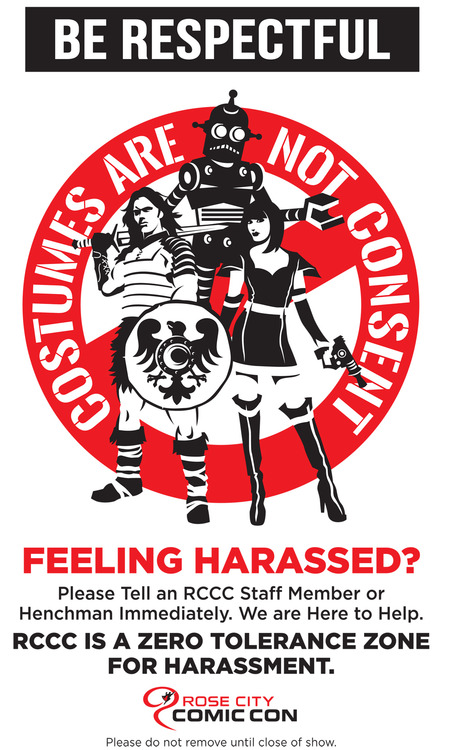
Fortunately, Geeks for CONsent and other anti-harassment advocates know that San Diego isn’t the only con around.  The work of the anti-harassment movement led both Emerald City Comic Con in Seattle and Rose City Comic Con in Portland to post some clear and beautiful signage throughout the convention center reminding attendees that “Costumes are not consent”.  Awesome Con, which hosts shows in Indianapolis, Milwaukee, and Washington, D.C., brought in Geeks for CONsent as their in-house anti-harassment team and used their anti-harassment training manual to train all of their volunteers in 2014.

Geeks for CONsent at Awesome Con DC, 2014

This weekend, NYCC will open their doors with a new anti-harassment policy, created by geek girl blog The Mary Sue and a panel of geeky advocates.  The policy includes a pretty comprehensive definition of harassment and protocols for reporting and dealing with harassers.  The policy also introduces the new Report Harassment feature of the NYCC app.  This cool piece of technology allows users to file an immediate, detailed report (provided, of course, that they have cell service in the concrete depths of the Javits Center).  Geeks for CONsent and Fan Girls’ Night Out will also be on hand to “spread the anti-harassment message, collect your stories, and provide a safe space to talk about your experiences”.

As geek culture becomes mainstream, making cons a place where all people feel welcome is more pressing than ever before.  At its core, geeking out is about enthusiasm.  It’s the type of unbridled exhilaration that gets you reading every installment, watching every episode, dressing up in character, traveling to cons.  Geeks are thrilled by seeing our favorite fictional heroes battle the forces of evil.  But what’s exciting now isn’t in the stories: it’s in us.

Major conventions are adopting new policies, geek celebs are speaking out against harassment, high traffic blogs and just-for-fun tumblrs are heralding the call that cosplay does not equal consent. Outside the geek-o-sphere, street harassment is being talked about by everyone from The Daily Show to Fox News (with, let’s say, “varying levels of support”).  After years of work, and even longer years of stifled silence, the heroic efforts of anti-harassment advocates are starting to turn the tide.

This weekend, I’ll be at NYCC and I’m excited to see how things are different.  Will the new policies eliminate harassment at the con?  Of course not – but this is the beginning.  It feels good to step into the Javits Center – wig, costume, and all – and know that the convention has my back.  And that?  That’s something to geek out about.

Katie is a social worker and community educator interested in ending gender-based violence, working with youth to make the world a better place, and using pop culture as a tool for social change. Check out her writing at the Imagine Better Blog and geek out with her on Twitter, @CornishPixie9.

Share

Filed Under: correspondents, Events, public harassment Tagged With: comic con, cosplay, NYCC

USA: Traveling While Female: Five Things India is Doing Better

September 30, 2014 By Correspondent

Angie Evans, Washington, DC, SSH Blog Correspondent

Photo provided by Angie

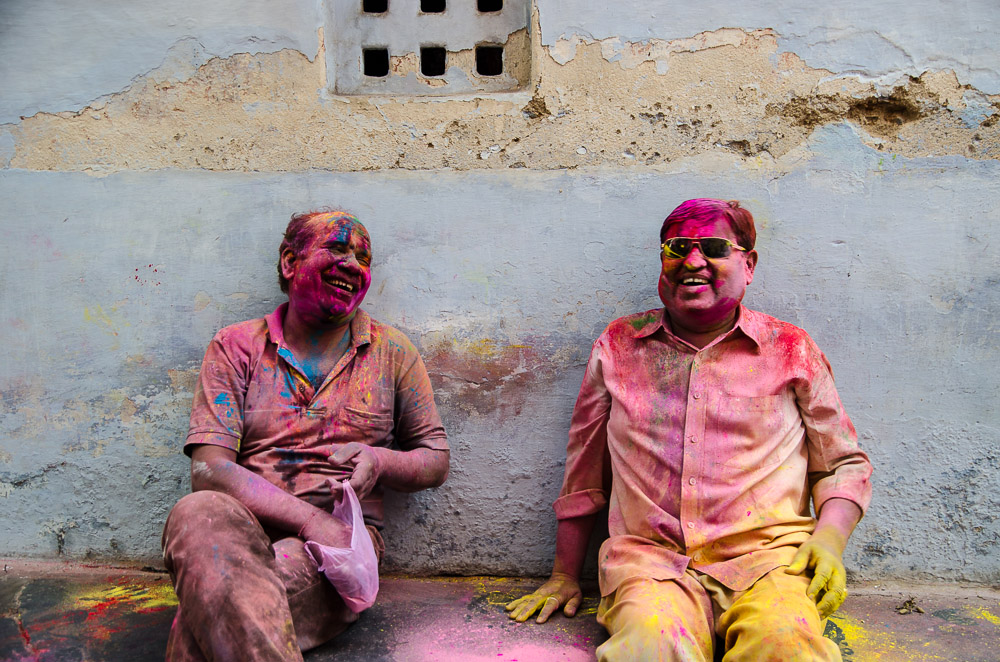
You can’t emotionally prepare yourself for sexual harassment or assault. It’s 11:15 a.m. and I am sitting on the rooftop of a guesthouse in Udaipur, India. My teeth are covered in purple chalk. From my fingertips to my elbow there is a splash of bright pink dye, later I will have to accept that my arm is going to be fuchsia for weeks. In the street I can hear kids laughing as they toss colors into the air. Two Grandfathers sit on a stoop below, chuckling with each other. I slump into a chair and breath for the first time in hours. Two other women sit with me. One had her shirt nearly ripped off by a group of teenagers and the other had to slap someone in the street for trying to run his hand across her chest. I’d had chalk smeared into my eyes by a man while his friend came up from behind me and grabbed by breasts.

Although Holi, the Hindu festival of colors, tops the bucket list for tourists all over the world, it isn’t the same experience for for all genders. The playful celebration that was traditionally held with family and friends relaxes many social norms between men and women, allowing some to use it as an excuse for groping, fondling, and grabbing women in the streets. In a culture so deeply rooted in spiritual practice and values, what is bubbling beneath the surface?

Reports of sexual assault in India have increased over the years, resulting in a continuous decline in the foreign tourism sector. In 2013, female travelers decreased by over a third in just 3 months. Hotel operators, travel agents, and others in the industry were undone by such a steep decline.  The international community was enraged by story after story of sexual assault. The first female chief justice was assigned to the the Delhi high court, immediately taking notice of some negative gender dynamics. An urgency prompted governmental investigations in national, state, and local Indian agencies.

Change is hard in a country with 1.2 billion people, but it’s an inevitable part of growth. A number of new policy measures have made female residents and travelers more safe in India. So what lessons can we learn from the policy changes and movement building in India around sexual harassment and assault?

1. Female Participation

When the Indian state of Gugarat decided to make a strong statement on sexual harassment, they set up a council to educate, mediate, and set policy framework within the high court. They made sure to prescribe exactly what kind of position in the system each member should have, and set a minimum quota for female participants. This isn’t the only governing body that set up a review board or fixed the number on the board, but it set a strong precedence for local communities.

2. Police Consent and Government Engagement

It is hard to know the true impact of sexual harassment in communities because it continues to be underreported for many reasons. In Delhi, they recognized that many victims felt uncomfortable calling the police so they set up a separate hotline just for sexual harassment and assault victims. They also started an on-going series of free self defense courses to female residents. In Ahmedabad, the police posted billboards in high traffic areas, offering a free ride home to any women who feel unsafe. The court systems are undeniably slow, and until this is changed, law enforcement officials need to play a strong role.

3. Education

India is slowly working on implementing one of their new laws, which protects women from workplace sexual harassment. A key part of that has become educating staff. This is important because the onus cannot be on women to stop the harassment, it must be on how men treat their female counterparts. Like all sexual harassment interventions in India, it must be about the perpetrator and not the victim in order to see fundamental change.

4. Make Streets Safe

Delhi is known worldwide for it’s confusing streets, lack of addresses, and chaotic traffic. Following the UN Safe Cities Global Initiative, the municipal government set up an audit for urban planning, identifying key ways that they could improve the safety of their city. Things as simple as street lights and better designed public restrooms can vastly improve safety records in a city. There are a number of Indian cities reviewing this checklist to find areas of improvement.

5. Support Survivors

Setting up sexual harassment and assault hotlines is the first step in a community response. Some organizations in India are making this the focus of their intervention because for many victims, it is a silent daily battle. In equipping these women with an emotional outlet, as well as the tools to respond to future experiences, you build an intervention that empowers each woman.

Organizations all over India are continuing to bring up problems with sexual harassment and assault, and will continue to fight for systemic and societal changes, because they haven’t reached a point where the laws represent the real values of the country. For a nation to truly grow and thrive, the equality of women must be central. And with women and children representing 70% of the population, this isn’t just the right thing to do in India, it’s good economic sense.

Angie is a community organizer and social worker. Last year she quit her job to travel around the world with her husband. They have just returned and are continuing to write about travel and adventure at http://whereisseangie.com

Share

Filed Under: correspondents, street harassment

« Previous Page
Next Page »

Share Your Story

Share your street harassment story for the blog. Donate Now

From the Blog

  • #MeToo 2024 Study Released Today
  • Join International Anti-Street Harassment Week 2022
  • Giving Tuesday – Fund the Hotline
  • Thank You – International Anti-Street Harassment Week 2021
  • Share Your Story – Safecity and Catcalls Collaboration

Buy the Book

  • Contact
  • Events
  • Join Us
  • Donate
  • Facebook
  • Instagram
  • Pinterest
  • Tumblr
  • Twitter
  • YouTube

Copyright © 2026 Stop Street Harassment · Website Design by Sarah Marie Lacy