• About Us
    • What Is Street Harassment?
    • Why Stopping Street Harassment Matters
    • Meet the Team
      • Board of Directors
      • Past Board Members
    • In The Media
  • Our Work
    • National Street Harassment Hotline
    • International Anti-Street Harassment Week
    • Blog Correspondents
      • Past SSH Correspondents
    • Safe Public Spaces Mentoring Program
    • Publications
    • National Studies
    • Campaigns against Companies
    • Washington, D.C. Activism
  • Our Books
  • Donate
  • Store

Stop Street Harassment

Making Public Spaces Safe and Welcoming

  • Facebook
  • Instagram
  • Pinterest
  • Tumblr
  • Twitter
  • YouTube
  • Home
  • Blog
    • Harassment Stories
    • Blog Correspondents
    • Street Respect Stories
  • Help & Advice
    • National Street Harassment Hotline
    • Dealing With Harassers
      • Assertive Responses
      • Reporting Harassers
      • Bystander Responses
      • Creative Responses
    • What to Do Before or After Harassment
    • Street Harassment and the Law
  • Resources
    • Definitions
    • Statistics
    • Articles & Books
    • Anti-Harassment Groups & Campaigns
    • Male Allies
      • Educating Boys & Men
      • How to Talk to Women
      • Bystander Tips
    • Video Clips
    • Images & Flyers
  • Take Community Action
  • Contact

USA: “Lock Up Your Daughters”: Teaching Them Early?

July 11, 2014 By Correspondent

Kasumi Hirokawa, PA, USA, SSH Blog Correspondent
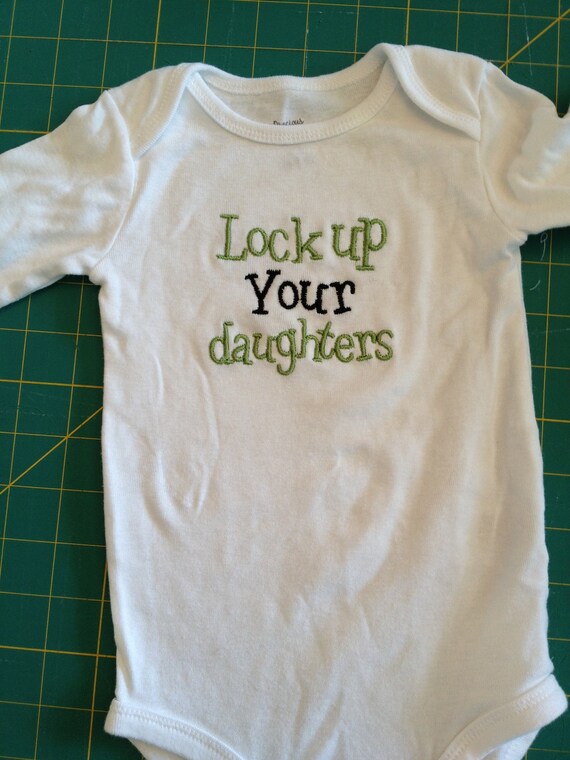
When I was scrolling through my Facebook feed this afternoon, I saw a photograph of a plump baby boy innocently smiling at a sock monkey. But neither the smile nor the plush monkey caught my attention first. Not even the bright green frame that matched that shirt. It was his bright green shirt (or a onesie) that made me linger on the photo. The graphics of the shirt said: Lock Up Your Daughters.

I think it was meant to be cute. It was meant to be funny. It was meant to be a corny innuendo, with a dash of age-appropriate naughtiness only his older relatives are able to chuckle at. Only that, for me, it wasn’t any of those things. I was made uncomfortable. Because I knew the woman who posted the photo has a daughter who is in elementary school.

To me, the slogan screams: this boy will grow up to be a stud; tell your girls to shut their legs while I, as a parent of the irresistibly charming boy, will do nothing to prevent him from taking away the purity of your precious princesses.

That makes me fear what the baby’s shirt may teach the little girl and the little boy about themselves, what is expected of them and how they view others around them. Will the lesson be that it is the responsibility of parents who have daughters to police their sexuality? Are girls responsible for protecting their purity? Is confining girls’ movement the only solution for them not to be bothered? Is sex something men take away from women? Is a woman’s worth dependent on how many sexual advances she refuses before marriage? If she is not properly “lock[ed] up,” does she deserve anything bad happening to her?

Of course, I’m not saying the boy’s parents were to blame for dressing him in such a shirt. Sexism is so insidious yet pervasive, it is hard to catch. The saying goes that a fish doesn’t know that it is swimming in water.

Rearing a child is no easy task, let alone raising a future feminist in the society infected with misogyny. But I hope the sock monkey-loving baby boy will grow up to be a man who stands up for his sister, not because he thinks she should be locked up but he sees her as a human being whose rights are equally important as his own.

Kasumi is a recent graduate from Penn State with a BA in journalism. Her writing has been published in Valley Magazine, City Weekend Shanghai, Penn State GeoBlog and Shanghai Daily. You can follow her on Twitter, @kasumihrkw

Share

Filed Under: correspondents

USA: Phone camera shutters and women-only cars: Japan’s answers to chikan

July 10, 2014 By Correspondent

Kasumi Hirokawa, PA, USA, SSH Blog Correspondent

Recently, I ran into a friend of mine who graduated from Penn State in May. She was on a month-long graduation trip to various locations in the Middle East and Asia, including Japan. She shared her stories of exotic food and unfamiliar customs she came across and I listened eagerly. I always enjoy good travel stories.

She said she enjoyed visiting Asia but was bugged by leering from locals. She attributed it to her being one of very few white girls in the vicinity. People were probably curious, she said. Some would stand too close to her when they hiss “helloooo.” Others would try to take sneaky pictures of her, only to be caught because of their shutter sounds. Street harassment was there to spoil the fun, like always.

Ah, the camera shutters. They were doing something to curb chikan crimes after all. Chikan is a term for a sexual predator and crimes involving one, be it unwanted flashing or groping, in Japan.

I remembered that, in Japan, it is impossible to turn off the shutter sounds on camera phones. Women commuters filed complaints that chikans wouldn’t stop taking upskirt photos in packed train cars. A bill called the Camera Phone Predator Alert Act, which required all mobile devices to have camera shutter sounds that could not be turned off, was proposed in 2009. The camera shutters were sort of a follow-up to women-only train cars that were implemented in 2001.

I haven’t had the experience of owning a camera phone with a mandatory shutter sound or riding a women-only train car since I moved to China, so I am not in a position to say how effective they are in deterring chikans.

While I do not oppose the shutter sounds, I am not fond of women-only train cars. First, they are not always women-only. There are a certain number of designated cars on a train with pink signs on the windows with hours. During those hours (typically rush hours in the morning and the evening), do they become women-only cars.

I know women-only cars were proposed by well-meaning policymakers. However, limiting women’s presence in public spaces is at best reductive and at worst, downright sexist. It’s easy to tell women to ride on designated cars or sign up for self-defense classes. It’s easy to blame a victim that she should have known better than to not get on the women-only car. But women-only cars are not dealing with the problem at its roots: men who harass women on trains. I’d like to see “Beware of chikans!” billboards replaced with ones that say, “Don’t be a chikan! Make public places safe for everyone!”

Kasumi is a recent graduate from Penn State with a BA in journalism. Her writing has been published in Valley Magazine, City Weekend Shanghai, Penn State GeoBlog and Shanghai Daily. You can follow her on Twitter, @kasumihrkw
Share

Filed Under: correspondents, street harassment

USA: #NotJustHello: What’s so bad about starting a conversation?

July 3, 2014 By Correspondent

Lorna M. Hartman, Spokane, WA, SSH Blog Correspondent

Twitter has provided women worldwide with an avenue for mass sharing of harassment and assault experiences.

It seems easy for some men to hear a story from a woman and simply dismiss it, as many women can testify. When hashtags go viral with dozens or even hundreds of women sharing these experiences, though, it’s much harder for people to simply dismiss them.

It’s harder to say, “You must have overreacted. It doesn’t sound like that big a deal,” when you’re saying it to several hundred or several thousand women from all over the world citing similar experiences.

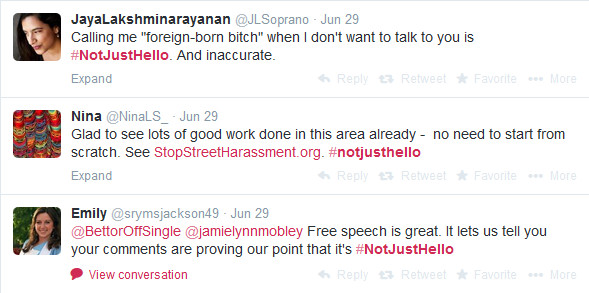
Writer Aja Romano of The Daily Dot published “#NotJustHello identifies a troubling trend in street harassment” on June 22. She reported, “We’re sure Twitter user UJohnsmeyer probably meant well. But his defense of men who talk to women on the street may have sparked the weekend’s most engaging social commentary hashtag.”

Here’s a piece of the Twitter conversation that led to #NotJustHello:

@UJohnsmeyer  @Feminist_Inti @Karnythia ever think that maybe a guy sees a chick he thinks is hot and just wants to try to start up a convo?

@Karnythia  @UJohnsmeyer @Feminist_Inti Ever think women don’t want to strike up convos with strange men?

More women joined the conversation, telling about their experiences. Finally, @Karnythia said:

@Karnythia We do understand that it’s #NotJustHello right? That street harassment is never that calm or polite?

The new hashtag took off. Here are some samples of both women’s experiences, and of men’s reactions to the hashtag:

@dale_in_denver @KaeAltoBella @AJStream If there is an expectation of a response, then it’s #notjusthello. Ignoring isn’t working or this wouldn’t be a #.

@notallmikaylas Your desire to hit on me does not trump my right to be left alone. #NotJustHello

@hannaheff When I refused to acknowledge a stranger’s compliment, he invaded my personal space and said, “I’m stronger than you.” #NotJustHello

@UJohnsmeyer How do you get women if you can’t say hello to them? #notjusthello

@theamandabatty ‘Hello’ is a smile or a respectful nod, not a catcall, a jeer, a crude gesture or name calling when I don’t respond. #NotJustHello

‏@BettorOffSingle [this individual posted several dozen times, attempting to monopolize the hashtag—his post below is representative]

Hey stupid women: #yesallwomen #notjusthello #feminism all lesbian constructs for seducing gullible str8 women by turning them against men.

@cameralinds_ It’s #notjusthello, it’s fear of retaliation for both responding and not responding.

@RynJ21 It’s #NotJustHello when I have a smile I created specifically to deal with street harassment. I call it, “Please don’t kill me.”

Male allies posted as well:

@HolzmanTweed When I was a teen, a guy tried to “teach” me how to catcall, explaining “the rules:” (1/x) #NotJustHello

@HolzmanTweed He told me look for a ring, an ankle chain, something that flagged her as taken so that I wouldn’t disrespect her man. (2/x) #NotJustHello

@HolzmanTweed There’s no pretense on the guy side that it’s about anything but establishing & confirming power, a compliance check. #NotJustHello

@wisemath Brothers, go read the #NotJustHello tag. If that doesn’t move something in you, I’ll pray for you.

@RobScowen For the male “not allowed to flirt” whiners, please read #NotJustHello *carefully* without feeling like the [f******] victim and educate self

As some women tweeted, if men understood the humiliation and the fear women feel when they are harassed on the street, fewer men would do it. Women’s personal risk in possibly being verbally or physically assaulted by a displeased harasser is real.

Last September, blogger UnWinona told of one terrifying experience while commuting on the Metro in California.

On this occasion a bicyclist brought his bike in with him. Despite an empty car, he sat across from her. When he started talking to her, she calmly told him to leave her alone as she was reading.

He walked to his seat in a huff, muttering about it not being his fault she was pretty. But he didn’t stop there; he continued to mutter and complain, and after a few minutes he got back up and started pacing. Then he started screaming at her, and then punching the train.

She was terrified. She froze in her seat, ready with her feet up in case he attacked her, certain that if she got up and walked away she’d be attacked when she turned her back to leave.

For two stops he kept this up. No one came to her aid; no one even came to see what was happening. The second she reached her station, she ran out the door.

She concluded [emphasis hers], “So when people (men) want to talk about ‘legitimate’ forms of assault, tell girls they should be nice to strangers and give men the benefit of a doubt, tell them to consider it a compliment, tell them to ignore the bad behavior of men, I want them to be forced to feel, for even one minute, what it feels like to have so much verbal hatred and physical intimidation thrown at them for nothing more than being female and not wanting to share.”

Lorna is raising three young, kindhearted male allies and has worked on rape and interpersonal violence since the 1990s, including serving on the local rape hotline, answering calls, and driving to emergency rooms to advocate for victims and connect them with resources they needed.

Share

Filed Under: correspondents, street harassment

Australia: “I expect to be able to drive my car without being stalked”

June 28, 2014 By Contributor

Corina Thorose, Melbourne, Australia, SSH Blog Correspondent

I drive a zippy little red Echo. It’s fairly girly, especially with the bumper stickers I have plastered all over the rear window, so most guys know it’s a woman’s car. I’m used to the odd look. We’re all guilty of checking out the person next to us. We might even try to pull up next to them at a red light for a second look if we like what we see.

Nothing about this said second look.

He stopped several cars ahead of me at the lights, and swivelled his entire head to look back me. At first I assumed he was just really indiscreet. Then as he moved off at the green very slowly so as to keep level with me, I assumed it was road rage, and that I had cut him off somewhere. But he wasn’t angry with me – he made his intentions very clear as followed me for a further 10 kilometres.

For the next 10k, I struggled to stay focused on the road as he harassed me. If he was behind me, he ran red lights to keep up with me. If he was in front, he braked so that I would be level with him. He drove with is head turned sideways, barely glancing at the road in front of him, staring at me with sex in his eyes and a lecherous grin on his face. I pulled back, allowing several cars to get between us, but he got even more reckless, diving into gaps of traffic to be next to me, looking me over with unrestrained lust.

I did something I haven’t done since I had gotten in trouble as a child. I rang my parents. Fortunately within ten minutes of their house, I told them I was being followed and to please meet me outside their house. I didn’t call the police, I didn’t drive to the nearest police station. I didn’t take down the creep’s details and make a report. None of these things occurred to me in my panic. All I wanted to do was put distance between us.

Eventually, I lost him. He didn’t hurt me in any way. There was no immediate danger and I was no worse off.

Except I was. I was pissed off. I was furious. How dare this man terrorise me on the street? In broad daylight, in the safety of my car, minding my own business, he terrified me. He reduced me to a child, ringing my parents for help instead of conducting myself as I normally do, with the grace and dignity of a thirty year old woman. My hands were shaking as I changed gears and I lost my logical thought process. I didn’t even take the rational course of action – what I always claimed I would do in that sort of situation – drive to the nearest police station and let them handle it. When you’re confronted with a threatening situation, something weird happens to your brain. It’s like tunnel vision – all I could think was stay on the road, keep moving, don’t look at him. He had complete power over me.

So, what’s the lesson here?

I know for next time (God forbid) to pick up my phone and dial 000. That’s what the police are there for. But if I’m honest with myself, I was scared that they would tell me to ignore it. That there was no real threat and he would go away if I paid him no attention. Because that’s how I’ve always handled street harassment. Don’t give them a reaction, just keep walking, don’t let the see you’re upset.

Fuck it.

I am upset.

When I told my friends what had happened to me, some of them did the unthinkable. They asked me what I was wearing. Like I’d been driving around in nipple tassels with a sign saying “Give It To Me” on the boot of my car. They told me not to take it personally, some guys are just losers, this guy obviously hasn’t gotten laid in ten years, and I’ve got big boobs – what did I expect?

I’ll tell you what I expect. I expect to be able to drive my car without being stalked. I expect to be treated according to my status as a living, breathing human being, and not according to my bust size. I expect that if I don’t shoot you a cheeky smile, you assume I’m not interested and LEAVE ME THE FUCK ALONE. You don’t gawk, you don’t gape, you don’t slobber, you don’t yell, you don’t pantomime a blow job, and you don’t follow me to the point that I am scared for my life.

My name is Corina, and I’m joining you from Melbourne, Australia for the next few months. I want you to know that I am committed to making the world a safer place. Because it’s not unreasonable to expect to live in a harassment free world. It is not unreasonable to expect a man to control himself. It is not unreasonable to teach our sons they have no right to catcall or objectify or mistreat women in anyway. It is not unreasonable to expect to be treated with respect.

Street harassment is not the norm – it is a crime.

Corina is a journalist who is currently in a Masters’ program in Professional Writing. Follow her work on social media: @BrandosBride, www.facebook.com/theirownbells, instagram.com/theirownbells

Share

Filed Under: correspondents, Stories, street harassment

USA: Weighing in on harassment against interracial couples

June 25, 2014 By Correspondent

Kasumi Hirokawa, PA, USA, SSH Blog Correspondent

As a car window rolled down, I waited. Perhaps my boyfriend saw it coming, too. “Chinky legs, chinky legs, chinky legs! Ayeeeee!” A male voice chanted at us when we crossed the street, hand in hand.

It was the second time people shouted insensitive remarks at us. Or to me? I do not know. Both incidents I experienced seemed to involve men yelling Asian slurs. Somehow in 2014, the sight of an East Asian woman and a black man linking arms still offends people. The sight of two people in love.

State College, Pa. is a small town of approximately 41,757, according to the United States Census data as of 2013. It’s also very white. The data estimates 83% of the town residents identified as white in 2010. I have also heard that Pennsylvania is one of KKK’s favorite hangouts from multiple sources, including this article by TIME magazine. However, none of these justify hate.

I still remember the first time something like it happened. I think I will never forget if it happens again. It was on our way home from a formal at a mutual friend’s house. We were walking back as we passed by a pair of wobbling white men when my boyfriend abruptly turned around and stopped. “What is it?” I asked. He replied through his clenched teeth, “I thought I heard them say horrible things. Something like ‘sideways pussy.’ Did you hear it?” I was not paying enough attention to even notice it. But my boyfriend is not the kind to make this sort of things up, especially when it is obvious that I am tired.

Unable to find much reliable literature on harassment against interracial couples online, I wondered if similar things happen to other interracial couples. I sought out a few friends of mine, each of whom was in at least one interracial relationship.

Mandy* is an Asian American woman and a student at a local university. She said she was at the receiving end of “judgmental” stares when she was with her boyfriend, who is black, for a gathering in a campus building. She recalled being the only Asian girl in the room: “People [kept asking me], ‘Are you with him?’”

Kyle*, a recent college graduate who lives in Green Lane, Pa., said he and his former partner was never subjected to “direct attack” from strangers but they “caught bad looks and [received] poor service” at restaurants. He said waiting staff would bring food to others who were seated after them – a white man and a black woman. “Waitresses wouldn’t stop by as frequently and you could see them looking [at us],” he recounted.

The days of racism and sexism are seemingly over in the eyes of those who refuse to look at what is happening around them. Who knows what the person behind you in the Starbucks line thinks about another from a different racial, religious or sexual orientation groups? They would shake hands with a fake smile with anyone when sober. How about when their PC façade is washed down by alcohol, mob mentality or raging sense of entitlement? Just like creepy comments hurled at me when I’m alone, these hurtful words and gestures are supposed to remind us that we have stepped out of the line and the harassers have the power to police us.

Kasumi is a recent graduate from Penn State with a BA in journalism. Her writing has been published in Valley Magazine, City Weekend Shanghai, Penn State GeoBlog and Shanghai Daily. You can follow her on Twitter, @kasumihrkw

Share

Filed Under: correspondents, Stories, street harassment

« Previous Page
Next Page »

Share Your Story

Share your street harassment story for the blog. Donate Now

From the Blog

  • #MeToo 2024 Study Released Today
  • Join International Anti-Street Harassment Week 2022
  • Giving Tuesday – Fund the Hotline
  • Thank You – International Anti-Street Harassment Week 2021
  • Share Your Story – Safecity and Catcalls Collaboration

Buy the Book

  • Contact
  • Events
  • Join Us
  • Donate
  • Facebook
  • Instagram
  • Pinterest
  • Tumblr
  • Twitter
  • YouTube

Copyright © 2026 Stop Street Harassment · Website Design by Sarah Marie Lacy