• About Us
    • What Is Street Harassment?
    • Why Stopping Street Harassment Matters
    • Meet the Team
      • Board of Directors
      • Past Board Members
    • In The Media
  • Our Work
    • National Street Harassment Hotline
    • International Anti-Street Harassment Week
    • Blog Correspondents
      • Past SSH Correspondents
    • Safe Public Spaces Mentoring Program
    • Publications
    • National Studies
    • Campaigns against Companies
    • Washington, D.C. Activism
  • Our Books
  • Donate
  • Store

Stop Street Harassment

Making Public Spaces Safe and Welcoming

  • Facebook
  • Instagram
  • Pinterest
  • Tumblr
  • Twitter
  • YouTube
  • Home
  • Blog
    • Harassment Stories
    • Blog Correspondents
    • Street Respect Stories
  • Help & Advice
    • National Street Harassment Hotline
    • Dealing With Harassers
      • Assertive Responses
      • Reporting Harassers
      • Bystander Responses
      • Creative Responses
    • What to Do Before or After Harassment
    • Street Harassment and the Law
  • Resources
    • Definitions
    • Statistics
    • Articles & Books
    • Anti-Harassment Groups & Campaigns
    • Male Allies
      • Educating Boys & Men
      • How to Talk to Women
      • Bystander Tips
    • Video Clips
    • Images & Flyers
  • Take Community Action
  • Contact

USA: Halloween Costume Review

October 31, 2013 By Correspondent

By Angela Della Porta, SSH Correspondent

Deciding on a Halloween costume is a pretty arduous task – you want to be original, and of course you want people to get it. Well, that task is especially hard for women! We have to balance having a great costume with not “asking for it.” I mean, I want to get trick-or-treat fun, not harassment or assault! So, I went to iParty to find the perfect costume, but I had a bit of a hard time finding an outfit. I thought I’d share a couple of my final contenders.

Going as Someone Else’s Culture


It’s a classic, right? Go as a Native American. The year before, I went as an African American and next year I’ll go as Latino. That makes complete sense!

If Native American didn’t work, I could always try wearing this flowy nightie that no one in India wears as clothing. Ooh, and you’ve got to love the double entendre of “Taj”ing one’s “Hall,” whatever that means.

The Criminal Justice System

I’m pretty sure this is what women have to wear in prison. I mean, it fits – since women in prison are pretty much sentenced to sexual assault from guards and medical officials the moment they enter the prison industrial complex, this outfit will be perfect.


I’m sure an outfit like that makes it easy to run after criminals and protect society. I wonder, though, where does the costume designer think she should put her gun?

Childhood Fun

Now, I remember Spongebob as a harmless cartoon, but it takes a lot of work to sexualize a woman by making her a sponge. You’ll see in the bottom right-hand corner that Nickelodeon, a children’s TV station, is the company selling this. Cute.

This is an ACTUAL children’s costume. It’s a children’s size 4/6, but it’s a cropped-top spandex devil outfit called “Red Hot” where the model in the photo is wearing platform stilettos  You can see in the photo that it says, “Children’s Size Costume.” They tell you it’s for children so many times because you can’t believe that six year olds, the average wearer of a children’s size 4/6, want to be sexy devil for Halloween. But they do, or it wouldn’t be there.

—

Now, don’t get me wrong. I don’t do this review because I think there is something inherently wrong with sexy women’s costumes (well, I’m not a fan of the cultural appropriation in the first two, but that’s another post). I’m just not sure what women are supposed to do. If they buy any of these costumes, the only ones on the shelves for adult women, then they are left to be scrutinized and judged for “asking for harassment or assault.” If something were to happen when in this costume, they would be blamed.

Women, wear whatever you want on Halloween, and on every other day of the year, for that matter. But it’s a catch 22 – want to wear something sexy? Get harassed. Want to wear something not-sexy? If you can find something, you still face judgment for not ascribing to someone else’s idea of femininity. So what do we do?

You can let people know their comments and judgments aren’t okay. You can call out rape culture and sexism in your own life.

Angela Della Porta is a recent graduate of Clark University in Worcester, MA. She will join with Teach for America in Detroit in the fall. Until then, she’s spending her time in rural Maine. Follow her on Twitter: @angelassoapbox

Share

Filed Under: correspondents, street harassment

USA: Placing the Shame Back on the Harasser

October 31, 2013 By Correspondent

By Lauren McEwen, Washington, D.C., USA, SSH Correspondent

In my months as a Stop Street Harassment correspondent, I’ve focused heavily on different ways I respond street harassment (harassment from elderly men and intra-racial street harassment, et cetera), but today, in my final, official post as a blog correspondent, I want to focus on a time when I failed to shout back loud enough. A time that I continue to look back on, disappointed at my own inability to thoroughly stand up for myself.

First, let me begin by saying that there is no “correct” way to respond to street harassment. I think we should always try to respond in a manner that 1) keeps us safe and 2) keeps our dignity and self-esteem intact, but there will always be those moments in which we, personally, feel that we could have done a better job. Those moments that we mull over long afterward, cursing ourselves for not saying the right thing, or failing to report the harassment to the proper authorities. This is probably one of the most damaging effects of street harassment – the guilt, shame and helplessness it can make us feel.

For example, once a teenage boy threw a full bottle of water at my back because I refused to stop and give him my phone number. It did not matter that I am an adult who wouldn’t have been interested even if he were of age, or that I was on the phone with my mother when he decided to loudly describe what he thought of my breasts in my top. I’d rejected him in front of his friends, so he threw the bottle at me. I doubled over from the force of the hit, and he and his friends ran from the corner, laughing.

I almost called the police, but stopped short because I hadn’t seen the boy’s face, and I knew that if the police helped at all, they would most likely round up every black boy within a five-block radius and frisk them. Of course, he got away with assault, and my back ached for days, but I wasn’t complicit in having innocent boys treated like criminals. I could live with that…after a while.

But I still cannot fully forgive myself for how I responded to being groped while leaving the train station in June. I was headed to the grocery store to pick up a few things for my then-boyfriend’s birthday. It was boiling out, so I was wearing a thin, cotton dress. I’m not describing what I was wearing because of internalized acceptance of rape culture, or anything like that. It’s important to understand how little actual clothing I was wearing to understand how violated I felt.

As I’m scrolling through the shopping list on my phone, I suddenly feel something press against my backside. It takes me about seven, sickening seconds before I fully realize what it is: an erect penis. I whip around, and come to face-to-face with a stranger: a middle-aged man wearing a white button down and khakis and carrying a leather briefcase.

For a millisecond, I consider that he may have been standing so close to me because the escalator was crowded, but that hope quickly crumbles when I realize that not only is the escalator nowhere near full, but that he had to lean forward in order to press against my behind.

I’m shocked and disgusted and furious, and I start cursing and shouting at him to get away from me – to never touch me. And that is when he did something that infuriated me even more than the groping: he shook his head and walked away, trying to signal to anyone within earshot that I was mentally unstable, and not worth listening to. The other people on the escalator began looking uncomfortable, and moved quickly aside as I stormed up the remaining steps, shaking, afraid that he would follow me.

No matter how many times I tell myself that I did respond, albeit not as effectively as I would have liked (that I was alone and things could have easily escalated if I’d continued to press the issue, that I reacted in the moment and cannot blame myself for being startled) I still wish I’d reported it to the transit police, at least, if not to teach him a lesson, then to prevent him from doing it to someone else.

By the time I made it to the grocery store, I could barely focus on getting my shopping done, taking an hour longer than necessary to gather everything I needed. Eventually, I called my boyfriend to pick me up, and he spent the car ride home feeling guilty for not driving me in the first place.

But I shouldn’t need a male escort to shepherd me around in order to avoid being groped by strangers. Not only is it demeaning, but it’s also impractical, and that kind of thinking places the weight of preventing street harassment back on its victims.

I write all of this to say, no matter how long you have been speaking up about street harassment, how many other people you have helped fight back against it, how many articles you’ve shared or retweeted – none of us are immune to that feeling of helplessness. None of us react the “right” way…at least, not each and every time.

And even though I am still trying to force myself to believe this, I’m saying it now…those moments do not make you weak. They do not make you coward. They make you a person who was too shocked or hurt or disgusted by another human being’s behavior to follow whatever anti-street harassment protocol you had planned. I just hope there isn’t a next time, and if there is, I want to place the shame back on my harasser, not carry it with me for months afterward.

Lauren is a recent graduate of Howard University where she majored in print journalism with a minor in photography. You can check out more of her work at laurenmcewen.weebly.com and follow her on Twitter at @angrywritergirl.

Share

Filed Under: correspondents, Stories, street harassment

Kyrgyzstan: Street harassment of transgender people in Bishkek

October 30, 2013 By Correspondent

By: Aikanysh Jeenbaeva, in collaboration with others from the BFCSQ, Bishkek, Kyrgyzstan, SSH Correspondents

“T-World, Transgender Advocacy Comic, Kyrgyzstan” Via www.Active-Art.org

Transgender people remain one of the most vulnerable groups of the population in Bishkek. Up to 90% of all transgender people experience constant pressure, violence and discrimination at the hands of relatives, acquaintances, law enforcement officials, medical professionals, complete strangers on the streets, etc.

The story below is told from the perspective of my fellow trans*activist, for whom harassment in public places is just one of the many facets of violence in his everyday reality.

“We get harassed by the police most often”, he says. “They come up to me or to my friends and start demanding to show identification. After seeing what they consider a discrepancy in the documents between indicated and real gender identity, they take us to the police station, where we are subject to more severe harassment in the form of humiliating interrogations and threats. One of the officers once said that people like me “are perverts and should be killed”.

This kind of attitude by the police officers is not only seen as normal, but also encouraged. Even if you call the MIA (the Ministry of Internal Affairs) hotline to report police misconduct and brutality, they hang up on you upon hearing that this was done on the basis of gender identity.

You never feel safe and you are never protected. Home is not a place where you feel loved and secure for a large part of my friends and myself and the streets are like a battlefield, where you never know when and who will accost you.

When I or my friends walk down the street, people usually stare at us trying to guess gender identity. Women (mainly) stare at the genital area trying to make out whether the transgender person has male or female genitals. People loudly comment my appearance, stop and start giggling or discussing between themselves whether I am a boy or a girl. And this is even worse for people who do not look masculine/feminine enough and thus do not fit into the cis-normative patriarchal gender binary.

Harassment is so normalized that people simply do not consider it as such. It is normal for them to come up to an unknown person and laughing, start asking whether you are a man or a woman, a boy or a girl. It is also normal for them to start contradicting you, if you choose to reveal your gender identity. They ask incredulously: “Do you really consider yourself a man?! But… just look at yourself!” I get called a hermaphrodite, a faggot, an “it”… there are so many insulting names that it won’t be possible to list them all here.

However, street harassment is not limited to staring or verbal abuse. Many of my friends have been harassed physically by strangers on the streets who have grabbed their chest to “check whether it is real or not”, have hit and beaten them.

Part of the harassment comes when people confuse transgender people with lesbians and gays, and in such a highly homophobic society as the Kyrgyzstani one is, you have to expect threats, loud insults, hateful and disgusted looks. And just imagine what happens to those who are non-heterosexual or queer transgender people…

When we gather as a group to go somewhere to eat or just hang out, we almost always get harassed. When it happens, some of the guys try to start a fight or curse back. Strange thing, if we react in an aggressive manner and yell or shout back at the people, that shuts most of the harassers up. This has led us to believe that the only language people understand is the language of violence and that it is the only efficient way to react. However, acting violently and aggressively in response to harassment makes you feel disgusted and angry that you have allowed yourself to get provoked once again.

Of course, not everyone can or wants to use the tactic. Some of my friends just gave up and stopped leaving home without any urgent need. The streets are a too scary and hostile place for them.

In the past, I used to react in a very angry manner. I was very upset after every such encounter and brooded over it for a long time. But after a while, I just stopped reacting to it. Now when someone makes a comment on the street, I simply pretend not to hear it. Still every time I experience it, it completely kills my mood and leaves me empty on the inside.

This is the society we live in — a discriminatory transphobic, homophobic, biphobic (add your description here) society. I know that tremendous efforts and time are needed to change it. But one thing that any person can do next time he/she has an urge to harass others on the street, is to think how it would feel, if you were in the place of that person.”

Aikanysh graduated from the University of Freiburg with a degree in European Literatures and Cultures and recently from the Diplomatic Academy of the KR with a degree in International Relations. Aikanysh is a co-founding member and coordinator of the Bishkek Feminist Collective SQ. Salidat is an undergraduate student at Kyrgyz National University and a dedicated volunteer at the Bishkek Feminist Collective SQ.

Bishkek Feminist Collective SQ was founded in 2012 by activists from various communities of Bishkek city. Follow BFC SQ on Twitter, @bish_feminists and on Facebook.

Share

Filed Under: correspondents, LGBTQ, Stories, street harassment

USA: “I reclaimed the street by reclaiming my feelings”

October 29, 2013 By Correspondent

By: Molly Redding, San Francisco, CA, USA, SSH Correspondent

I love Saturday mornings. No alarm, no obligations, and 48 hours of freedom to look forward to. After a large cup of coffee and some quality time with the San Francisco Chronicle online, I head outside to walk to my favorite yoga class.

I started walking to this class awhile back since other transportation options didn’t work, but now I’ve come to really enjoy it. After 8 years of residency I still love San Francisco as much as the day I moved, and this walk allows me to experience different neighborhoods and the richness of diversity that exists in this city.

But not this morning. As I made my way down to the gym, I walked down a street that isn’t part of my normal route, and spotted two men talking to one another. I feel like as a woman sometimes you sense these things are going to happen before they do. It must be a look or something you get that you just know, the next 30 seconds or so are just going to suck. You might take a second to hope you’re wrong, only to be proven right. Here’s what they said to one another as they leered at me:

“Hold on a second. I want to check out this pretty thing walking by.”

“Mmmmhmmm. That is nice.”

“Yes, those pants fit her WELL!”

They literally stopped their conversation so they could watch me walk by and comment. Their opinion of my body, my body,  was so pressing that they had to stop what they were doing just to express it. As I walked past and knew they were staring at my ass, I felt completely naked. I had an urge to cover my butt with my hands so they couldn’t stare at it, even though I knew that wouldn’t help.

In a flash, I felt the heat of shame rising to my face. At being leered at yes, but also at my reaction. I just kept walking. I’ve written an entire dissertation about street harassment., I write a monthly blog post, and I didn’t have a good comeback or witty comment? I know the dangers of taking action against harassers, but this was a bright Saturday morning with tons of people milling about. I felt like I had let everyone down, by not reacting quick enough, by not trying to stop it. If I, an anti-street harassment activist, can’t even react the right way when I get harassed in my own neighborhood, how can I preach to others to do the same?

As I crossed the street and made my way to the gym, I realized that by putting pressure on myself, I was only making the situation worse. Harassment is designed (whether harassers know it or not) to make the victim feel exposed, on display, ashamed. I could choose to feel that way, or I could choose to acknowledge my feelings of shame, anger and frustration,  recognize that we still have a lot of work to do, and go on my way. And so I did. I reclaimed the street by reclaiming my feelings, by not letting anyone monopolize what I think and how I feel.

I realize this won’t work in every situation. Trust me, I’m still disturbed by the guy who exposed himself to me outside my apartment as I was coming home from a wonderful night at my best friend’s wedding. Harassment is a form of trauma that can stay with us for a long time.

Luckily, I know I have a community that will share their stories and support me no matter how I react to a harasser. Writing my story helps, but so does just telling people around me – my roommate, coworkers, family. Sharing stories will not only help us heal, it will help the rest of the world know we won’t tolerate this behavior anymore. So keep sharing your stories!

Molly received a graduate degree in International Development and Gender from the London School of Economics in 2011, where her dissertation focused on websites allowing victims of harassment to post about their experiences. She has worked in the non-profit sector for over 10 years. You can follow her on Twitter, @perfeminist.

Share

Filed Under: correspondents, Stories, street harassment

South Africa: Perspectives on How Men Should Approach Women in the Street

October 28, 2013 By Correspondent

By: Gcobani Qambela, South Africa, SSH Correspondent

Via The Huffington Post

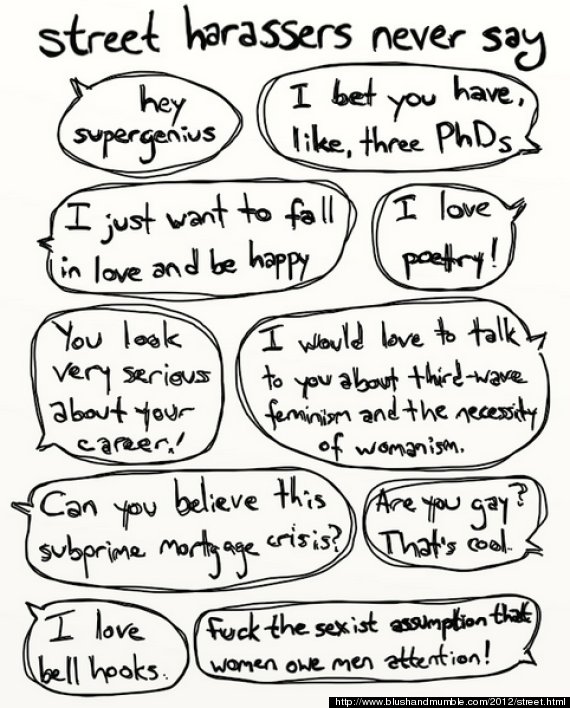
I recently read an interesting article in The Huffington Post titled “What We Wish People Would Say To Us On The Street”. The article covers the illustration by Norma Krautmeyer “which observes what people never say to women on the street.” This month I decided to talk to a small number of South Africans from across genders in various provinces in South Africa about the different ways they would like people to approach them in the street.

I believe street harassment in any form is unacceptable, but where necessary, how can men be better prepared to approach women in respectful and dignified ways in the street? What are the best ways to start a conversation with strangers across genders in a non-threatening way in the streets?

I spoke to gender activist and researcher, Rethabile Mashale, in Cape Town, in the Western Cape province of South Africa. She tells me that she has had her fair share of being subject to “catcalling and harassment” in the street. So what approach does she prefer when strangers, especially men approach her in the street? She says she has devised five basic alternatives. “The first is that a decent and genuine ‘hello’ and ‘how are you?’ which are followed by a genuine concern for whatever happens next” always work she says. Secondly she says “never lick your lips, or do a once over, over my body.

The person, thirdly, must look me in the eye instead of my tits” she continues. Fourthly she says while a clever joke can work, pick up lines are generally also unacceptable. She says lastly and mostly importantly “lead with getting my PERMISSION to engage in conversation, in fact, I would say that is the most important one” to get permission to talk and engage a person and quietly accept should she decline.

I also spoke to Amanda* in the province of KwaZulu-Natal. She told me she feels like street harassment is very degrading and that there is always a very “thin-line” between a stranger cracking a conversation and also at the same time harassing you. However the important distinction she made is that “Harassment is when I say ‘no’ and he doesn’t stop or if he feels the need to touch or say derogatory things to me.”

Tandokazi Mbopa, a university student in Port Elizabeth, in the Eastern Cape province, told me that she just does not want strangers approaching her in the street at all. This, she said, was born out of a horrible experience of being persistently harassed in the street. She told me that last year, she was walking and running late to school and a guy in a car kept hooting at her even though she ignored him. “He really didn’t get the hint ‘because he was driving next to me saying: ‘Oh, where are you going? Do you want a lift?’ as if I was going to get into that car after that hooting” she tells me.

Despite her declination to get into the car she says he refused to take a hint and kept driving slowly next to her saying, “Ooh, baby you’re hot. Baby you’re hot.”

“I felt like meat. The way he was looking at me. I was wearing track pants and a vest down to cover my butt… I wanted to change whatever was making him look at me like that and call me ‘sexy’” she tells me. “I don’t respect any guy approaching me on the street. I never will, unless if I’ve met you before – just not in the streets,” she concludes.

While these are only three interviews that I have included here, what emerged clearly from all the women I spoke to is that the key is consent and permission to approach and talk to women or anyone else in the street should be garnered clearly from the person who is being approached. If the women do not want to speak or engage then one should politely accept that. While Krautmeye’s illustration is encouraging, it is also important to remember that there are people with painful experiences like Tandokazi of dealing with harassers in the street even though the harassers probably thought they were saying something ‘nice’ to her. It is important therefore to treat even what appears to be ‘nice’ harassment with caution for it can also be traumatic for those on the receiving end. Consent and acceptance of a woman’s choice is thus critical in all cases, even if it appears that the guy is saying something that the woman would appreciate.

*The interviewee wished to remain anonymous.

Gcobani is completing his Masters in Medical Anthropology through Rhodes University, Grahamstown, South Africa. His research centres around issues of risk, responsibility and vulnerability amongst Xhosa men (and women) in a rural town in South Africa living in the context of HIV/AIDS. Follow him on Twitter, @GcobaniQambela.

Share

Filed Under: correspondents, Stories, street harassment

« Previous Page
Next Page »

Share Your Story

Share your street harassment story for the blog. Donate Now

From the Blog

  • #MeToo 2024 Study Released Today
  • Join International Anti-Street Harassment Week 2022
  • Giving Tuesday – Fund the Hotline
  • Thank You – International Anti-Street Harassment Week 2021
  • Share Your Story – Safecity and Catcalls Collaboration

Buy the Book

  • Contact
  • Events
  • Join Us
  • Donate
  • Facebook
  • Instagram
  • Pinterest
  • Tumblr
  • Twitter
  • YouTube

Copyright © 2026 Stop Street Harassment · Website Design by Sarah Marie Lacy