• About Us
    • What Is Street Harassment?
    • Why Stopping Street Harassment Matters
    • Meet the Team
      • Board of Directors
      • Past Board Members
    • In The Media
  • Our Work
    • National Street Harassment Hotline
    • International Anti-Street Harassment Week
    • Blog Correspondents
      • Past SSH Correspondents
    • Safe Public Spaces Mentoring Program
    • Publications
    • National Studies
    • Campaigns against Companies
    • Washington, D.C. Activism
  • Our Books
  • Donate
  • Store

Stop Street Harassment

Making Public Spaces Safe and Welcoming

  • Facebook
  • Instagram
  • Pinterest
  • Tumblr
  • Twitter
  • YouTube
  • Home
  • Blog
    • Harassment Stories
    • Blog Correspondents
    • Street Respect Stories
  • Help & Advice
    • National Street Harassment Hotline
    • Dealing With Harassers
      • Assertive Responses
      • Reporting Harassers
      • Bystander Responses
      • Creative Responses
    • What to Do Before or After Harassment
    • Street Harassment and the Law
  • Resources
    • Definitions
    • Statistics
    • Articles & Books
    • Anti-Harassment Groups & Campaigns
    • Male Allies
      • Educating Boys & Men
      • How to Talk to Women
      • Bystander Tips
    • Video Clips
    • Images & Flyers
  • Take Community Action
  • Contact

USA: Let Me Do My Job!

March 4, 2013 By Contributor

By Lauren Duhon, SSH Correspondent
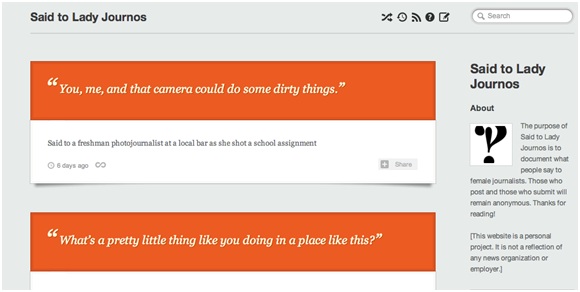
Recently, I read a blog post about a journalist who has experienced consistent harassment online through social media and e-mails after she broke the news about Jerry Sandusky at Penn State. The writer of the blog states that women who write about unpopular subjects are often subjected to threats, sexual taunts or harassment. From my experience, it doesn’t even have to be about a subject that is considered to be unpopular or controversial. As a photographer and a writer, men have constantly harassed me on the job.

Several times on interviews, sources have found it necessary to call me names that leave me feeling uncomfortable or comment on my physical appearance, such as noting a feature on my blouse that just happens to be near my breasts. Particularly, it creeps me out when a male source will touch my leg as a means of literally grabbing my attention. When I’m out taking photos, I’m usually confronted with men asking me for a private photo session or I hear them yelling “Hey, pretty photographer lady, that’s an awfully big camera you have!” Thanks for letting me know, stranger. I obviously did not realize I have a huge camera in my possession. Way to be creepy!  I’ve heard everything from sweetheart to dollface or received comments asking me “What’s a pretty girl like you doing at a place like this?” I’m capable of doing my job just like anyone else, regardless of the situation. The comments and scenarios vary, but it is always unwarranted.

However, when the subject matter has been more controversial or unpopular, I have found that sources tend to take me less seriously. Maybe because I am a student? Who knows? My thought is that they usually humor me because I’m a young woman. The second I ask questions, I don’t matter and they dismiss my existence.

It isn’t always like this, but being a woman often impacts my ability to do my job. According to the 2012 Byline Survey Report, more than 60 percent of newspaper employees are men. Having to earn respect in a field dominated by men is enough of a challenge, let alone having to defend myself when I am confronted with awkward situations and harassment. I fortunately haven’t had to deal with harassment in the work place, but I have read stories from female journalists about co-workers or editors who have invaded their privacy on a daily basis.

I also came across a tumblr page called Said to Lady Journos that compiles comments about female journalists who have experienced harassment on the job. One woman was asked whether or not she was studying to earn her master’s degree. When she said no, the man replied with,”you’re the perfect example of why there aren’t any women on the board,” when referring to a university’s board of regents. Another example is a comment from a contractor to a female journalist at a US military base in Iraq. He tells the reporter that, “if you got shrapnel in your ass, I’d be happy to take it out.” Out of line, obviously. One of the worst ones I read was about an Indian female reporter that was told by a café owner that she was a “cute little thing,” but she should be “running a 7-Eleven or something” instead.

The point is that I want to be able to go out on an assignment and take photos or write an article without unnecessary comments. To quote Joel Mathis, the writer of the previously mentioned blog post, “Women journalists shouldn’t have to be afraid to do their jobs because they’re women.” There is a level of respect that needs to exist, and this goes for any profession. Just because I’m a young woman and you see me out in public with a notepad or a camera does not mean you can approach me and say or do whatever you want. I have several colleagues of mine who often complain about similar situations.  Treat us as professionals, because everyone deserves it.

Lauren Duhon is a student journalist from LSU in Baton Rouge, La.

Share

Filed Under: correspondents, street harassment

USA: Free Lurkers with Gym Membership

February 27, 2013 By Contributor

By Natasha Vianna, SSH Correspondent

Photography by Randy M Ury Corbis

A few years ago, I signed up for a gym membership for the first time in my life. It was exciting! I am a mom so getting back to working out, losing the baby weight, and feeling good was all an amazing concept. And that’s all it ever was, a concept. By the end of my first gym visit, I hated the gym because of the men.

Day one at the gym included some cardio, some zumba, and some weights. What I didn’t realize is that my membership not only granted me access to the gym and childcare center, but it also included creepy stares from lurky men and free, new unwanted nicknames from the desperate.

My first day was horrifying. As I was on the treadmill, I felt so uncomfortable as I watched two guys walk behind me to just stand there and stare at my ass. And when I walked to the water fountain, someone strategically met me there at the same time to watch me bend over for a sip.

I never felt so uncomfortable in my life. The experience and the staring were in no way flattering to me. In fact, when I went home, all I could do was look for workout clothes that weren’t clingy. At one point, I even asked myself if I was dressing too sexy for the gym.

One evening, the scariest perk of my co-ed gym membership surfaced. A man from the gym followed me to my car at night. As I carried my 3 year-old daughter, he walked only a few steps behind us and I didn’t notice him until I was already opening my car door. Nervously, I locked her inside and asked him what he wanted. He insisted I give him my phone number and when I said no, he told me that he wouldn’t take no for an answer.

Not even a moment later, someone from the gym walked outside and startled him. I smiled and waved them over. He looked back at me and told me he would try again tomorrow. I never went back to the gym again.

So today, when I was talking to a male friend, I told him I couldn’t go to co-ed gyms anymore. He asked me why and I told him the story. His first few comments included: “Why would you go to a gym filled with guys?” and, “What were you wearing?”

I pulled out his male privilege card and reminded him that I was a woman and he was a man. Never in his life would he be asked those questions if a woman harassed him. Never in his life would he be asked if he was wearing clothes that were too tight after complaining about someone following him to his car. Yet, here I stand constantly talking about the types of harassment I endured and the first thing some people ask is how I evoked or provoked my mistreatment.

Women should be able to wear anything anywhere without worrying about a man’s ability to control himself. Women should be able to go to a co-ed gym and work out peacefully. Gyms should have zero tolerance for sexual harassment and should be concerned about the safety and well-being of their members. Some co-ed gyms have implemented designated areas of the gym for women with the machines women are more likely to use. While this seems like a solution, it’s a joke. The machines are usually shitty and only 1/10 of what is offered in the gym.

How awesome would it be to see a sign on every wall reminding members that sexual harassment is not tolerated? Or if a portion of every single person’s contract included a sexual harassment clause?

Have you ever been harassed at the gym? Share your story.

Natasha Vianna, a fearless activist and young feminist, is a freelance writer and blogger based out of Boston, MA. Follow her on twitter!

Share

Filed Under: correspondents, Stories, street harassment

USA: How the Media Normalizes Street Harassment

February 22, 2013 By Contributor

By: Erin McKelle, SSH Correspondent

As we know, street harassment is a serious problem and the vast majority of women will experience street harassment at some point in their lives. It’s a product of sexism and bigoted attitudes that say women are sexual objects. But not everyone sees it this way; in fact, many people accept it as a normal experience and something that is just part of being a woman.

The media is one of the worst perpetuators of street harassment normalcy. There are so many instances on television that show women wanting to experience harassment or who are disappointed at not being catcalled or leered at. Think about it….the classic scene of two women walking by a construction site, one being harassed and one not. The one who’s not then proceeds to think she isn’t attractive, is getting old, etc. I’ve personally seen this particular scenario play out many, many times on television.

Just look the 2012 Fiat Super bowl commercial. A man is staring at a woman, she sees him and slaps him for his behavior. Then, she acts very seductive and is touching the man sexually. But the twist is as she leans in for a kiss, the woman in the commercial turns into a car! Advertisers trying to make this instance a joke perpetuates the idea that street harassment isn’t something to take seriously and that it’s perfectly acceptable to leer and gawk at women that you see on the street!

Or take a look at this Noxzema advertisement. Clearly, it is promoting the idea that there is something sexy about being harassed on the street. It’s not really anything to be concerned about, in fact, it’s flattering! This is clearly a very disturbing and infuriating ad, as it is selling the idea of being harassed. That is how they are trying to convince you to purchase their product. With Noxzema, you too can be harassed on the street!

Obviously, we have to eradicate these ideas and as a culture stop buying into the idea that street harassment is in any way normal or okay. It just perpetuates the harassment by making people think that there is nothing wrong with harassment when clearly, there is. It’s called harassment for a reason. Normalizing it is going to make the problem not seem like much of a problem and from this, will ultimately make it worse. Let’s stop street harassment and let’s stop consuming or buying into media that has other ideas.

Erin is an e-activist and blogger based in Ohio. You can find more of her work here and here.

Share

Filed Under: correspondents, street harassment

USA: Rest Areas Aren’t So Relaxing

February 17, 2013 By Contributor

By Lauren Duhon, SSH Correspondent

As a college student at Louisiana State University, I spend a lot of time on the interstate driving to and from my home in Texas. Each road trip brings the opportunity for uncomfortable situations as I stop at truck stops, gas stations, fast food restaurants and rest areas along the way.

This weekend I made the 300-mile trip from Baton Rouge to Houston and I encountered some less than comfortable scenarios with each stop. I was confronted with everything from whistles and catcalls, to glares and offensive gestures. Most of the comments were along the lines of “Hey, sweet thing!” or used the words “doll face” and “sweetheart” followed by a honk. The severity of each occurrence varied, but I usually expect to find some lonesome trucker or awkward tourist gawking at me each time I get out of my vehicle.

Most of the time I can ignore the comments, other times I grow increasingly annoyed and angry. The situation should make anyone uncomfortable, let alone a 20-year-old college student by herself on the open road. I have tried to seek out safe havens, but it is usually unavoidable. It has gotten to the point where I often avoid stopping altogether unless I absolutely have to.

It is a shame that I don’t feel comfortable driving on the road with the fear of being harassed by random men. Driving is stressful enough as it is, and it is a pity that the added pressure of harassment from others is even a thought that crosses my mind.

I hope for men to take a second to realize that I am not an object for their viewing pleasure as they stop along the highway. I am the daughter of someone who is trying to safely return home from college. I would surely hope these men wouldn’t want for their daughters to be in the same situation. I shouldn’t feel threatened or vulnerable every time I need to stop. It is not my goal to place rest areas and truck stops in a negative light, but there needs to be a safer climate for everyone on the road and it starts with the men.

Lauren Duhon is a student journalist from LSU in Baton Rouge, La.

Share

Filed Under: correspondents, Stories, street harassment

USA: Hypermasculinity and Street Harassment

February 15, 2013 By Contributor

By Sean Crosbie, SSH Correspondent

Street harassment is one of the by-products of the culture of hypermasculinity that is so pervasive in our society. David L. Mosher and Mark Sirkin provide an excellent list of the typical behaviors of hypermasculinity in “Measuring a macho personality constellation,” published in the Journal of Resarch in Personality: degrading attitudes towards women (i.e. viewing them as property), violence as a manly ideal, and the thrill of danger. All of the behaviors that Mosher and Sirkin describe create cultures of both entitlement and silence. Some men feel entitled to interact with women in an inappropriate manner; likewise, a culture of silence ensures that these behaviors will be accepted and not judged by other men in the group. Men on the sidelines may be afraid to break what Michael Kimmel refers to as the “guy code.”

In a previous blog post, I wrote about how women feel like targets in our male dominated public space, and how this has effects on women’s use of that space. The two friends who I interviewed for the post also had strong opinions about how hypermasculinity is a factor in street harassment. While both cited the culture of silence as a hindrance to constructive action, interviewee 2 noted how “having a girl on your arm” and playing games to get a woman’s attention (even if she is not interested) is seen as macho:

…Having a girl on your arm is seen as masculine. Being able to get that girl with a cat-call I suppose is macho…Society definitely plays a part in how people act because, naturally, we care what others think of us. And there are games that people play to get each other’s attention. It is when one of the people involved is clearly uninterested or feeling uncomfortable with the game that I think it becomes harassment.

Men feel they have a right to “…get that girl with a cat-call” just as they believe they have a right to “own” public spaces; both are symptoms of a culture of entitlement. Interviewee 1 pointed out how the culture of silence has a negative effect on men in a group. In this “perverse support system,” any man who goes against the “guy code” is considered an outsider:

We know that humans act differently while they’re in groups. Groups of men seem to reinforce “masculine” attitudes toward women, and cheer each other on while one is behaving inappropriately toward a woman or group of women. This perverse support system exacerbates the problem of harassment … I wish more men would step up and say “hey, that’s not cool, let’s go” instead of standing on the sidelines.

Both of these women agree that something must be done to change a culture where entitlement and silence create unsafe spaces for women everywhere. We must empower male allies to take action against harassment and not be relegated to the sidelines. Since none of the behaviors associated with hypermasculinity are biological, there is much we can do to change the education of men and boys and put an end to the attitudes that create street harassment. I will address some of the ways in which local communities and governments can work to accomplish this in a future post.

Sean has written for Stop Street Harassment since April 2011.  He is a library/research assistant at a labor union in Washington, D.C. and holds a Bachelor’s degree in economics from American University.

Share

Filed Under: correspondents, male perspective, street harassment

« Previous Page
Next Page »

Share Your Story

Share your street harassment story for the blog. Donate Now

From the Blog

  • #MeToo 2024 Study Released Today
  • Join International Anti-Street Harassment Week 2022
  • Giving Tuesday – Fund the Hotline
  • Thank You – International Anti-Street Harassment Week 2021
  • Share Your Story – Safecity and Catcalls Collaboration

Buy the Book

  • Contact
  • Events
  • Join Us
  • Donate
  • Facebook
  • Instagram
  • Pinterest
  • Tumblr
  • Twitter
  • YouTube

Copyright © 2026 Stop Street Harassment · Website Design by Sarah Marie Lacy