• About Us
    • What Is Street Harassment?
    • Why Stopping Street Harassment Matters
    • Meet the Team
      • Board of Directors
      • Past Board Members
    • In The Media
  • Our Work
    • National Street Harassment Hotline
    • International Anti-Street Harassment Week
    • Blog Correspondents
      • Past SSH Correspondents
    • Safe Public Spaces Mentoring Program
    • Publications
    • National Studies
    • Campaigns against Companies
    • Washington, D.C. Activism
  • Our Books
  • Donate
  • Store

Stop Street Harassment

Making Public Spaces Safe and Welcoming

  • Facebook
  • Instagram
  • Pinterest
  • Tumblr
  • Twitter
  • YouTube
  • Home
  • Blog
    • Harassment Stories
    • Blog Correspondents
    • Street Respect Stories
  • Help & Advice
    • National Street Harassment Hotline
    • Dealing With Harassers
      • Assertive Responses
      • Reporting Harassers
      • Bystander Responses
      • Creative Responses
    • What to Do Before or After Harassment
    • Street Harassment and the Law
  • Resources
    • Definitions
    • Statistics
    • Articles & Books
    • Anti-Harassment Groups & Campaigns
    • Male Allies
      • Educating Boys & Men
      • How to Talk to Women
      • Bystander Tips
    • Video Clips
    • Images & Flyers
  • Take Community Action
  • Contact

Bangladesh: Rally and Discussion

October 3, 2013 By Contributor

By: Quazi Baby, Executive Director of Participatory Development Action Program

On 17 September at 11 a.m. Participatory Development Action Program (PDAP) arranged a rally on Street Harassment in Dhaka, Bangladesh. About 50 participants (including men, women, girls and boys) joined at the rally, holding a banner where it was written “Campaign against street Harassment ”. While walking along the road, participants shouted, “Stop Street Harassment!” The rally was finished at 11:45 a.m.

After finishing the rally, 20 grassroots women, girls, men and boys came to PDAP’s office and attended at the discussion programme. I explained about the reason for street harassment and how we can protest this harassment.  Grassroots leaders explained about the present situation for girls and women. They said we all are unsafe on the street. We all need to protest jointly with other organization. But we do not have enough time to do this, because we need to earn money for running our family.

During the discussion, four grassroots leaders Ms. Madina, Ms. abida, Ms. Akbari Ms. Noorjahan spoke on their sufferings where they are living and what they do to overcome the situation. Besides, two young girls (Shirin and Ferdoushi) and two young boys (Mehdi and Noor) were spoken about their feelings and showed their solidarity to protest against harassment.

Share

Filed Under: Events, Stories, street harassment

“I will never stop fighting”

October 2, 2013 By Contributor

By Dienna Howard

Dienna interviewing Moor Mother Goddess at SlutWalk DC in Aug. 2013 with the help of volunteer Dario Baguena.

On September 20, 2013, I went outside to enjoy the weather and have lunch. I was having a stressful day and thought that being outside in the warm weather would give me a chance to clear my head. As I walked to Freedom Plaza, I passed by a man who appeared to be in his 50s who was with a group of people. As I walked past him, he said, “Hey, beautiful” at me. Whenever a man who is a stranger to me makes a comment like that, it doesn’t make me feel beautiful. It makes me feel tense, guarded, and uncomfortable that I’m being appraised by my appearance. He sat there looking at me as if he demanded a response.

“The only person I want to hear ‘hey, beautiful’ from is my man,” I said. “Not some random man on the street.” I’m not in a relationship, but if I were, that hypothetical boyfriend would be the only man I’d want to hear something like that from. And I made that comment because while I don’t like being seen as someone else’s property, oftentimes men who think like this only back off if they think that the woman is with someone else.

With this guy, it didn’t work. He went from calling me “beautiful” to calling me “ugly,” calling me a “bitch,” saying that I was “white” (because in his twisted mind, a black woman who wants nothing to do with a stranger who happens to be the same race is a “race traitor”), saying I was on Ritalin, and the ultimate insult, telling me that I “suck white man’s dick.” All this is the reason why I don’t accept compliments from men I don’t know – it’s never a compliment, it’s all about power and control.

When this happened, I lost my appetite and it was suddenly too hot to be outside. I managed to record as much as the incident as possible on a new phone that I was still learning how to use. I stood my ground, telling him that he should’ve risen up above being a black male stereotype, that he was a stranger to me and I don’t accept compliments from strangers, and that as many vulgar names as he used against me, I never did the same in return. Upset as I was, I did not stoop to his level. Another man who was with the harasser apologized on his behalf, though the harasser should’ve apologized. He even tried to get the harasser to stop it. The harasser told me that I should’ve said, “Thank you, brother” to him for a compliment that I never asked for. When the harasser looked like he was going to follow me, I called the police, though his friend begged me not to.

As I spoke with the dispatcher, I felt that nothing would come from the call. I wanted to move away from where the harasser was, but the 911 dispatcher gave me the impression that I should’ve stayed close by. I said that I needed to get back to the office, but there was no estimated time as to when the police would arrive. Knowing that I could risk being late to return to work and that the harasser would’ve been long gone by that point, I apologized for “wasting DC government resources” and told them to cancel the call.

I decided to head back to the office, the harassment adding to the stress that I was feeling prior to the incident. On the way back a man on the street tried to give me a rose (I noticed that he does not offer his roses to men who pass him by) and I said “no” a few times until he got the hint. Another man referred to me as “Boo-Boo,” a term that I find dumb and childish. I said that my name was not “Boo-Boo” and that he was to refer to me as “Miss or Ma’am.” He did not get the hint.

When I returned to the office, I was worn out. My body felt tense, my teeth were clenched, and I had to  internalize that for the remainder of the day. I used the little power left in my phone to update my Facebook status about the lunchtime harassment, but didn’t get to see the responses until after work since my phone died and I don’t log onto Facebook with my work computer. I kept my office door (in my case, a curtain) closed as much as possible, feeling the hurt and pain of this virulent and violent form of verbal harassment, and needing to be alone as much as possible to work through it.

This incident was not the first time I was harassed, nor will it be the last. I have been harassed since I was 16 years old, before I knew that there was a word for it. When I was younger I did not have the strength or the tools to stand up against it. I remember being in my late teens or early 20s and riding the bus, and a man old enough to be my grandfather sat next to me. He started talking to me, talking about how attractive I was, and I chose to ignore it. He assumed that I was deaf, so he started speaking in a more lewd manner and speaking about me in sexual terms. Since I was “deaf” I couldn’t break my facade and had to sit there and listen to his sexual commentary, yet even if I chose to break my facade, I was too fearful to.

I have been followed by men in their cars, physically threatened (one man threw punches close to my face because I dared to ignore him and tell him why), chased, and called every sexist and racist name in the book. The older I got and the more harassment that I experienced, I became more angry and started fighting back. Sometimes I’d yell back. Sometimes I’d curse. Sometimes I’d take photos and videos of the harassers. I’d even take more benign approaches, like ignoring them, or calmly explaining why I don’t like their behavior, or just giving a simple “no.” Sometimes these methods worked, sometimes they didn’t. My reactions depended on my mood, the time of day, and my safety level. Even with the number of anti-harassment trainings out there giving the tools on what to do and say when encountering a harasser, there’s no one correct way to handle street harassment – it’s about what works best for a person at that moment. That’s why I have no regrets on how I handled the recent harassment – I don’t take back anything I said, I don’t regret calling the police, nor do I regret canceling the call. Other people will nitpick my actions, but the only person’s opinion that’s important on the matter is my own.

People tend to blame the recipient of harassment. When sharing my stories, I get lots of feedback from people who support me and who get it. But the voices of those who don’t support me and who don’t get it are louder. I cannot count the number of times I’ve been told that I bring upon my own harassment. It’s because I’m beautiful. Because I should’ve accepted his compliment. Because I’m petite and look like an easy victim. Because I’m too hard on men. It’s because of how I was dressed. It’s because I’m a woman. Or I get told what I should’ve done. If I ignore it, I get told that I should’ve said something, but if I say something, I get told that I should’ve ignored it.

I also deal with the erasure of my stories. When I talk about dealing with intraracial harassment as a black woman, white women will dismiss my stories with, “It doesn’t only happen to black women.” That’s obvious. But instead of just listening, they interject into black women’s stories and try to make it about them. I can only speak from my experience as a black woman facing harassment, and these women should let me have the podium. White women’s stories are not universal, and everyone should have the freedom to talk about being harassed without being dismissed. Being harassed is hard enough in itself, and they don’t need to add to that feeling.

I have no idea why I get harassed so frequently, and trying to figure it out would be like blaming the victim. What I do know is that it’s taking its toll on me – I can only take unwanted attention turned insults from random men for so long before it wears on my psyche. I’ve been called “bitch” so many times that people would think it was my given name. I try to act tough but it gets to me. I’m always guarded, wearing my shades even when the sun’s not out, listening to an MP3 player to tune harassers out, and have my harassment radar set on high. Harassment makes me feel anxious and uncomfortable.

I live in a world where people aren’t comfortable with letting me be because I don’t conform to a group mentality. My identity and opinions are erased and people try to put their own labels on me. It’s this same mentality that gets me labeled “cold” because I’m not big on small talk and happy hours. One where racist people write me off as being “stupid” because of the color of my skin. Or one where others call me “mean” because I’m not a delicate woman who grins like an idiot. It’s the same mentality that has a harasser calling me a “bitch,” because when I defend my right to walk freely in a public space, I’m no longer an object to him, but an individual with thoughts and ideas, and he finds that threatening.

I became a member of Arlington Independent Media late last year. AIM is a nonprofit organization that provides its members with the tools to create their own public access programming. Since taking many classes at AIM, I’ve become active in volunteering on different productions while getting the feel for their camera equipment. When I passed a certification test to use the organization’s field equipment I was ready to produce my own content. I thought that my first production would be short and lighthearted (I’ve always wanted to do sitcoms), but summer was starting up and I felt that that would be the best time to do a documentary on street harassment. I spent hours interviewing different people and organizations active in the fight against street harassment, had volunteer crews come out with me to tape different anti-harassment events, and inadvertently got video footage of my harassers in action (such as the above-mentioned harassment incident).

The documentary will be edited soon and won’t be out until the end of the year. While dealing with harassment is beyond tiresome, getting together to talk about it will never become old. We need to keep telling these stories and keep sharing these stories. And as worn out and mentally beaten as I am from being harassed so frequently, I will never stop fighting in the battle against it.

Dienna Howard is an artist who recently had work featured at the Target Gallery and Convergence, both in Alexandria, VA. Dienna is a volunteer/producer for Arlington Independent Media, and through that organization is currently producing her first documentary, one on the issue of street harassment.

Share

Filed Under: Stories, street harassment

“This is a classic case of blaming the victim”

October 1, 2013 By Contributor

On a very hot summer day, my friend and I (both female) went for iced coffee, and sat on the patio of the cute restaurant we were visiting. I was wearing a cute shorter skirt. In the 30 minutes we spent on the patio, two different men driving by yelled catcalls at us. It was very uncomfortable.

Later that evening, I relayed the story to another (female) friend. “Were you wearing that skirt?” she asked. When I replied that yes, I had been wearing the same skirt, she scoffed, “Well no wonder.” I felt embarrassed, self conscious of my long legs, and responsible for attracting the catcalls.

This is a classic case of blaming the victim.

– Anonymous

Share your street harassment story for the blog.

Share

Filed Under: Stories, street harassment

Canada: Judging the Book by its Cover

September 30, 2013 By Correspondent

By: Lisane Thirsk, Ottawa, Canada, SSH Correspondent

I have a habit of holding off on consuming popular culture and trends. Only once the hype is over do I go back and indulge to see what the craze was about.

By the time I’m in the middle of whatever it is I resisted (Harry Potter, Pinterest, Breaking Bad, etc.), people tend not to be eager to chat about it, since by then it’s old news and has already been analyzed to death. Yet I enjoy being able to evaluate what I really think about the latest book/TV show/film/technology with less of the mainstream hype around it.

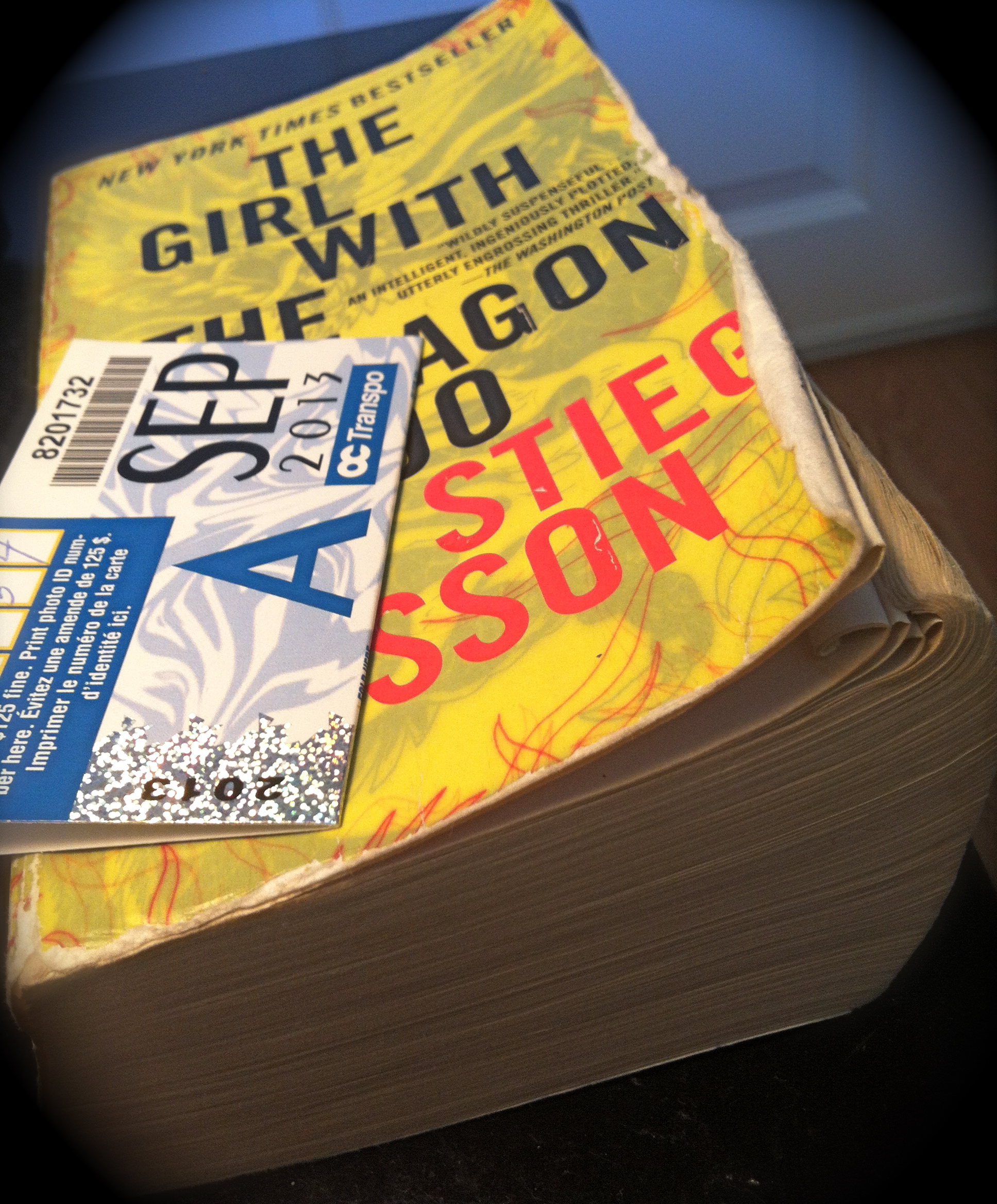
A few weeks ago I needed another book for my commute to downtown Ottawa, so, in a typical move, I picked up a tattered copy of The Girl with the Dragon Tattoo from the Thrift Store.

On my way home from work the other day I was reading my new-old book on a bench while waiting for a transfer bus. Suddenly, I was on my guard after a young man sat down too close to me on the long and otherwise vacant bench.

As buses pulled up and I glanced over to see if it was my bus, I caught glimpses of my seat neighbour. He was a teenager, maybe seventeen years old.

Suddenly he turned to me and said, “Can I ask you something?”

At this point I admit saying in my head: No, I don’t feel like making small talk because you’re bored and feel entitled to interrupt me with a comment about my appearance. No, I don’t care to justify the fact that I enjoy reading. No, you can’t have my phone number, little boy.

I closed my book and turned to him with a somewhat icy look in anticipation of what I thought was coming. Still, I said, “Sure.”

“On a scale of one to ten, how good is that book?”

My shoulders relaxed. As a matter of fact, I’d just been pondering how I felt about it.

I gave it a four and explained why. I watched him closely as I gave him an earful of a response, throwing out references to other guilty-pleasure thriller reads from the past few years, which he caught.

We talked a little longer about bestsellers from past years before he got on a bus that pulled up.

The chat actually improved my mood for the rest of the trip home. I interpreted this particular encounter as positive, despite my initial unease with him sitting so close.

What had I been expecting, based on my experience in similar situations? Street harassment.

No matter which city I’m in, it’s not uncommon for men and even boys I don’t know to intrude on my space and time in a way women never do. This is especially true on and around public transit in all the cities I’ve spent time in.

And I’m usually supremely annoyed by men who use what I’m reading in public as an excuse to start a conversation that quickly becomes unwelcome. In my opinion this is generally solid advice: See a Woman Reading? Leave Her Alone.

At the same time, I like people watching and I’m always interested in strangers carrying around books instead of e-readers (and why I adore the Underground New York Public Library project). My commute is more interesting when out of the corner of my eye I see someone reading an unexpected title.

This particular day, based on a combination of factors, I felt it was acceptable to be interrupted with that question; I was happy to spend a few minutes chatting about a paperback bestseller from a few years ago.

Why not celebrate interactions with strangers that make life enjoyable? That’s why I love the Street Respect Stories on the Stop Street Harassment blog. The brief conversation with a teenager at a bus stop was neutral, if not pleasant, compared to what I had braced myself for.

The relief I felt at not having to deal with harassment during my commute that day was anything but neutral, of course. It was based on my personal experiences, gendered socialization, and the power dynamics present in all street interactions.

The bottom line, though, is that it’s time for street respect to be the rule, not the exception for women reading – or doing anything – in public.

Lisane works in the non-profit communications sector and supports local anti-street harassment advocacy through Hollaback! Ottawa. In 2012, she completed a Master’s in Socio-Legal Studies at York University in Toronto, where she wrote her Major Research Paper on gender-based street harassment. She holds a B.A. in Latin American Studies and Spanish from the University of British Columbia.

Share

Filed Under: correspondents, Stories, Street Respect

USA: Hollaback! Boston Releases State of the Streets

September 30, 2013 By Correspondent

By: Delia Harrington, Massachusetts, USA, SSH Correspondent

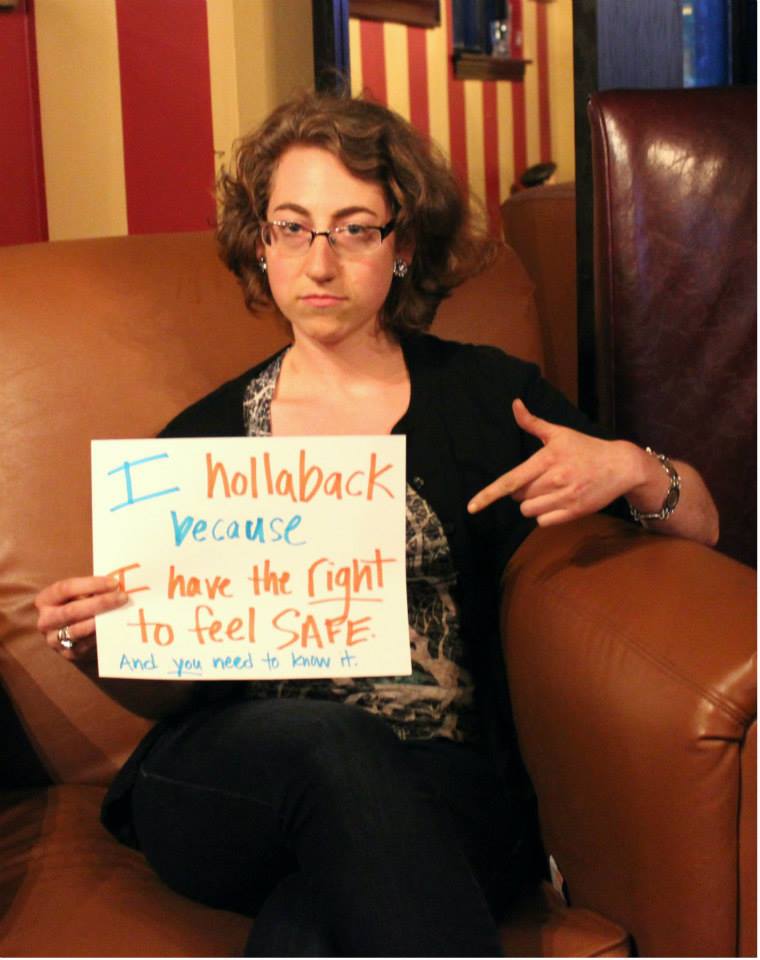
“I Hollaback because I shouldn’t ride my bike in order to avoid harassment.” – Nai

Hollaback! Boston released their State of the Streets report today, based on data collected from over 500 Bostonians during the month of August.  A startling 88% of respondents had experienced street harassment, proving that there is absolutely a place in Boston for the work of organizations like Hollaback!, Everyday Feminism, and of course Stop Street Harassment.

As readers may know, Hollaback! was co-founded in New York City by Emily May, and has since become a worldwide movement.  The organization strives to end street harassment; conducting workshops and campaigns, and empowering those affected by street harassment by gathering and sharing their stories.

The Boston chapter was co-founded by current leaders Britni de la Cretaz and Kate Ziegler in 2011.  While each branch operates autonomously, they share strategies with one another.  According to today’s Report, the Boston branch was inspired by Hollaback! Ottawa’s own fact-finding.  Similarly, some recommendations mention the successes of other Hollaback! branches.

The report details how Bostonians define harassment, where and how often they experience it, how it makes them feel, as well as recommendations moving forward from Hollaback!  According to the report, Hollaback! Boston decided to collect information not only to see the scope of the issue in Boston, but also to educate others.  While the site leaders hear stories of street harassment often, many others don’t.  As they say in the report,

“We wanted to find a way to communicate this fact to people, especially people that may not think that street harassment is really a problem or people that don’t experience street harassment themselves. We wanted to put the reality of what we face when we walk out the doors and out onto the streets of Boston in black and white.”

Respondents to the survey were overwhelmingly women (86%) and  people in the LGBTQIA community (31%).    Of those respondents, 87% were female-identified,  90% were LGBTQIA-identified, 94% identified as a person of color, 96% identified as both LGBTQIA & POC,  and 90% identified as being a person with a disAbility, reported experiencing street harassment.  This supports the notion long held among those attempting to end street harassment that POC, LGBTQIA folks and those with a disAbility experience particularly high levels of street harassment.

“I Hollaback because I have the right to feel safe. And you need to know it.” – Becca

Harassment is largely taking place on the street (97%), on the MBTA (63%),  in bars or clubs (37%),  in public parks (32%), and at  school (14%).  Not surprisingly, those respondents experiencing harassment said it made them feel angry (85%), nervous (80%) , annoyed (78%), disgusted  (72%) , and scared (64%).   And for  those who claim street harassment is enjoyable for the victim, or that it is not a big deal, only 14% of respondents said  they were ‘flattered’, and only4% said street harassment ‘didn’t bother’ them.  While the report refrained from editorializing, I’d like to note that while some respondents were flattered or not bothered, it is impossible to tell whether the person you’re seeing on the street will be nervous or flattered by the attention, so it’s best to err on the side of caution (and the numbers) and treat everyone as though they wouldn’t like it.

Like many working in this space, Hollaback! Boston sees bystander intervention as a key tool to combat street harassment.  Unfortunately, only 14% of respondents reported an instance of someone intervening on their behalf.   As a result, Hollaback! suggests the, “creation of a public education campaign that focuses on tangible ways that people can safely intervene.”

The data is likely unsurprising to readers of this site and fans of Hollaback’s work, but it is incredibly valuable to have hard statistics to show to potential partners moving forward.  For example, given that 63% of respondents reported feeling harassed on the MBTA, the report’s suggestion of an ad campaign (similar to that created by Hollaback! Philadelphia and run on SEPTA trains), training for MBTA employees on how to respond to street harassment, and an awareness campaign (à la “See Something, Say Something”) about available reporting mechanisms may all be seen as higher priorities by MBTA officials.  Moreover, while Hollaback! makes several suggestions moving forward, they are all constructive and include next steps for themselves as an organization.  Hopefully this approach will continue to be successful as they use their model of presenting a problem and a potential solution that includes their assistance at the same time.

I hope that other Hollaback! branches and similar organizations are able to conduct a similar survey in the future, so other cities can wield statistics that accurately reflect the unique picture of street harassment in their area.  I hope Hollaback! Boston continues to receive good local press coverage, which could pressure businesses and city officials to prioritize street harassment.  Congratulations to Hollaback! Boston, and we look forward to the implementation of the recommendations.

Delia Harrington is a recent graduate of Northeastern University and calls Boston home. In recent years, she has found herself studying, working, and volunteering in Egypt, Cuba, France, Benin, the Dominican Republic, Turkey, Germany, and Greece.  You can read more of her writing on her blog, or follow her on Facebook and Twitter, @deliamary.

Share

Filed Under: correspondents, News stories, Resources, Stories

« Previous Page
Next Page »

Share Your Story

Share your street harassment story for the blog. Donate Now
From the Blog

  • #MeToo 2024 Study Released Today
  • Join International Anti-Street Harassment Week 2022
  • Giving Tuesday – Fund the Hotline
  • Thank You – International Anti-Street Harassment Week 2021
  • Share Your Story – Safecity and Catcalls Collaboration

Buy the Book

  • Contact
  • Events
  • Join Us
  • Donate
  • Facebook
  • Instagram
  • Pinterest
  • Tumblr
  • Twitter
  • YouTube

Copyright © 2026 Stop Street Harassment · Website Design by Sarah Marie Lacy