• About Us
    • What Is Street Harassment?
    • Why Stopping Street Harassment Matters
    • Meet the Team
      • Board of Directors
      • Past Board Members
    • In The Media
  • Our Work
    • National Street Harassment Hotline
    • International Anti-Street Harassment Week
    • Blog Correspondents
      • Past SSH Correspondents
    • Safe Public Spaces Mentoring Program
    • Publications
    • National Studies
    • Campaigns against Companies
    • Washington, D.C. Activism
  • Our Books
  • Donate
  • Store

Stop Street Harassment

Making Public Spaces Safe and Welcoming

  • Facebook
  • Instagram
  • Pinterest
  • Tumblr
  • Twitter
  • YouTube
  • Home
  • Blog
    • Harassment Stories
    • Blog Correspondents
    • Street Respect Stories
  • Help & Advice
    • National Street Harassment Hotline
    • Dealing With Harassers
      • Assertive Responses
      • Reporting Harassers
      • Bystander Responses
      • Creative Responses
    • What to Do Before or After Harassment
    • Street Harassment and the Law
  • Resources
    • Definitions
    • Statistics
    • Articles & Books
    • Anti-Harassment Groups & Campaigns
    • Male Allies
      • Educating Boys & Men
      • How to Talk to Women
      • Bystander Tips
    • Video Clips
    • Images & Flyers
  • Take Community Action
  • Contact

That Time We Spoke About Street Harassment on the Nicaraguan Radio

April 21, 2016 By HKearl

Cross-posted from The Vulnerable Traveler with permission from the author Char J. Stoever.

Last week, I walked to the Women’s Collective of Matagalpa, which I’ve been to multiple times for their spontaneous theater shows. The collective has a theater program, health and education outreach, and a radio station.

April is Sexual Assault Awareness month. April 10-16 is International Anti-Street Harassment Week, so I thought I’d see if the collective was having an event to raise awareness. I’d just written about kick-ass organizations in Egypt, Mexico, the U.S., and India fighting against street harassment, so I thought I’d ask.

I asked Machú, a woman who works there and documents all of the spontaneous theater shows. “No, we haven’t planned anything, but maybe you could talk to Argentina. She’s running the radio program right now since Leo is in Europe on the theater tour.”

Fanny, one of my the most expressive, lively actresses, happened to be there and listened in. She said hello to me with the typical kiss on the cheek and jokingly said, “Hi, Charlotte-I mean, Charleen!” because it took her a while to get my name right. We giggled, then she walked me over to the radio station, where I spoke with Argentina about my spontaneous question-turned-project.

“We don’t have anything planned to raise awareness, but street harassment happens every day, not just one week of the year. I can reserve a slot for you to come chat at 8 AM on Monday if you’d like. It would be good if you brought a friend who is from here.” I agreed that it would be important for a Nicaraguan woman to talk about it, so I called my friend Rosa right away. She agreed to send her daughter, Amy, whose quinceañera (15th birthday party) my mom and I attended last Christmas Eve.

Fanny’s son, Marlon, was also there, and I asked if he could come. He agreed because street harassment affects everyone, not just women. In November 2015, Gerardo Cruz was stabbed and killed in San José, Costa Rica after he caught a perverted man following a woman from behind and filming up her skirt. The video went viral, but he lost his life for speaking against street harassment.

https://www.youtube.com/watch?v=MbYxRwqNIoA

Street harassment affects everyone. It’s so important to talk to boys as well as girls about actions that dismantle gender equity. These kinds of workshops will be done at Peace Corps Camp CHACA for boys in Nicaragua this July.

Street harassment also hurts economies. I often wonder how much more tourism dollars a country’s people could earn if women weren’t afraid of traveling because of feeling uncomfortable in public. I’ve decided against traveling down the street or to different countries because I don’t want to be hissed at or groped in public.

On Monday, I walked with Amy to The Collective. “Are you nervous to be on the radio?” I asked her. “No,” she said. “Well, I am! I’m glad you’re not nervous. What you’re doing is so important because many people don’t have a chance to share their opinions and to be heard. I’m nervous, but excited” I replied. I’d been on the radio before in Ecuador when I went with La Poderosa Media Project in 2011, but that time, I just spoke about who I was and where I was from. This time, it would be a more meaningful topic that I’d hoped would begin more much-needed conversations about unintentional (and intentional) gender oppression.

Amy and I got to the station and arrived before Argentina did. I don’t know about Amy, but I was squirming in my seat! In order to kill time, we chatted about her experiences with harassment.

https://www.instagram.com/p/BEW5jelMZfF/

Then, it was time to start once Argentina and Meyling arrived. We introduced ourselves and Argentina began the interview. She talked about how street harassment is becoming a more violent issue. The older men she’s talked to say that back in the day, they used to “seduce” women in the street by saying “sweet” things to them (las enamoraban), but never being disrespectful to them. Now, men are being more and more vulgar, forward, and disrespectful. With that background knowledge about the history of cat calling, we began.

Argentina (our host): How does street harassment make you feel?

Meyling: If you walk down into the city, and on the way down, you hear ten cat calls, then on the way back up, you’ll hear them ten times again. It’s exhausting for women to feel like they are constantly being objectified, or worse, groped. If men yell vulgarities at me, like “hey mamacita, you look delicious today,” then I tell them that what they’re doing is punishable by the Ley 779, and that I have the right to report them to the police. Once, a man in the street threatened to beat me up because I didn’t like him! He tried hugging me to feel my chest, but I had to use a self-defense move I learned in a jiu jitsu class on him.”

Meyling ended up thrusting her palm against his chin, causing him to fall back as she ran away.

Me: When men cat call me a “delicious white woman” in the street, I feel uncomfortable and objectified. I’m not a coconut popsicle! (The women in the room covered their mouths and laughed at this one) I’m not a food. I’m not an object. I’m a person. It’s interesting to point out that back in the day, men talking to women in the street was seen as a civilized, polite affair. Enamoraban a las mujeres (They seduced women).

“Enamorar” has the most positive connotation. Then, it was and is called “cat-calling”, or tirar piropos. We cannot see it as this innocent act any more. It’s violent, it’s unsolicited, and so we need to call it what it is: street harassment.

Amy explained that she’s experienced street harassment for as long as she could remember, and she brought up the important issue of child raising. By sharing her experience about her father trying to get her brother to talk to women as a boy, she made it clear that we need to think about how we raise our children. We need to teach our children how to be respectful to others.

https://www.instagram.com/p/BEW95gQsZVq/?taken-by=vulnerabletraveler

Break time rolled along. My Nicaraguan counterpart teacher, Claudia, tapped on the door and came in a bit late because she’d gotten lost. Claudia and I are runners, so we both know what it’s like to have our workout routines disrupted by harassment. I was assaulted on a run last year because I wore headphones to avoid harassment, and my attacker thought I had a shiny iphone in my pocket, but I didn’t. I simply wore headphones to trick men into thinking I couldn’t hear them, but I still experienced physical violence. I’ve mostly recovered from it, as I ran a 10k later, but it’s undeniable that street harassment has shaped my experience here.

https://www.instagram.com/p/BEXERJ9sZQX/

Claudia goes running at 5 AM to avoid the crowds. Once, on a run, a man began to take of his clothes and masturbated in front of her. She threatened to report him if he ever did that again, but the next day, she was too shaken up to go running.

https://www.instagram.com/p/BEW8gGDMZTq/

After Claudia shared, Argentina asked our listeners whether they thought cat-calls were innocent compliments or harassment. No one called in to participate, but oh well- the five of us had more than enough to say! We moved on to talking about how women dress. No matter how you dress, you’ll get attention. Harassers seem to think that women dress in order to please the men, not themselves.

“I’m a lesbian, so I’m not attracted to men,” I shared. “If I wear shorts it’s because it’s hot outside and I want to avoid sweating profusely (It’s always in the 80s and humid around here). I don’t wear shorts to please men.”

I almost didn’t come to Nicaragua because I was afraid of having to be in the closet, but here I was, coming out on the radio!

Before we knew it, it was 9 AM. We wrapped it up, and I gave a shout out to Amy’s mom, Rosa, for sending her brave daughter along to chat about street harassment. We’d all been pretty nervous to be on the air, but as the show progressed, we ended up laughing, giggling, and nodding our heads at one another.

We didn’t feel alone that morning, and I’m sure our listeners didn’t either. By having conversations like these about the misconceptions and effects of street harassment, maybe someday we’ll put an end to it.

Amy was such a boss that Argentina asked for her contact info to come back for another show!

Have you experienced street harassment? If not, do you know someone who has? How has it affected you or them?

Share

Filed Under: anti-street harassment week, street harassment Tagged With: Nicaragua

“Realize that catcalling women won’t benefit them”

April 20, 2016 By Contributor

I’m a first year college student and the apartment I’m currently living in is near a construction site (actually it’s a house that’s being renovated). Ever since the construction began, I feel uneasy and unsafe when walking on our street because there are a few men who stare at me and sometimes make kiss sounds or whistle or make any noise.

I just ignore them.

But there’s this instance when a large group of men were laughing and calling me a girlfriend of one of their members. I felt so angry I thought I would shout at them or curse at them, but I just walked away and ignored them. But as I arrived at my apartment, I realized that this has to stop. I have to stop this.

I know I’m not the only one experiencing this. There are a lot of us feeling angry, sad, unsafe, and threatened. I have decided and promised to myself that if they won’t stop, I will tell the authorities and probably make them leave the area even if that means that they will lose their job. I don’t care. They should know and feel the consequence of their actions.

It’s time for them to feel sorry for what they do and maybe realize that catcalling women won’t benefit them.

Optional: What’s one way you think we can make public places safer for everyone?

I think it’s time to have a kind of government who will actually address this kind of situation. It should be part of the law. This act should be punishable. It’s time to make catcallers feel scared and guilty.

– I

Location: Philippines

Share your street harassment story for the blog.
See the book 50 Stories about Stopping Street Harassers for more idea
.

Share

Filed Under: Stories, street harassment

“I heard him say all kinds of perverted things”

April 20, 2016 By Contributor

It was early in the night, I was minding my own business, riding my bike home (with my body entirely covered, not that it matters), when one of the guards in my neighbourhood saw me pass by his side. I was about to wave/nod at him since I’ve “known” him for years when I heard him say all kinds of perverted things at me, plus give a very dirty and unnerving look.

I turned around and kept my speed as I looked at him with an appalling look on my face so that he saw who I was (one of the people who pay him for making sure streets are safe, ironically).

I’d been greeting him with a smile on my face for two years and now I avoid walking past that block since I feel so ashamed for what he did and… he’s still there!

This is only one case out of an uncountable amount of harassment I cope with on a daily basis, which is very consuming of my time and energy and comes from both familiar and unfamiliar faces around where I live (which is a highly-regarded neighbourhood by the society…)

Optional: Do you have any suggestions for dealing with harassers and/or ending street harassment in general?

Unfortunately, due to the amount of insecurity in the streets of Buenos Aires, I’ve been told by professionals to keep minding my own business so as to preserve my physical safety. I don’t know how to react anymore, which has negative effects on my mental health

– Anonymous

Location: Buenos Aires, Argentina

Share your street harassment story for the blog.
See the book 50 Stories about Stopping Street Harassers for more idea
.

Share

Filed Under: Stories, street harassment

“These particular occurrences stuck with me’

April 19, 2016 By Contributor

I have two distinct separate stories that stood out to me more than all the other incidents of harassment that I’ve dealt with.

The first one happened around the end of July of last year. I was walking to the shop on my dinner break from work whilst on my phone (literally tending to my own business) and this, I would say, 20 y/o guy in a car drove to a traffic light ignorantly playing his music way too loudly. I turned to look at the commotion briefly and then looked back at my phone. The next minute I heard the loudest wolf whistle at my direction (apart from a few maybe 10 y/o boys running past me and an old couple sat on a bench I was the only one there so I knew it was directed at me), I looked back at the guy with a blank expression, clearly with lack of interest and again tended to my own business.

The second story occurred quite recently. I was in Ibiza and stood in the terminal of an airport waiting to board my plane back to the UK and I was looking at nothing in particular when I glanced at this guy who was looking at me. I looked away thinking we had just awkwardly made eye contact and left it at that, five minutes later I caught the guy again, just looking me, and he made absolutely no effort to look away and he continued to just gawk at me for a good and heavy thirty to forty minutes or so. It just baffled me as to how, according to him, it was completely okay to just f*****g look at me up and down with a small grin, like as if he was enjoying it.

I know these stories aren’t that big of a deal compared to other bigger harassment incidents that happen, but these particular occurrences stuck with me more for whatever reason.

– Anonymous

Location: UK and Ibiza airport

Share your street harassment story for the blog.
See the book 50 Stories about Stopping Street Harassers for more idea
.

Share

Filed Under: Stories, street harassment

Pervical Beer Company Jokes about Street Harassment

April 18, 2016 By Contributor

By Britni de la Cretaz

No matter how many times women and other marginalized folks make the point that street harassment isn’t a joke, it seems that advertisers aren’t getting the message. Last week, a new local brewing company out of Boston, Massachusetts, aired their very first TV spot. It ran during the Red Sox game and, unfortunately, it was problematic.

The commercial begins with a woman walking into a liquor store, the camera (and the store clerk’s eyes) lingering on her butt. She buys two six packs of Percival Beer Company’s beer and walks home, being subjected to catcalls like, “Hey, let me get some of that!” on her way. When she gets home, she tells her male partner that she’s never doing that again due to the harassment she received. The ad then cuts to her partner buying the same beer and facing the same catcalls on his walk home, presumably for a laugh.

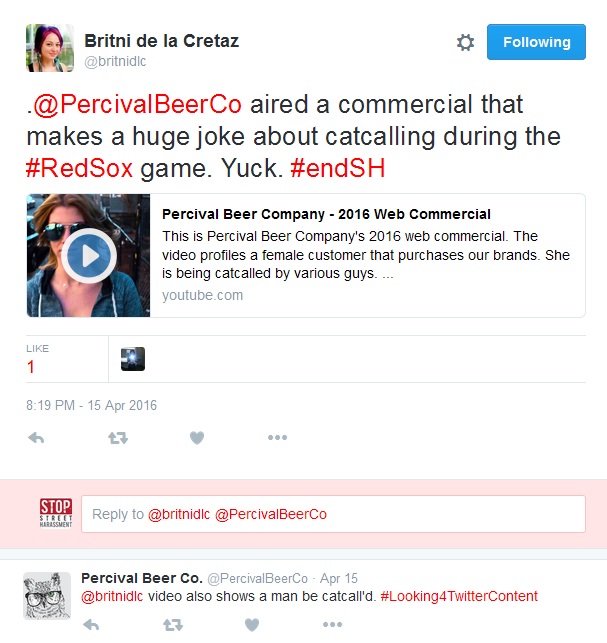
When I tweeted at the company about the ad, they at first tried to explain away why the ad was OK, telling me that the “video also shows a man being catcalled.”

BritniPercivalBeer2


BritniPercivalBeer

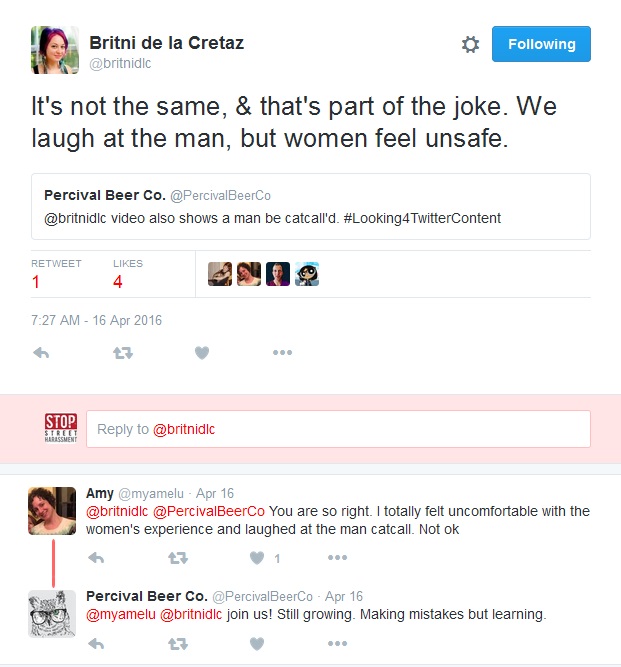
But as I (and another Twitter user) pointed out to them, men and women being catcalled are not comparable.

The thing is, when a woman is catcalled by a man, there is a power differential that doesn’t exist when a man is harassed by that same man. When women are harassed by men on the street, we legitimately fear for our safety. Often times, that harassment escalates into physical violence. Even if the woman is being catcalled about the beer and not her body, the intentions don’t change the impact of those comments. For a woman walking through public space, we don’t recognize the difference. What we hear is unsolicited commentary directed our way from men we don’t know. And this isn’t a funny hypothetical for us; it’s a reality that women and other marginalized people face on a daily basis when they walk down the street.

So while we can laugh at the man being catcalled, that’s an indication of the male privilege (and homophobia)  inherent in that interaction. He has the privilege to be taken aback and walk on from the harassment because it’s not seen as threatening to him, whereas, even in the commercial, his female partner makes it clear that the same interactions made her feel unsafe.

To their credit, when faced with two women who were unhappy with their commercial, Pervical Beer Company responded that they are “still growing. Making mistakes but learning.” But these kinds of mistakes don’t need to happen. These kinds of mistakes happen when there are no women at the table to say, “Hey, this isn’t actually a good idea.” Mistakes like this are an indication that companies need to diversify their staff behind the scenes so that things like this don’t happen in the first place.

It’s even more disheartening that this ad is airing during Red Sox games, as the last people that need to have the idea that street harassment is a joke reinforced is the largely male audience that watches sporting events. Intentional or not, this commercial is harmful.

We need our advertisers to do better than this if we ever hope to end violence against marginalized folks in public space. So advertisers, the next time you think you want to make a joke about street harassment, I have some advice for you: don’t.

Britni de la Cretaz is a freelance writer, feminist parent, and Red Sox enthusiast living in Boston. She has been organizing against street harassment locally since 2011. Follow her on Twitter at @britnidlc.

Share

Filed Under: street harassment Tagged With: beer commercial, Boston, catcalling joke, offensive ad

« Previous Page
Next Page »

Share Your Story

Share your street harassment story for the blog. Donate Now

From the Blog

  • #MeToo 2024 Study Released Today
  • Join International Anti-Street Harassment Week 2022
  • Giving Tuesday – Fund the Hotline
  • Thank You – International Anti-Street Harassment Week 2021
  • Share Your Story – Safecity and Catcalls Collaboration

Buy the Book

  • Contact
  • Events
  • Join Us
  • Donate
  • Facebook
  • Instagram
  • Pinterest
  • Tumblr
  • Twitter
  • YouTube

Copyright © 2026 Stop Street Harassment · Website Design by Sarah Marie Lacy