• About Us
    • What Is Street Harassment?
    • Why Stopping Street Harassment Matters
    • Meet the Team
      • Board of Directors
      • Past Board Members
    • In The Media
  • Our Work
    • National Street Harassment Hotline
    • International Anti-Street Harassment Week
    • Blog Correspondents
      • Past SSH Correspondents
    • Safe Public Spaces Mentoring Program
    • Publications
    • National Studies
    • Campaigns against Companies
    • Washington, D.C. Activism
  • Our Books
  • Donate
  • Store

Stop Street Harassment

Making Public Spaces Safe and Welcoming

  • Facebook
  • Instagram
  • Pinterest
  • Tumblr
  • Twitter
  • YouTube
  • Home
  • Blog
    • Harassment Stories
    • Blog Correspondents
    • Street Respect Stories
  • Help & Advice
    • National Street Harassment Hotline
    • Dealing With Harassers
      • Assertive Responses
      • Reporting Harassers
      • Bystander Responses
      • Creative Responses
    • What to Do Before or After Harassment
    • Street Harassment and the Law
  • Resources
    • Definitions
    • Statistics
    • Articles & Books
    • Anti-Harassment Groups & Campaigns
    • Male Allies
      • Educating Boys & Men
      • How to Talk to Women
      • Bystander Tips
    • Video Clips
    • Images & Flyers
  • Take Community Action
  • Contact

“Never justify harassment”

September 16, 2015 By Contributor

It happened when I was 13 in a town bus and the guard brutally hit me. I have seen such things done by the same guard.

Optional: Do you have any suggestions for dealing with harassers and/or ending street harassment in general?

Never justify harassment and never bring up reasons but solutions.

– Anonymous

Share your street harassment story for the blog.
See the book 50 Stories about Stopping Street Harassers for more idea
.

Share

Filed Under: Stories, street harassment

“No one on the street said anything”

September 15, 2015 By Contributor

I was walking two blocks home from the grocery store and a guy rides past me on his bicycle and slaps my ass. All I could think to yell was “Get the f**k out of here!”

No one on the street said anything.

– Anonymous

Location: 16th and East Colfax, Denver, CO

Share your street harassment story for the blog.
See the book 50 Stories about Stopping Street Harassers for more idea
.

Share

Filed Under: Stories, street harassment

“I was walking home from school”

September 15, 2015 By Contributor

I was walking home from school and some guys drove past me and yelled, “Damn girl, nice butt!” I was confused as this has never happened before. People don’t tend to notice me. So I continued walking as the guys in the car drove away.

Optional: What’s one way you think we can make public places safer for everyone?

By having people who are witnessing it, help out in defending the victim.

– Anonymous

Location: Colorado

Share your street harassment story for the blog.
See the book 50 Stories about Stopping Street Harassers for more idea
.

Share

Filed Under: Stories, street harassment

Croatia: “Raise Your Voice!”

September 14, 2015 By Correspondent

Marinella Matejcic, Croatia, SSH Blog Correspondent

One time I was going home from a club in Zagreb, a capital of Croatia, with a couple of friends. Two guys stopped us, asked us for directions, and when we continued our way, one of them slapped me on my behind. As I was the unfortunate one to be addressed in such an obnoxious way, I returned to them and asked them politely who did it, told the perpetrator to take off his motorcycle helmet – and slapped his face pretty hard. Sure, there is no need to answer violence by perpetuating violence, but something just snapped and I was beyond irritated. And I was lucky: nothing serious happened after this incident. That guy just asked us out, we, naturally, declined and that’s it.

But I’ve rejected being the object and the victim.

Downtown Zagreb, image via enviropau.wordpress

According to the research conducted by Hollaback Croatia in 2012, as much as 70 – 90% of women have experienced some form of a verbal encounter from a stranger in public space at least once in their lifetime. The harassment ranged from swearing to comments about their appearance. A fair percentage of women have been flashed, have seen public masturbation, been groped or followed. Every third woman was physically attacked at least once in her lifetime. Every second woman in Croatia will experience some form of street harassment by the age of 18.

Since street harassment is so hard to itemize, there are no official data, just this research done by the Hollaback Croatia initiative. The thing with this research is that most of the women who participated in it are living in the biggest city in Croatia, where is it somehow expected for this to happen. It’s not justified, it’s just expected. If there was any research conducted on the national level, the results would provide a better picture.

Just to be sure about the lack of institutional statistics on the subject, for the sole purpose of this blog post, I contacted the Croatian Ministry of the Interior, asking them if there are any data that could be used. They responded surprisingly quickly, asking me for the clarification of the query. They didn’t know what I meant by the term “street harassment”. The whole situation gets even more absurd when you realise that Croatia basically has the legal frame that puts (sexual) harassment in the penalty code.

When being harassed, most women just stay passive, ignore it or try to move away. It is this society that we’re brought up in, that’s something we learn to do: if you’re a woman (or any member of the LGBTIQ community) you’re not allowed to raise your voice, to fight back. If you’re witnessing that kind of event and not doing anything about it, you’re helping the perpetrator. That’s something most of us are very aware of while debating or chitchatting but have you ever actually stood up and stopped the harasser from harassing?

The fact that in most cases street harassment does not include “more” than “just words” is just not enough to justify it. Not in any community. That’s not the matter of culture, but patriarchy and male domination. We shouldn’t just let it be. We have to act. Stand up. As with any other form of violence, it is never the victim’s fault. Don’t judge, act (but think on your own safety). Raise your voice!

Marinella is a freelance journalist/writer, feminist activist, and soon-to-be administrative law student. She writes for Croatian portal on gender, sex and democracy called Libela.org and covers CEE stories for globalvoicesonline.org. Follow her on Twitter @mmatejci.

Share

Filed Under: correspondents, Stories, street harassment

USA: Hey Baby! Unhinged

September 11, 2015 By Correspondent

Hannah Rose Johnson, Tucson, AZ, USA, SSH Blog Correspondent

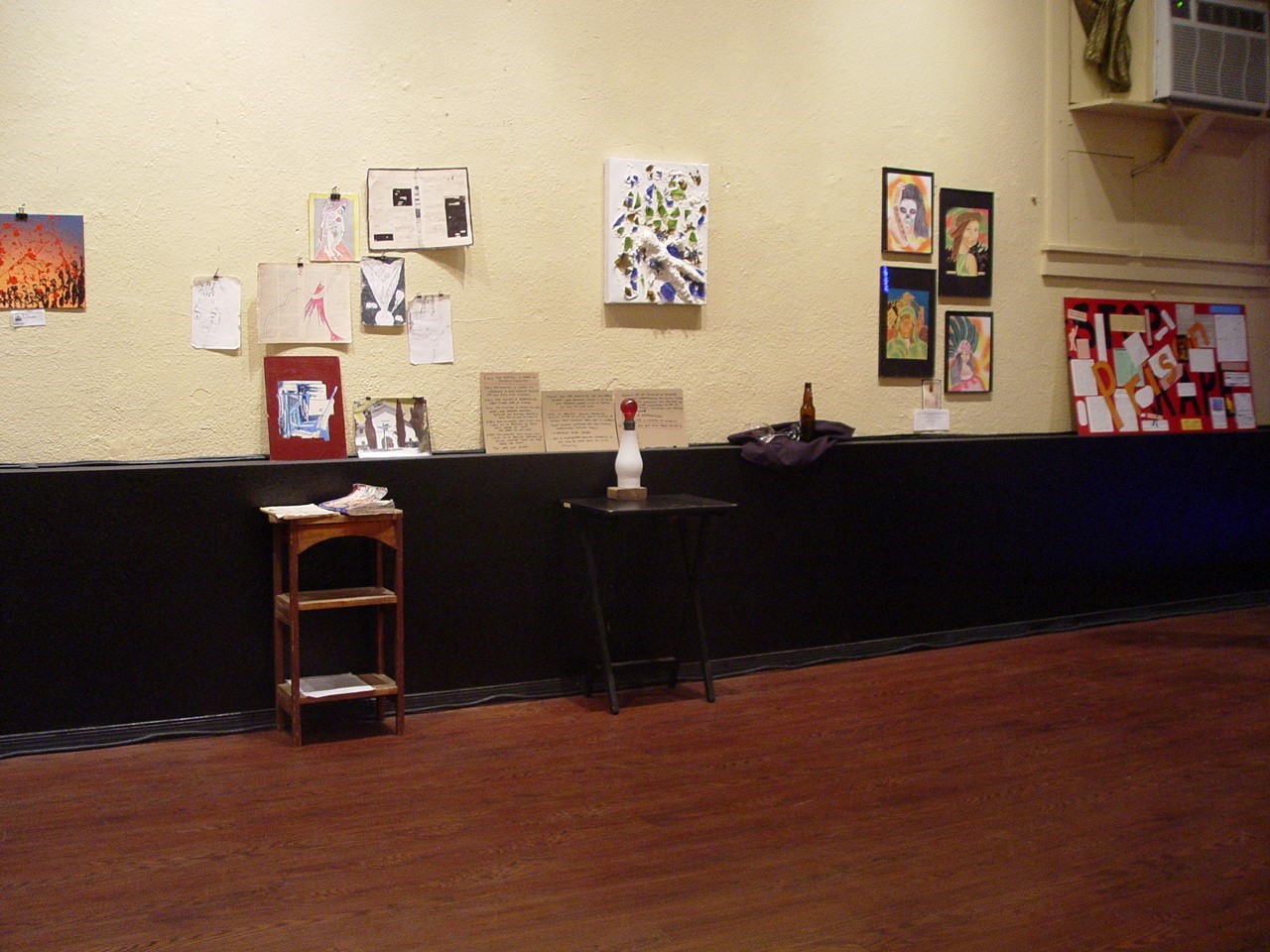
Hey Baby! Art Against Sexual Violence is an exhibition series that uses art as a vehicle and tool to end street harassment and sexual violence. After participating in this year’s shows, in April and May, I wanted to know more about this art movement. I wanted to know more about the people I passed in my office hallway, who I breezed by on 4th Avenue, who were doing this work. I wanted to piece together a genealogy. So I sat down with Wendy Sampson, an organizer who originally brought Hey Baby! to Tucson, and Manuel Abril, a current Hey Baby! organizer (and SSH board member).

Hey Baby! Art Against Sexual Violence show 2015.

This is what I learned: (it’s not linear and it’s not a history).

Rewind to 2010. Hey Baby! was a copycat of an event that happened in North Carolina, which Sampson’s friend suggested they organize in Tucson. Sampson said, “The one in North Carolina was a one-time event and we just planned a one-time event as well. We were like oh, this was a good idea, we should do it here.”

Sampson presented a really interesting analysis on the relationship between street harassment and intimate partner violence. She said that complacency with a culture of street harassment infiltrates our relationships with each other. That if we are willing to treat one another like shit on the street, we are willing to behave like that in intimate settings. But she also said people can more easily rally around street harassment; that “people have a tangible reaction [to street harassment] and are steady in that reaction than intimate partner violence, which is messier and complicated and drains you in a different way.”

Putting on Hey Baby! provided a break amidst the emotional exhaustion of the intimate partner violence work that she was doing. Sampson said, “I remember being excited about the art we had. I remember feeling that ANGER, that can get drown out through exhaustion, and to share it with other people was really rejuvenating.”

No one knew that it would get taken up again by other activists or be institutionally grant funded for a while, and eventually come out again on its own, unhinged. After Wendy organized the event she left Arizona. For four years. She admitted that she didn’t remember much about the actual event because she was so exhausted from the accountability processes. Though she did say, “I remember putting art up…I remember someone doing poetry…there was a lot of art being laid out and a lot of things people could take home, like posters…”

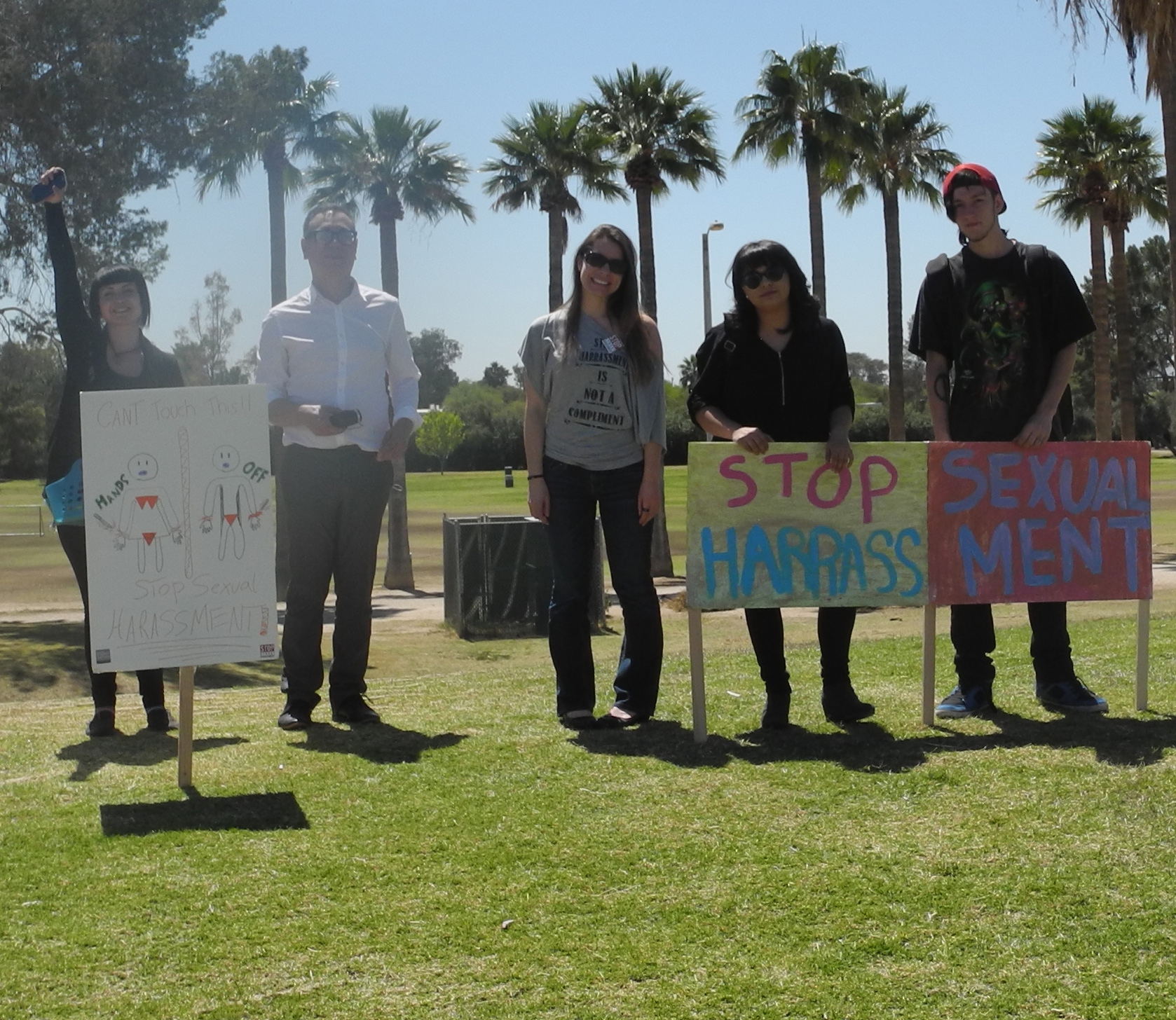
2014 Hey Baby art in Tucson
2014 Hey Baby art in Tucson (Abril is two in from the left)

I asked Abril to fill in the gaps. What he said about the ebb and flow of transitions actually isn’t the most relevant. We’re talking about a genealogy here, a series of connections that produces something that may mean something else depending on the timing and environment. And Hey Baby! got taken up with organizers, non-profits, and sexual violence prevention educators at different times and places.

What he did say that I thought was interesting was about the show this year: “We wanted to recapture the feeling of connecting with a kind of playfulness where we didn’t feel suffocated by everything that could go wrong.” The kind of wrong that comes from building a complex analysis that isn’t easily palatable.

Messiness.

Abril said that before inviting people to participate this year, “We told ourselves that we are going to f**k up and that’s going to be a part of our process…we wanted stuff that was messy and that didn’t have a predictable outcome in terms of how people were going to receive it…. And a lot of came from that…[artists and organizers] felt relieved not having to tell people what we already knew. Like depart from the place where we know rape culture exists, and pull in the other things, conditions that we live in that are socially or institutionally imposed. And try to make connections to those.”

Organizing against street-harassment is complex because when we examine the conditions of sexual violence we enter a multi-dimensional zone. Hey Baby! Art Against Sexual Violence brought together art as resistance, art as distance, and as a creative strategizing tool. We wrote, painted, collaged, sculpted and performed new narratives that exposed the intricacies from where sexual violence departs from and seeps into. Pieces that examined street harassment, catcalling, rape, date-rape, partner violence, state-violence, mental illness, incarceration, abuse within activist communities, victim-blaming, and challenging perfect-victim narratives.

After talking with Sampson and Abril, I had more questions. Curiosities about anti-street harassment movements, art as activism, and where are these people in North Carolina who organized the first event? [Editor’s note: My 2010 book on street harassment features the North Carolina event!]

I had some more tracking down to do.

For more information about Hey Baby! Check out www.facebook.com/HeyBaby.Art or www.heybabyart.tumblr.com

Hannah Rose is writing from Tucson, Arizona and Lewiston, Maine (US) as she transitions from the Southwest to the Northeast for a career in sexual violence prevention and advocacy at the college level.  You can check her out on the collaborative artistic poetic sound project HotBox Utopia.

Share

Filed Under: Activist Interviews, correspondents, street harassment

« Previous Page
Next Page »

Share Your Story

Share your street harassment story for the blog. Donate Now

From the Blog

  • #MeToo 2024 Study Released Today
  • Join International Anti-Street Harassment Week 2022
  • Giving Tuesday – Fund the Hotline
  • Thank You – International Anti-Street Harassment Week 2021
  • Share Your Story – Safecity and Catcalls Collaboration

Buy the Book

  • Contact
  • Events
  • Join Us
  • Donate
  • Facebook
  • Instagram
  • Pinterest
  • Tumblr
  • Twitter
  • YouTube

Copyright © 2026 Stop Street Harassment · Website Design by Sarah Marie Lacy