• About Us
    • What Is Street Harassment?
    • Why Stopping Street Harassment Matters
    • Meet the Team
      • Board of Directors
      • Past Board Members
    • In The Media
  • Our Work
    • National Street Harassment Hotline
    • International Anti-Street Harassment Week
    • Blog Correspondents
      • Past SSH Correspondents
    • Safe Public Spaces Mentoring Program
    • Publications
    • National Studies
    • Campaigns against Companies
    • Washington, D.C. Activism
  • Our Books
  • Donate
  • Store

Stop Street Harassment

Making Public Spaces Safe and Welcoming

  • Facebook
  • Instagram
  • Pinterest
  • Tumblr
  • Twitter
  • YouTube
  • Home
  • Blog
    • Harassment Stories
    • Blog Correspondents
    • Street Respect Stories
  • Help & Advice
    • National Street Harassment Hotline
    • Dealing With Harassers
      • Assertive Responses
      • Reporting Harassers
      • Bystander Responses
      • Creative Responses
    • What to Do Before or After Harassment
    • Street Harassment and the Law
  • Resources
    • Definitions
    • Statistics
    • Articles & Books
    • Anti-Harassment Groups & Campaigns
    • Male Allies
      • Educating Boys & Men
      • How to Talk to Women
      • Bystander Tips
    • Video Clips
    • Images & Flyers
  • Take Community Action
  • Contact

“It’s disrespectful and inappropriate”

September 11, 2015 By Contributor

I was on a college campus and parked at the parking garage near the library. The area isn’t the best on campus, but I had never felt unsafe before, and besides, it was the middle of the afternoon when I went.

Anyway, I parked, and as I was walking out of the parking garage, some guy called from his truck, “You walk by me too quick, hon!” I never saw him because I just kept walking and pretended I hadn’t heard him, but I felt my face flush and my heart beat faster with a little fear. This was the first time I had ever been catcalled or street harassed, and I just felt like I was in danger.

A guy that is willing to call out to you might be willing to do other things, you know? A week after this happened, there was a news story about someone who was raped in that area. I just wish that people could walk through public places and feel safe from the threat of verbal, physical, or sexual assault. It’s disrespectful and inappropriate. I want someone to find me attractive, but it should be someone I know and care about, not some random guy in a parking garage.

Optional: What’s one way you think we can make public places safer for everyone?

Around campus we have police boxes that have buttons that connect the speakers to 911. I think that these would be valuable to have in many places, especially secluded public spaces like parking garages. We also have an safety escort service, which has two people pick you up and take you home if you want. This too would be a great idea for off campus as well. Obviously we can’t forcibly keep people from calling out lewd things, but we can put safety precautions in place to help potential victims take control of the situation.

– Anonymous

Location: Indiana, USA

Share your street harassment story for the blog.
See the book 50 Stories about Stopping Street Harassers for more idea

Share

Filed Under: Stories, street harassment

New Anti-Harassment Cards

September 10, 2015 By HKearl

Girl World Chicago‘s Red Cards are available for download (pictured are two examples).

“With six different options, you can use these double-sided cards to respond to your harasser and let them know what they did is NOT OKAY; or give the “All The Fed Up Ladies” card in solidarity next time you see someone experience harassment.”

your compliments are creepy card to hand to harassersStop & Think: you are disrespecting me card to hand to a harasser


Share

Filed Under: Resources, street harassment

New Legislation for Safe Access Zones in Melbourne

September 10, 2015 By HKearl

Victoria (Australia) Parliament Member Fiona Patten’s office reached out to me about a new initiative relating to street harassment (read about what Patten did in April). Her Senior Electorate Officer Nevena Spirovska told me:

“In Melbourne, and around the world, women seeking fertility treatments are often harassed as they try to access services that are legally performed at the clinics. The street harassment can take the form of verbal abuse, blocking entrance to the clinic, praying or attempting to offer “curb-side counselling” to women, their families and workers – in one instance, a security officer at a Melbourne fertility clinic was shot dead by a religious fanatic.

Fiona Patten has now introduced a Bill in Victorian Parliament that will create a Safe Access Zones of 150m around fertility clinics. Protestors can still be present and have the freedom to assemble, just as long as they do not enter the Safe Access Area [or buffer zones].”

You can read more in this article.

This is an important and under-discussed form of street harassment (our blog correspondents have written about it in the USA and the UK) and I hope she is successful in getting the bill passed!

Share

Filed Under: street harassment Tagged With: Australia, reproductive rights

USA: “It’s Okay To Be Angry”

September 10, 2015 By Correspondent

Maryah Converse, New York, USA, SSH Blog Correspondent

“Do you think that women can be their own worst enemies? When they act as if the harassment were a compliment, or don’t speak up. Aren’t you your own worst enemies?” asked a man in the audience after a performance of #SpeakUp: The Street Harassment Play.

I did not just assume his good intentions, as Flux Theater Ensemble’s “Rules of Engagement” asked us to do in the facilitated discussion after the performance. I felt his good intentions, saw it in the dismay on his face at the reactions of all the women in the circle.

I thought, how many times have I said this to myself? “You shouldn’t have walked away. You should have stood up to that man. You’re your own worst enemy, woman!”

Then I remind myself that it is a psychological defense mechanism. I cannot confront or even take seriously every incident of street harassment in my life. I would have no time or energy for anything else. And sometimes—no, often it is physically dangerous. On my computer, I have a quote by the writer Margaret Atwood: “Men are afraid that women will laugh at them. Women are afraid that men will kill them.” I hate that she is right.

Some of the others in our circle have responded to his well-intentioned but jarring question. Then Shaun Bennet Fauntleroy said, “The worst enemy is the one who makes us feel small.” It felt like the perfect note to end our discussion.

*     *     *

Bennet Fauntleroy was not just the facilitator of our discussion group. She is also the woman behind the event, #SpeakUp: The Street Harassment Plays, and wrote one of the seven short monologues in the project.

#SpeakUp, photo via Flux Theatre Ensemble's Facebook Page
#SpeakUp, photo by Isaiah Tanenbaum. Via Flux Theatre Ensemble’s Facebook Page

Each of the monologues approached harassment from the many ways that women respond, all different, all equally valid. The second piece, “Just the Way It Is” by Nicole Pandolfo, was the only male voice, and it provoked that too-common fear response. There is the trauma response of the seventh voice, “What I Would Do to You” by Maria Alexandria Beech.

The third voice, “God Bless You Mama: A Woman’s Guide to the World” by Sol Crespo, was by far the funniest. The text dripped with sarcasm, on the verge of farce, but was played absolutely straight by Holly Chou. With heartfelt innocent sincerity, she declares, “If he hadn’t reminded me to smile, I would never have known I had the ability … or the permission!” She keeps declaring with a bright smile, “Men are SO HELPFUL!”

I could not help but notice that the loudest laughter in the room came from the men. Every time I laughed, I felt guilty, because under the humor, this can be deadly serious.

The fifth voice was like a punch in the gut. I knew from the first sentence that this was the work of Lauren Ferebee, titled “Rogue Agent.” It was no surprise that my friend Lauren would want to write a theater short for a production of this kind. Another full-length play of hers, “Somewhere Safer,” is a nuanced reflection on terrorism and the wars in Afghanistan and Syria, gender, and the choices we have to make between morality and making a living.

Here in “Rogue Agent” was the anger response to harassment, raging against the machine. “I never wanted to be a woman writer,” the narrator spits out, played with the perfect low, gravelly voice by Hanna Cheek.

I asked Lauren about her piece, and she described the lack of women’s voices in the standard literary canon, saying, “To me, the silence of women artists across history is, on a structural level, related to the silence of a woman who has been called out over and over again in public. On a societal and personal level, women who live, write and work in the public space are told over and over again ‘you don’t belong here.’ I struggle with having internalized that voice telling me that I don’t belong here, and I struggle with having internalized that larger dynamic that my work doesn’t belong here.”

When I asked Lauren why she chose theater as the medium for her message, she said she wanted to tell audiences “that it’s ok to be impacted by those experiences. It’s ok to be angry. And that we should be angry, whether anyone tells us it’s ok or not.”

That is exactly what I heard in her piece in the lines, “All I ever learned about anger was to turn it into a secret … so I talk.”

Maryah works for the Unitarian Church of All Souls in New York City where she has provided particular leadership in the Racial Justice Initiative. She has an MA in Near Eastern Languages and Cultures, and was a Fellow at the Center for Arabic Study Abroad in Cairo.  Read her blog “Arabs I’ve Known.”

Share

Filed Under: correspondents, street harassment

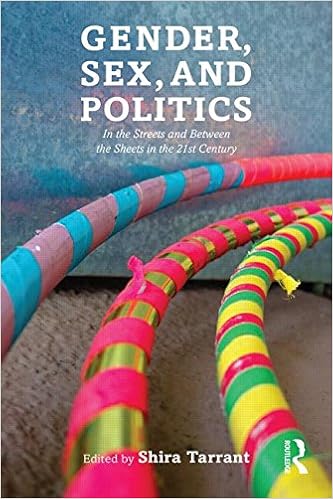
New Book: Gender, Sex, and Politics

September 9, 2015 By HKearl

Gender, Sex, and Politics book coverI met Dr. Shira Tarrant five years ago next month when she attended a book talk I gave in Pasadena, CA. I was thrilled as I’d been following and reading her work for a while and even quoted her book Men Speak Out: Views on Gender, Sex and Power in mine.

Our paths crossed again in 2013 when she participated in a focus group I held in Los Angeles as part of the national study on street harassment that Stop Street Harassment released last year.

Tarrant is so smart and writes about gender in a very accessible way. She is also a very warm, kind and approachable person and I envy the students who get to have her as their professor at California State University, Long Beach, where she is a Profess of Women’s, Gender, and Sexuality Studies!

Tarrant’s latest project was editing the newly released book Gender, Sex, and Politics: In the Streets and Between the Sheets in the 21st Century (Routledge, 2015). It contains 27 short chapters written by contributors. Tarrant opens the book by acknowledging that she doesn’t agree with every viewpoint she included – and she doesn’t expect any of the readers to agree with all of them either. Instead, it is her hope to provide “opportunities to think through various perspectives and ideas that we may take for granted or assume to be true…[and] examine our assumptions and presumptions and come to better informed understanding about the politics of sex and gender.”

After I read the book, I found that I agreed with most of the authors, but she was right, a few I had some disagreements with and would have liked the chance to discuss the points in person. I was grateful that several of the authors challenged my thinking and others significantly expanded it.

At the end of each chapter are a list of questions to prompt you to think further about the topics and issues raised and challenge your own response to it and your existing assumptions. This makes it an ideal book for a women and gender studies class, sociology class, or social change class.

The 27 chapters are divided into 5 sections and the short chapters/essays in the first section focus on the topic of gender, sexuality, and social control. Within that section were two short chapters about street harassment. In the first, Hollaback! co-founders Emily May and Samuel Carter wrote about how the Hollaback! organization grew from an idea to a movement. As a sidebar to their essay was a piece written by a former SSH Blog Correspondent Joe Samalin for SSH about the male privilege of not knowing first-hand about street harassment that he and many other men, especially straight men, enjoy.

The second short chapter is by Dr. Kimberly Fairchild and looks at how victim-blaming causes people to feel less sympathy for some assaulted and harassed women. Specifically, “women are judged to be culpable for street harassment and sexual assault because of their sexy dress.” She concludes, “The problem is that if we are apt to blame the victim then street harassment will continue to be considered typical, normal, and acceptable – despite all the negative consequences harassment entails.”

A piece in a later section that relates to street harassment is Alexandra Tweten’s short chapter “Bye Felipe: Online Harassment and Straight Dating.” On her site Bye Felipe she posts women’s submissions of sexism, hate and harassment from men they encounter in online dating and focuses on how that site came about and the main categories of posts she receives. She writes that “the cultural atmosphere that says it’s okay for hundreds of men to catcall any women in public space is part of the same continuum of misogyny that drives men to brutally injure women, as exemplified by the man in New York City who slashed a woman’s neck because she ignored him…There are clear messages in society telling men that they deserve to go on a date with women simply because the men want to and simply because they are male.”

Further, she notes that “Bye Felipe has acted like an immortalized record of catcalling, which links the harassment women see on the street to the same type of harassment they see in their own living rooms, when they are simply online… Until we change the cultural atmosphere, women will continue to receive these hurtful messages online and in real life.”

One of my favorite writers is Soraya Chemaly and she wrote a short chapter called “Slut-Shaming and the Sex Police: Social Media, Sex, and Free Speech.” In it she discusses how like a public street, women on the Internet have to regularly fight for control over their “self-defined image and expression – of ideas, of bodies, of sexuality” and she looks at issues like sexting, online dating, revenge porn and free speech issues. She pulls apart the complexities of needing to allow women (and men) the freedom and right to have sexual agency and engage in consensual sexual behaviors and freedom of expression (e.g. nudity as art or nudity as an expression of one’s sexuality), while also regulating and discouraging non-consensual, harassing and objectifying behavior.

One of the short chapters that was most informative for me was Noah E. Lewis’s piece “Sex and the Body: A 21st-Century Understanding of Trans People.” Noah breaks down what trans people are experiencing in a very logical, clear way. For example: “I transitioned to achieve comfort in my own body. I did not transition because of gender stereotypes, gender roles, or gender expression. I did not transition for the benefit of anyone else. I did not transition in order to be able to express masculinity or femininity, but rather maleness or femaleness. I transitioned not because of my gender but because of my sex.” The really powerful piece concludes with a useful sidebar: “Boosting Trans Equality: 10 Tips for Cis People.”

Tarrant and the 27 contributors show how relevant gender is in our daily lives — from online dating to the experience of walking down the street – and the format makes each chapter easy to digest and ponder while the discussion questions can help guide either internal debate or a classroom discussion.

Share

Filed Under: Resources, street harassment

« Previous Page
Next Page »

Share Your Story

Share your street harassment story for the blog. Donate Now

From the Blog

  • #MeToo 2024 Study Released Today
  • Join International Anti-Street Harassment Week 2022
  • Giving Tuesday – Fund the Hotline
  • Thank You – International Anti-Street Harassment Week 2021
  • Share Your Story – Safecity and Catcalls Collaboration

Buy the Book

  • Contact
  • Events
  • Join Us
  • Donate
  • Facebook
  • Instagram
  • Pinterest
  • Tumblr
  • Twitter
  • YouTube

Copyright © 2026 Stop Street Harassment · Website Design by Sarah Marie Lacy