• About Us
    • What Is Street Harassment?
    • Why Stopping Street Harassment Matters
    • Meet the Team
      • Board of Directors
      • Past Board Members
    • In The Media
  • Our Work
    • National Street Harassment Hotline
    • International Anti-Street Harassment Week
    • Blog Correspondents
      • Past SSH Correspondents
    • Safe Public Spaces Mentoring Program
    • Publications
    • National Studies
    • Campaigns against Companies
    • Washington, D.C. Activism
  • Our Books
  • Donate
  • Store

Stop Street Harassment

Making Public Spaces Safe and Welcoming

  • Facebook
  • Instagram
  • Pinterest
  • Tumblr
  • Twitter
  • YouTube
  • Home
  • Blog
    • Harassment Stories
    • Blog Correspondents
    • Street Respect Stories
  • Help & Advice
    • National Street Harassment Hotline
    • Dealing With Harassers
      • Assertive Responses
      • Reporting Harassers
      • Bystander Responses
      • Creative Responses
    • What to Do Before or After Harassment
    • Street Harassment and the Law
  • Resources
    • Definitions
    • Statistics
    • Articles & Books
    • Anti-Harassment Groups & Campaigns
    • Male Allies
      • Educating Boys & Men
      • How to Talk to Women
      • Bystander Tips
    • Video Clips
    • Images & Flyers
  • Take Community Action
  • Contact

UK: Empowering Women through Street Art

October 23, 2014 By Correspondent

Siel Devos, London, England, SSH Blog Correspondent
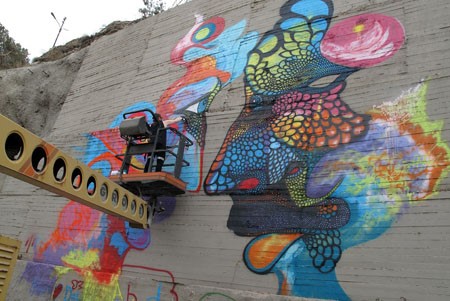
Via the Jordan Times

Last month I wrote about how I experienced harassment in Amman, and I ended my post by wondering how we can address this issue and bring a change to the mentality of Arab men and boys towards women. You can imagine my excitement when I came across a project called Women on Walls that focuses on women’s empowerment through graffiti and gives artists a chance to express themselves through street art.

Women on Walls (WOW) was founded by Angie Balata and Mia Grondahl, who recorded the contributions made by graffiti artists to the 25 January Revolution in Egypt in her book “The Revolution’s Graffiti”. After noticing that of the 17.000 street art photographed in the book only 253 featured women, they decided to take action and came up with the Women on Walls project to draw attention to women’s rights issues through street art. Thanks to their graffiti project in the Bourse area in Cairo, WOW gained more exposure, which eventually led them to collaborate with women’s and anti-harassment organisations like HarassMap and Uprising of Women in the Arab World in 2014. WOW is currently expanding through the region, starting with a street arts festival in Jordan, where 25 women artists from Palestine, Jordan and Lebanon contribute works to the wall to spark the conversation on women’s issues.

Laila Ajjawi, one of the artists participating in the WOW festival in Amman, says she wants to bring a message to men who still look at girls as objects instead of full-fledged human beings with intellectual depth. Research has shown that 80 percent of Jordanian women have experienced street harassment, and 99.3 percent of Egyptian women have reported being sexually harassed, so it’s clear that street harassment is still a problematic issue in the region. This is the reason why Ajjawi choose to focus on street harassment in line with the Women on Walls festival theme “Stories from Fear to Freedom”. She finds that street art is the perfect way to address the issue of street harassment because it reaches a much wider audience. “It challenges harassers in their domain: the streets. This kind of art doesn’t just decorate cement walls; it forces a conversation. “It catches the eye,” says Ajjawi. “But it’s not confrontational.”

Women are often fearful of speaking out against harassment, but Ajjawi hopes that her art may stand in for those who have been silenced into submission.

“If a women is silent, it’s because society compels her to be silent,” says Ajjawi.

The Amman festival combined the Women on Walls project with Baladak, launched by Al Balad Theatre in 2013, who aim to enhance the sense of citizenship through street art. In addition to revealing the street art gallery, the festival also included discussions, lectures and meetings initiated by local organisations to “raise awareness on women’s issues in Jordan and the Arab world, and create an inspirational space for artists to express their opinions,” says Al Balad Theatre Programme manager Lubna Al-Juqqa. The aim is to change the stereotypical image of women that is presented by the media as “just a pretty face”.

A great initiative if you ask me – I hope Women on Walls will expand throughout the region and most importantly, continue to raise awareness of street harassment and women’s issues in the Middle East.

Siel is a master’s student in Middle Eastern studies with a major in contemporary Islam at SOAS University in London. Find her on twitter and instagram under @mademoisielle.

Share

Filed Under: correspondents, street harassment

USA: Safer streets becoming a reality in Kansas City

October 22, 2014 By Contributor

Our six Safe Public Spaces Mentees are half-way through their projects. This week we are featuring their blog posts detailing how the projects are going so far. This sixth post is from our team in the USA. Their projects are supported by SSH donors. If you would like to donate to support the 2015 mentees, we would greatly appreciate it!

BikeWalkKC has made some exciting progress toward making our streets safer in the last three months. BikeWalkKC, Kansas City’s only regional bicycling and pedestrian advocacy organization, helped pass an anti-harassment ordinance to protect vulnerable road users (pedestrians, bicyclists, people in wheelchairs) on October 2.

As a biking and walking advocacy organization, we work to empower individuals to pursue active forms of transportation. Just as poor sidewalks or a lack of bike lanes are barriers to walking or biking, street harassment also causes individuals to feel unsafe walking or biking on our streets.

In order to get the ordinance passed, we reached out to City Councilmembers and local law enforcement earlier this fall. We also launched a petition, gathered letters of support, and conducted an online survey about street harassment. Interesting survey results include:

* 82% of individuals had experienced harassment while walking
* 75% of individuals had experienced harassment while biking
* The most frequent source of harassment was from motorists (65%)
* Only 17% say bystanders have ever intervened

One survey respondent said she experienced street harassment on an average three times a week. “I shouldn’t have had to have been so nervous to walk down my own street in the middle of the day. But I was. Every day. People shouldn’t need to be afraid like this.”

The full report can be seen here.

We received a lot of local press and nationwide attention about the ordinance, such as the Huffington Post, Jezebel, and City Lab. There are at least three other cities in the metro currently working on passing an anti-harassment ordinance.

We were pleased that Kansas City, Missouri City Council is committed to making Kansas City a safer city. Before the ordinance was finally passed, there was a lot of debate among councilmembers concerning the language and making sure First Amendment rights were not being infringed upon.

“During the process to pass it, we found an ally in the ACLU, rekindled a relationship with our local ADA advocacy organization, and really solidified our relationship with council members at city hall,” says BikeWalkKC Marketing and Development Director Sarah Shipley. “It has quite frankly been an amazing experience.”

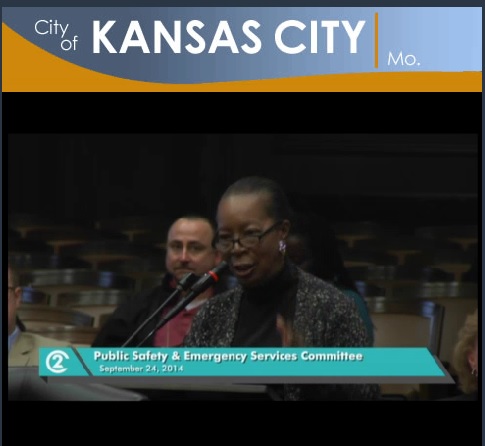
View the testimonies of the courageous citizens who testified on why we needed safe streets in Kansas City at a City Council meeting.

Anti-Harassment Testimonials from BikeWalkKC on Vimeo.

Now that we have passed the ordinance, we are currently planning an educational campaign and workshops surrounding street harassment for community members. Stay tuned for this soon, and thanks again to Stop Street Harassment for all their support and assistance.

Here is the text for the ordinance:

140777 (Sub.)Amending Chapter 50, Article VI, Offenses Against Public Safety, by enacting a new Section 50-205 which will prohibit certain acts against bicyclists, pedestrians, and wheelchair operators.

SECOND COMMITTEE SUBSTITUTE FOR ORDINANCE NO. 140777, AS AMENDED

Amending Chapter 50, Article VI, Offenses Against Public Safety, by enacting a new Section 50-205 which will prohibit certain acts against bicyclists, pedestrians, and wheelchair operators.

WHEREAS, Kansas City wants to encourage modes of transportation other than motor vehicles; and

WHEREAS, it is desirable to create a healthy, safe environment in Kansas City for all people; and

WHEREAS, harassment of bicyclists, pedestrians (including those walking with a guide dog or a white cane), and wheelchair operators increases the hazards already posed to these persons operating on our City streets; NOW, THEREFORE,

BE IT ORDAINED BY THE COUNCIL OF KANSAS CITY:

Section 1. That Chapter 50, Article VI, Offenses Against Public Safety, is hereby amended by enacting a new Section 50-205, Harassment of a Bicyclist, Pedestrian or Wheelchair Operator, to read as follows:

Sec. 50-205. Harassment of a Bicyclist, Pedestrian or Wheelchair Operator

(a)    The following words, terms and phrases, when used in this section, shall have the meanings ascribed to them below, except where the context clearly indicates a different meaning:

Bicycle means any device upon which a person may ride, which is propelled by human power through a system of belts, chains, or gears, and may include an electric assist motor, and has wheels at least 16 inches in diameter and a frame size of at least 13 inches.

Wheelchair means any manual or motorized device designed specifically for use by a person with a physical disability for means of conveyance.

(b)   No person shall, for the purpose of intimidating or injuring any person riding a bicycle, walking, running, or operating a wheelchair or for the purpose of intimidating or injuring such person’s service animal:

(1)               Throw an object, direct a projectile, or operate a vehicle at or in such person’s direction or at or in the direction of such person’s service animal; or

(2)               Threaten such person; or

(3)               Sound a horn, shout or otherwise direct loud or unusual sounds toward such person or toward such person’s service animal; or

(4)               Place such person in apprehension of immediate physical injury; or

(5)               Engage in conduct that creates a risk of death or serious physical injury to such person or such person’s service animal.

(c)    Any person convicted of a violation of this chapter shall be punished for that violation by a fine of not less than $50.00, but not more than $500.00 or by imprisonment of not more than 180 days or by both such fine and imprisonment.

Rachel Krause is BikeWalkKC’s Marketing and Communications Coordinator.

Share

Filed Under: SSH programs, street harassment

DC: Volunteer with RightRides DC!

October 22, 2014 By HKearl

From our DC friends Collective Action for Safe Spaces:

On Friday, October 31, we’re launching RightRides DC, our groundbreaking new, grassroots program to provide free, safe, late-night rides home for women and LGBTQ people. The number one thing we need to make this service a huge success? YOU! We’re still in need of dispatchers, drivers and navigators. Each car will have a driver and a navigator, so apply with a friend!

Be a part of something big. Sign up to volunteer now!

When Do You Need Me to Volunteer?

Volunteers must attend our training session on Thursday, October 23, and must be available to volunteer during RightRides operating hours from 11:30 pm to 3:30 am on October 31. All volunteers will be provdied with a free Zipcar membership as well as free transportation home!

What Do I Need to Do?
Volunteers will be paired up in driver/navigator teams (yup, that means you can sign up for shifts with a friend!) to operate three donated Zipcars. Prefer not to drive? That’s OK, we need dispatchers, too! Volunteers must have a valid drivers license, be able to attend our October 23 volunteer training, and pass a background check. They also should be able to commit to volunteering on at least two service dates this year.

Why Should I Volunteer?
Staying safe can end up unfairly costing women and LGBTQ folks in time, opportunities, and cold hard cash. RightRides DC, the first service of its kind in the city, is an important first step in addressing the “safety gap” in DC’s public transportation. Do good to your community and be a part of something big!

P.S. Be sure to RSVP to our RightRides DC Launch Party on Wed., 10/29 at Right Proper Brewing Company!

And don’t forget to save the RightRides DC number in your phone now; call or text 202-556-4232 for a free, safe ride home from 12am-3am on October 31. Tell your friends!

Share

Filed Under: Events, Resources, street harassment

USA: Does Socialized Aggression Fuel Street Harassment?

October 22, 2014 By Correspondent

Khiara Ortiz, NY, USA, SSH Blog Correspondent

As a woman living in New York City, it’s a given that I have to put up with street harassment on an almost daily basis. I leave my apartment in the mornings on my way to work and the men at the produce market on the corner of my street will toss out sexually fueled comments like biscuits to a dog, hoping I’ll bite. I don’t, but it’s not always easy to ignore them. Sometimes, I change the route I take to the train just to avoid them, only to be greeted by another slew of catcalls on the other side of the street.

And it doesn’t stop there. I work in the midtown neighborhood of Manhattan where there’s always an endless amount of construction work being done and an endless amount of street harassment from construction workers polluting the streets like the dirt and dust clouds from a drilling site.

All of these instances have made me think about why street harassment happens. Most women in America are aware that street harassment either happens to other women, happens to them, that they will probably experience it at least once a week, and that they’ll just have to put up with it. But I’ve begun to wonder how many of the victims of street harassment think about the why; why is this man calling me out for being female?; why does he think he can talk to me like that?; why can’t he see me as his equal, as another human being going about her day, NOT wanting to draw any type of attention towards herself, much less any sexual attention?

In New York, anonymity is easy. You see hundreds, maybe thousands, of people every day. The chances of remembering a face you saw the day before or even that morning are slim. People go unnoticed all the time. This has led me to consider the reasons men feel comfortable practicing street harassment and entitled in doing so. Perhaps the man feels he will not be punished because the woman he is calling out to won’t remember him. Or maybe the complete opposite is true and the man wants to be remembered by a woman, wants to feel more masculine, and therefore calls out to the woman at her expense and for his own psychological benefit. He has now brought himself to the surface of the woman’s psyche and may not even realize he’s done so in a negative way.

In either situation, I think there’s an underlying factor: the release of aggression. An article published in The New York Times in 1983 cited that while “psychologists and psychiatrists often disagree sharply when they discuss whether behavioral differences between the sexes exist, many agree on one difference – that boys and men are still the more aggressive and violent [sex].”

An article published last month in Psychology Today addressing the same issue, the differences in aggression between men and women, theorized about the reasons behind this seemingly factual statement. The article cites a theory by Leonard Berkowitz, a leading American psychologist, who says that “men and women are educated, traditionally, to carry out different social roles.”

The type of aggression that occurs among women is “verbal aggression in intrasexual competition”, not the more obvious, testosterone-fueled aggression that’s valued in men by societal standards. Men’s aggressive tendencies are rooted in the way they are brought up by their parents, in the positive reinforcements they experience when they play rough or practice aggression, to an extent, in sports. When they grow up to become men and no longer have the outlets they did as little boys – sports, games between friends, etc. – they lose a clear target towards which to direct their aggression, which by this time can manifest itself in sexual forms. I believe that sexual harassment, street harassment, and catcalling are all outlets for men who don’t know how to deal with their cultivated aggression. And the streets are places outside their homes, away from their wives and children, where they don’t have anyone to tell them any better because they know the women they target will most likely walk by, leaving them anonymous and free of punishment.

I think that an effective way to break this cycle is to start calling men out on the wrongness of street harassment. Make them uncomfortable, make them realize that their targets aren’t just objects of sex walking by like sponges ready to absorb insults. In the way that the parents of a kidnapped daughter might use photos of the daughter or stories about her to humanize her to the kidnapper, women must humanize themselves before these men to make them realize they cannot and will not be used as targets for male aggression.

Khiara is a recent graduate of New York University with a BAS in Journalism and Psychology who works as an assistant in the contracts department for Hachette Book Group. She is also the co-social media manager for Stop Street Harassment.

Share

Filed Under: correspondents, street harassment

India: Do you want to talk about it?

October 22, 2014 By Contributor

Our six Safe Public Spaces Mentees are half-way through their projects. This week we are featuring their blog posts detailing how the projects are going so far. This fifth post is from our team in India. Their projects are supported by SSH donors. If you would like to donate to support the 2015 mentees, we would greatly appreciate it!

It is a rainy day at my corporate job. Storm*, my intern, walks into work, dabbing raindrops off her arms, animatedly describing the downpour outside while waving her rain jacket around and sprinkling my office with water. She is upbeat as always: dressed in an olive green kurta** with pink tights, a light, long scarf that goes with her ensemble, thick black kohl underneath her determined eyes, her oversized headphones in place. “How are you still wearing your headphones in this rain?” a colleague asks, and she says, “I never take them off. They’re my talisman against the street porukkis***.” My colleague giggles awkwardly. “Well ladies need that, good for you”, he adds.

Storm, like several other women in Chennai, has one unchanging feature in her daily itinerary: to make it through the day without calling ‘unwanted attention’ to herself, and even if it happens, to have the patience to not let it affect her, and to not react. “These headphones remind me that I can have a day that does not include actually hearing half the things men shout to me on the street”, she says.

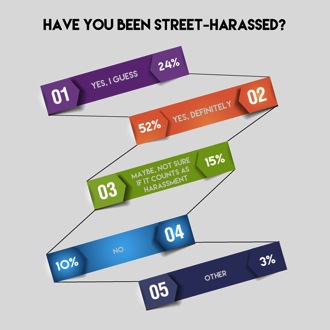
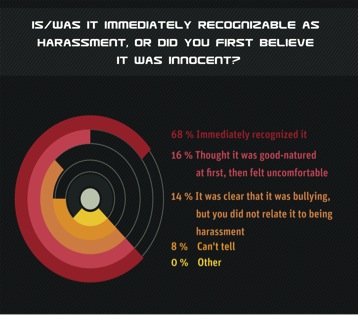
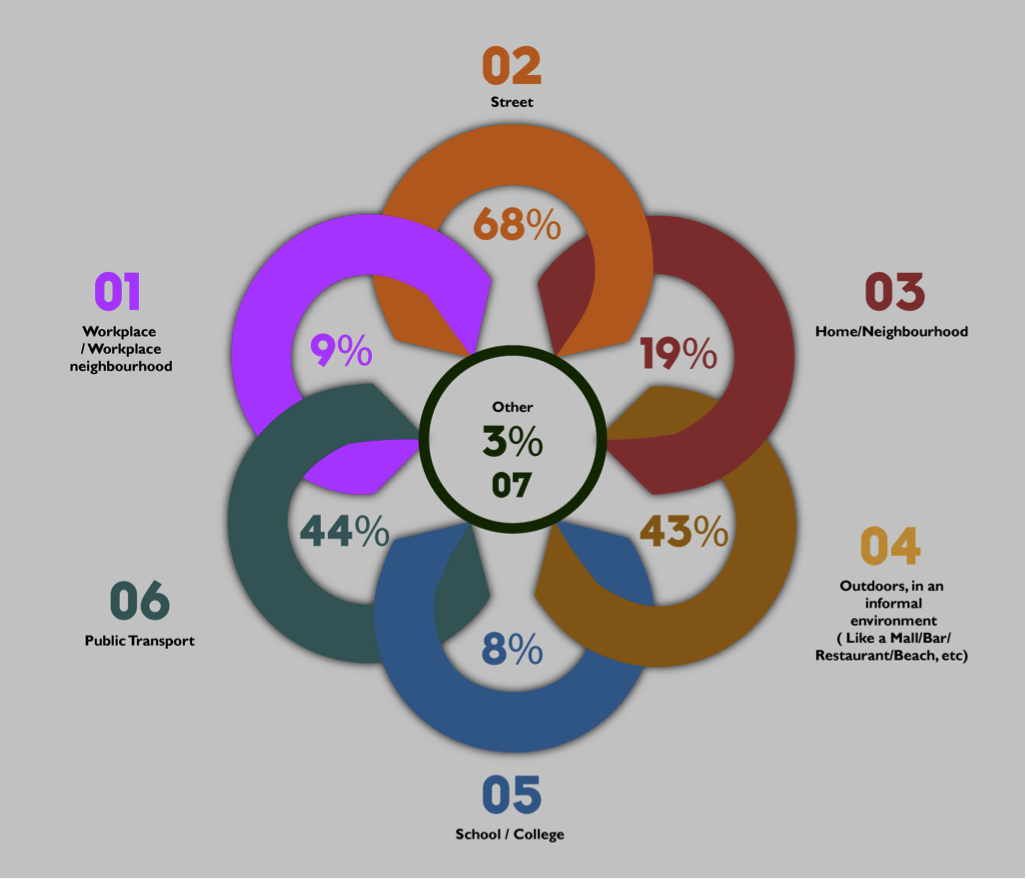
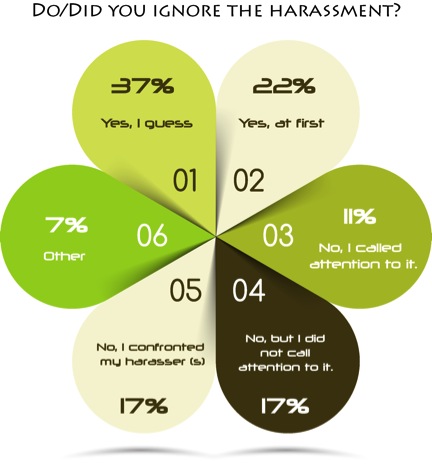
But not everyone is as brazen as Storm, making derisory mentions of street harassment in front of their bosses. It is not common that women talk about street harassment as an actual deviation from the norm in Chennai. In fact, it is so expected, that women often fail to recognize it as harassment, or call it that. To find out how many women identify verbal and physical harassment in public spaces, we circulated a survey among women of all ages who live in Chennai. Participants were allowed to choose all the responses that applied.

Public transport and streets seem to be the hubs of street harassment. “First, it will start with catcalls, if it is a deserted area it will move to degrading comments”.

“I cycle to work, so most days I experience cat calls, honking at me to get my attention- so that they can make kissing gestures and other hand gestures that make me cringe, they sometimes even shout out words and make me feel uncomfortable. Aside from the men on the road who make such remarks I also face road safety issues thanks to many women and men who brush me off the road because I ride a cycle. Other men on cycles also make kissing gestures and other signals that make me feel uncomfortable. But all this I have only ignored. I have looked at them angrily, but somehow, showing them that you are angry makes them more excited and they accelerate towards you.”

“Most of the time, harassment happens when you are least expecting it; while walking down a busy road, at the railway station and sometimes in a crowded street, which you’re having a hard time navigating. It also largely occurs in public transport, where it can easily be brushed aside as lack of space. The point is, with me, it has mostly happened when I’ve been in a crowd, as against the empty or badly lit street back home.”

Verbal harassment isn’t the end of it. Physical harassment is more common than verbal, because in a city as crowded as Chennai, it is almost unnoticeable. “I am pinched/felt up/groped almost everyday on the public bus at rush hour”. Our survey reports incidents of physical harassment from strangers, while walking, driving, or taking any form of public transport, including cabs.

“It ranges from making lewd comments, singing and whistling to groping, rubbing up against me. I believe that even bothering me when I don’t want to talk — forcing me to make conversation or give them attention — and expressing an interest in me when I’ve made it abundantly clear that I’m not interested, is harassment. Fortunately, I’ve never been asked by strangers to smile.”

For Chennai, that’s fortunate indeed.

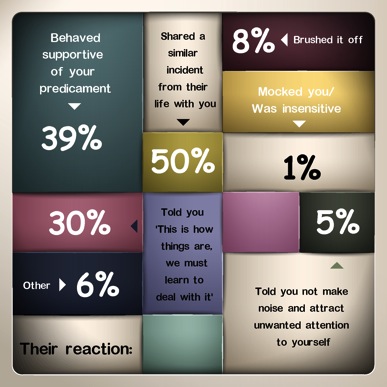
Is it that hard to have a constructive discussion about street harassment in Chennai? We asked our survey participants how they felt about speaking to people about their experience of being street harassed. “I am not told ‘Boys will be Boys’, I am told ‘Girls should be Girls!’ I am always made to believe I did something to bring this ‘attention’ to myself”. Many conversations about street harassment transform into situations where the confidante shares a similar story from their life, or brushes it off, saying “This is how things are in India” or “You should adjust”, or just more advice about dressing conservatively, and only going out in groups. There is not a dearth of support, just a deep sense of helplessness at the status-quo. “I am always told, ‘We must learn to survive. This is how life is’. It sure as hell needn’t be!”

Our mission is to move people of all genders to start acknowledging street harassment as a problem, and not a convention in Chennai. We want to get women to start talking about experiencing street harassment in Chennai. We want to educate teenagers to recognize, question, and intervene in street harassment.

As the next step towards these goals, we are now inviting participants of our survey along with other high school and college students to participate in group-discussions about street harassment. We will use our survey and the results from it as leading points, and the results of these discussions as content for our lesson plans and aids to discuss street harassment in the classroom.

Street harassment is currently being discussed in the classrooms of our participating high-schools: recognizing it, not trivializing it, reacting to it, talking about it, and most importantly, being an effective bystander. Our dream is to expand these discussions to every school, and every classroom in Chennai, and providing tools to aid these sessions.


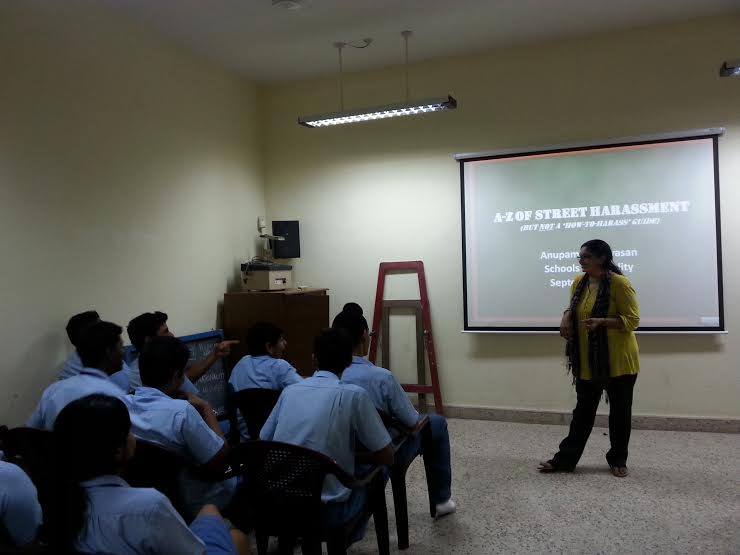
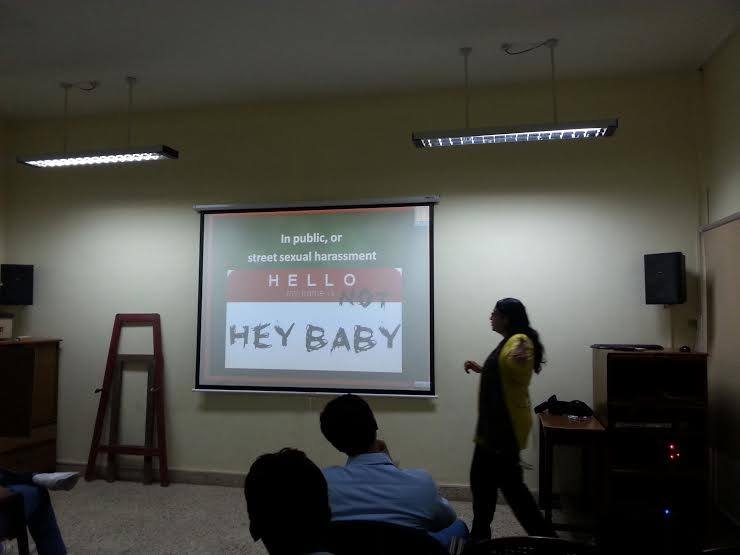
In the above photos, Anupama from Prajnya gives the students a ‘laundry list’ of what constitutes harassment: It is not about what the perpetrator intends, but how the person at the receiving end feels.

Most of all, we want these discussions to find ways to stop street harassment, a phenomenon that stems from inequality among genders: in power, safety, entitlement, and respect. Quoting a response from our survey, “I carry pepper spray, but it is shoddily packaged and I cannot use it in case of an emergency. I think for street harassment to really stop, such men have to develop respect towards themselves, only then can they respect others around them.”

*- Storm is not her real name (quite sadly for me)

** -A kurta is an Indian tunic

***- ‘Porukki’ is a word transliterated from Tamil, the native language spoken in Chennai. It loosely translates to ‘goon’, usually used in the context of someone lewd/lecherous. And yes, I’m ashamed that we have a word for that.

 Gayatri Sekar, Schools of Equality. Graphics by Samrudh Solutions

Share

Filed Under: SSH programs, street harassment

« Previous Page
Next Page »

Share Your Story

Share your street harassment story for the blog. Donate Now

From the Blog

  • #MeToo 2024 Study Released Today
  • Join International Anti-Street Harassment Week 2022
  • Giving Tuesday – Fund the Hotline
  • Thank You – International Anti-Street Harassment Week 2021
  • Share Your Story – Safecity and Catcalls Collaboration

Buy the Book

  • Contact
  • Events
  • Join Us
  • Donate
  • Facebook
  • Instagram
  • Pinterest
  • Tumblr
  • Twitter
  • YouTube

Copyright © 2026 Stop Street Harassment · Website Design by Sarah Marie Lacy