• About Us
    • What Is Street Harassment?
    • Why Stopping Street Harassment Matters
    • Meet the Team
      • Board of Directors
      • Past Board Members
    • In The Media
  • Our Work
    • National Street Harassment Hotline
    • International Anti-Street Harassment Week
    • Blog Correspondents
      • Past SSH Correspondents
    • Safe Public Spaces Mentoring Program
    • Publications
    • National Studies
    • Campaigns against Companies
    • Washington, D.C. Activism
  • Our Books
  • Donate
  • Store

Stop Street Harassment

Making Public Spaces Safe and Welcoming

  • Facebook
  • Instagram
  • Pinterest
  • Tumblr
  • Twitter
  • YouTube
  • Home
  • Blog
    • Harassment Stories
    • Blog Correspondents
    • Street Respect Stories
  • Help & Advice
    • National Street Harassment Hotline
    • Dealing With Harassers
      • Assertive Responses
      • Reporting Harassers
      • Bystander Responses
      • Creative Responses
    • What to Do Before or After Harassment
    • Street Harassment and the Law
  • Resources
    • Definitions
    • Statistics
    • Articles & Books
    • Anti-Harassment Groups & Campaigns
    • Male Allies
      • Educating Boys & Men
      • How to Talk to Women
      • Bystander Tips
    • Video Clips
    • Images & Flyers
  • Take Community Action
  • Contact

USA: Does Socialized Aggression Fuel Street Harassment?

October 22, 2014 By Correspondent

Khiara Ortiz, NY, USA, SSH Blog Correspondent

As a woman living in New York City, it’s a given that I have to put up with street harassment on an almost daily basis. I leave my apartment in the mornings on my way to work and the men at the produce market on the corner of my street will toss out sexually fueled comments like biscuits to a dog, hoping I’ll bite. I don’t, but it’s not always easy to ignore them. Sometimes, I change the route I take to the train just to avoid them, only to be greeted by another slew of catcalls on the other side of the street.

And it doesn’t stop there. I work in the midtown neighborhood of Manhattan where there’s always an endless amount of construction work being done and an endless amount of street harassment from construction workers polluting the streets like the dirt and dust clouds from a drilling site.

All of these instances have made me think about why street harassment happens. Most women in America are aware that street harassment either happens to other women, happens to them, that they will probably experience it at least once a week, and that they’ll just have to put up with it. But I’ve begun to wonder how many of the victims of street harassment think about the why; why is this man calling me out for being female?; why does he think he can talk to me like that?; why can’t he see me as his equal, as another human being going about her day, NOT wanting to draw any type of attention towards herself, much less any sexual attention?

In New York, anonymity is easy. You see hundreds, maybe thousands, of people every day. The chances of remembering a face you saw the day before or even that morning are slim. People go unnoticed all the time. This has led me to consider the reasons men feel comfortable practicing street harassment and entitled in doing so. Perhaps the man feels he will not be punished because the woman he is calling out to won’t remember him. Or maybe the complete opposite is true and the man wants to be remembered by a woman, wants to feel more masculine, and therefore calls out to the woman at her expense and for his own psychological benefit. He has now brought himself to the surface of the woman’s psyche and may not even realize he’s done so in a negative way.

In either situation, I think there’s an underlying factor: the release of aggression. An article published in The New York Times in 1983 cited that while “psychologists and psychiatrists often disagree sharply when they discuss whether behavioral differences between the sexes exist, many agree on one difference – that boys and men are still the more aggressive and violent [sex].”

An article published last month in Psychology Today addressing the same issue, the differences in aggression between men and women, theorized about the reasons behind this seemingly factual statement. The article cites a theory by Leonard Berkowitz, a leading American psychologist, who says that “men and women are educated, traditionally, to carry out different social roles.”

The type of aggression that occurs among women is “verbal aggression in intrasexual competition”, not the more obvious, testosterone-fueled aggression that’s valued in men by societal standards. Men’s aggressive tendencies are rooted in the way they are brought up by their parents, in the positive reinforcements they experience when they play rough or practice aggression, to an extent, in sports. When they grow up to become men and no longer have the outlets they did as little boys – sports, games between friends, etc. – they lose a clear target towards which to direct their aggression, which by this time can manifest itself in sexual forms. I believe that sexual harassment, street harassment, and catcalling are all outlets for men who don’t know how to deal with their cultivated aggression. And the streets are places outside their homes, away from their wives and children, where they don’t have anyone to tell them any better because they know the women they target will most likely walk by, leaving them anonymous and free of punishment.

I think that an effective way to break this cycle is to start calling men out on the wrongness of street harassment. Make them uncomfortable, make them realize that their targets aren’t just objects of sex walking by like sponges ready to absorb insults. In the way that the parents of a kidnapped daughter might use photos of the daughter or stories about her to humanize her to the kidnapper, women must humanize themselves before these men to make them realize they cannot and will not be used as targets for male aggression.

Khiara is a recent graduate of New York University with a BAS in Journalism and Psychology who works as an assistant in the contracts department for Hachette Book Group. She is also the co-social media manager for Stop Street Harassment.

Share

Filed Under: correspondents, street harassment

India: Do you want to talk about it?

October 22, 2014 By Contributor

Our six Safe Public Spaces Mentees are half-way through their projects. This week we are featuring their blog posts detailing how the projects are going so far. This fifth post is from our team in India. Their projects are supported by SSH donors. If you would like to donate to support the 2015 mentees, we would greatly appreciate it!

It is a rainy day at my corporate job. Storm*, my intern, walks into work, dabbing raindrops off her arms, animatedly describing the downpour outside while waving her rain jacket around and sprinkling my office with water. She is upbeat as always: dressed in an olive green kurta** with pink tights, a light, long scarf that goes with her ensemble, thick black kohl underneath her determined eyes, her oversized headphones in place. “How are you still wearing your headphones in this rain?” a colleague asks, and she says, “I never take them off. They’re my talisman against the street porukkis***.” My colleague giggles awkwardly. “Well ladies need that, good for you”, he adds.

Storm, like several other women in Chennai, has one unchanging feature in her daily itinerary: to make it through the day without calling ‘unwanted attention’ to herself, and even if it happens, to have the patience to not let it affect her, and to not react. “These headphones remind me that I can have a day that does not include actually hearing half the things men shout to me on the street”, she says.

But not everyone is as brazen as Storm, making derisory mentions of street harassment in front of their bosses. It is not common that women talk about street harassment as an actual deviation from the norm in Chennai. In fact, it is so expected, that women often fail to recognize it as harassment, or call it that. To find out how many women identify verbal and physical harassment in public spaces, we circulated a survey among women of all ages who live in Chennai. Participants were allowed to choose all the responses that applied.

Public transport and streets seem to be the hubs of street harassment. “First, it will start with catcalls, if it is a deserted area it will move to degrading comments”.

“I cycle to work, so most days I experience cat calls, honking at me to get my attention- so that they can make kissing gestures and other hand gestures that make me cringe, they sometimes even shout out words and make me feel uncomfortable. Aside from the men on the road who make such remarks I also face road safety issues thanks to many women and men who brush me off the road because I ride a cycle. Other men on cycles also make kissing gestures and other signals that make me feel uncomfortable. But all this I have only ignored. I have looked at them angrily, but somehow, showing them that you are angry makes them more excited and they accelerate towards you.”

“Most of the time, harassment happens when you are least expecting it; while walking down a busy road, at the railway station and sometimes in a crowded street, which you’re having a hard time navigating. It also largely occurs in public transport, where it can easily be brushed aside as lack of space. The point is, with me, it has mostly happened when I’ve been in a crowd, as against the empty or badly lit street back home.”

Verbal harassment isn’t the end of it. Physical harassment is more common than verbal, because in a city as crowded as Chennai, it is almost unnoticeable. “I am pinched/felt up/groped almost everyday on the public bus at rush hour”. Our survey reports incidents of physical harassment from strangers, while walking, driving, or taking any form of public transport, including cabs.

“It ranges from making lewd comments, singing and whistling to groping, rubbing up against me. I believe that even bothering me when I don’t want to talk — forcing me to make conversation or give them attention — and expressing an interest in me when I’ve made it abundantly clear that I’m not interested, is harassment. Fortunately, I’ve never been asked by strangers to smile.”

For Chennai, that’s fortunate indeed.

Is it that hard to have a constructive discussion about street harassment in Chennai? We asked our survey participants how they felt about speaking to people about their experience of being street harassed. “I am not told ‘Boys will be Boys’, I am told ‘Girls should be Girls!’ I am always made to believe I did something to bring this ‘attention’ to myself”. Many conversations about street harassment transform into situations where the confidante shares a similar story from their life, or brushes it off, saying “This is how things are in India” or “You should adjust”, or just more advice about dressing conservatively, and only going out in groups. There is not a dearth of support, just a deep sense of helplessness at the status-quo. “I am always told, ‘We must learn to survive. This is how life is’. It sure as hell needn’t be!”

Our mission is to move people of all genders to start acknowledging street harassment as a problem, and not a convention in Chennai. We want to get women to start talking about experiencing street harassment in Chennai. We want to educate teenagers to recognize, question, and intervene in street harassment.

As the next step towards these goals, we are now inviting participants of our survey along with other high school and college students to participate in group-discussions about street harassment. We will use our survey and the results from it as leading points, and the results of these discussions as content for our lesson plans and aids to discuss street harassment in the classroom.

Street harassment is currently being discussed in the classrooms of our participating high-schools: recognizing it, not trivializing it, reacting to it, talking about it, and most importantly, being an effective bystander. Our dream is to expand these discussions to every school, and every classroom in Chennai, and providing tools to aid these sessions.


In the above photos, Anupama from Prajnya gives the students a ‘laundry list’ of what constitutes harassment: It is not about what the perpetrator intends, but how the person at the receiving end feels.

Most of all, we want these discussions to find ways to stop street harassment, a phenomenon that stems from inequality among genders: in power, safety, entitlement, and respect. Quoting a response from our survey, “I carry pepper spray, but it is shoddily packaged and I cannot use it in case of an emergency. I think for street harassment to really stop, such men have to develop respect towards themselves, only then can they respect others around them.”

*- Storm is not her real name (quite sadly for me)

** -A kurta is an Indian tunic

***- ‘Porukki’ is a word transliterated from Tamil, the native language spoken in Chennai. It loosely translates to ‘goon’, usually used in the context of someone lewd/lecherous. And yes, I’m ashamed that we have a word for that.

 Gayatri Sekar, Schools of Equality. Graphics by Samrudh Solutions

Share

Filed Under: SSH programs, street harassment

Peru: The Macho is a Coward

October 22, 2014 By Correspondent

Laura Bustamante, Lima, Peru, SSH Blog Correspondent

Ser macho es Ser “marica”

Via Peru.com

El otro día, la calle estaba desolada, tuve miedo de cruzar a la acera de al frente al ver a un hombre que lucía poco confiable, pensé en no cruzar, pero mi espíritu reivindicativo y feminista brotó, por qué como mujer tenía que restringir mi libre tránsito, elecciones y sentirme insegura en mi barrio por un hombre, entonces crucé. Y lo veía venir, mientras caminaba él se acercaba mirándome, no iba a correr, odio huir ante una agresión masculina… soy una mujer no una rata. Se acercó cortando mi camino y rozando mi brazo, inclinándose para decirme no sé qué, yo escuchaba música con mis audífonos, mientras me alejaba le grité: ¡Respeta a las mujeres! El se volteó y parado desafiante me dijo: sólo te estoy “saludando”.

Para mi es sencillo: Es inadmisible que muchos hombres crean que se nos pueden acercar en las calles sin consenso, por qué se creen con derecho a “saludarnos”, invadir nuestro espacio, rozarnos, decirnos cosas sexuales o tocarnos. Es que la violencia sexual, simbólica y psicológica a la que se somete a la mujer se justifica por los roles de género que debemos asumir, ser hombre, ser mujer. Mientras la mujer es pasiva, no activa sexualmente, linda y sumisa; se espera que el hombre -aquí la palabra que me da náusea- sea macho, un macho latino, el macho peruano, por ello se sienten orgullosos, ellos son machos pues, son lo máximo, los que están en la cima de la jerarquía, tienen más libertades, activos con híper-sexualidad, fuertes que no lloran. Bajo este sistema machista-patriarcal el hombre es dueño del espacio público y privado, poseen territorio y hembras, es el protector y proveedor que tiene el control, y el medio para ejercer su dominio es la violencia.

Sí, bienvenidos a “Macholandia”, el reino no muy lejano del macho latino y su ideología, que sobrevalora la sexualidad masculina, educa hombres conquistadores que siempre deben desear una mujer para demostrar su hombría, incluso ejerciendo una sexualidad violenta, porque el macho acumula mujeres no hombres, es heterosexual no “maricón”, por eso rechaza y desvaloriza lo femenino, débil e inferior, donde las mujeres existen para darle placer y afirmar su masculinidad, convirtiéndolas en objeto, y como debe ser “fuerte”, es dominante y el cuerpo femenino les pertenece, así acosan a las mujeres en la calle, el hombre se convierte en juez y puede juzgar sexualmente el cuerpo de una mujer.

Así, la mujer como objeto queda sujeta a la voluntad del hombre protector o del que decide dañarnos, dando paso a la cultura de la violación, porque el macho al demostrar su heterosexualidad fuerte-dominante puede intentar aprovecharse y nosotras nos debemos cuidar: “el hombre propone, la mujer dispone”, porque “un hombre no puede controlarse, es su instinto” y todo será nuestra culpa, tu culpa por tomar o vestirte así, porque tu ropa justifica que te acosen, te toquen o hasta te violen. ¡Hay pobrecitos estos machos inocentes! Dueños de todo y todas pero no de sus actos y responsabilidades, machos racionales llevados por sus emociones agresivas, fuertes pero débiles a su sexualidad, dominantes pero sometidos al machismo, la culpa la tienen ellas, las Evas, la tentación. El agresor se convierte en víctima de provocación y la agredida en culpable, en puta, en la vergüenza que en casos más terribles se le exige continuar con un embarazo por violación, como lo exige el Estado peruano, la mujer objeto sexual también es objeto reproductivo.

El acoso sexual callejero afecta el día a día de las mujeres, evitas una construcción por los obreros, te cubres más de lo que quieres, evitas ciertas zonas o salir sola de noche; tratas de salir acompañada por un hombre reforzando tu dependencia. Afecta la seguridad, independencia, libertad sexual y de tránsito, tu derecho a vivir sin miedo ni violencia, pero todo esto no es suficiente y estos machos defenderán su masculinidad incorrecta, negarán que el acoso sexual callejero es una forma de violencia sexual sutil, naturalizado y tomado en broma, parte de la cultura de la violación porque no interesa tu permiso, consenso, si no te gusta, el macho se siente con derecho de juzgar sexualmente tu cuerpo o tocarte, tu cuerpo es de ellos de manera simbólica. Dirán de las mujeres que se defienden que son exageradas, histéricas, incluso se burlan o se vuelven más agresivos, porque no conciben que el cuerpo femenino no les pertenezca, no pueden vivir en un mundo donde no sometan, abusen y ejerzan poder sobre sus compañeras femeninas.
¬¬
Deberían entenderlo ¡ya!, ser macho es peyorativo, no es motivo de orgullo es una vergüenza, el macho desvaloriza y rechaza lo considerado femenino, como a los gays, los llama maricas, que significa: cobardes, afeminados. Es que los machos creen que es un orgullo ser abusivo, agresivo, homofóbico, violento, ser el que somete y reprime sus sentimientos, sin empatía, que trata a otros seres humanos (mujeres) como objetos. Al final, ser macho es ser un pusilánime sin valor rendido ante los mandatos del machismo, un inseguro que prueba constantemente su masculinidad, es un cobarde que se mete con las mujeres apoyado en la intimidación porque tienen más fuerza física. Estos machos se dan cuenta que a las mujeres no les gusta su acoso, que molestan, que lo hacen contra su voluntad y da miedo, pero generar miedo los hace sentir más machos y con más poder.

Ser macho no es una masculinidad es un tipo de dominación, una masculinidad debe ser una expresión de tu humanidad, debe convertirte en mejor persona sin dominar a otras u otros para definirte, hay que repensar “el orgullo de ser macho” porque ser macho es ser un “verdadero maricón”.

Laura ha estudiado Administración en Turismo en Universidades de Perú y Barcelona, y Estudios de Género en la ONG Flora Tristán. La puedes seguir en Twitter en @laeureka.

IN ENGLISH

The other day I was afraid to cross the street when I saw a man and no one else around. But my feminist spirit arose; why as a woman should I have to restrict my movement and feel unsafe in my neighborhood because of a man?

Then I crossed. And I saw it coming; while I was walking he was approaching, staring at me. I wasn’t going to run away from a potential male aggression … I am a woman not a rat. He came near to me almost cutting me off and rubbed my arm, leaning in to me to tell me – I do not know what – I was listening to music with my headphones on. As I walked away I said, “Respect Women!” He turned and stood defiantly replying, “I’m just ‘greeting you’.”

For me it is simple: It is unacceptable that many men believe that they can approach us on the streets without our consent that they feel entitled to “greet us”, invade our space, tell us sexual things, or even touch us.

The sexual, psychological and symbolic violence to which women are subjected are often justified by the gender roles we assume. While the woman is supposed to be passive, not sexually active, beautiful and submissive, a man is expected to be –and here is a word that makes me nauseated- a “macho”, a Latino macho, the Peruvian macho. That word makes many Latin-American men proud: they are machos, they are at the top of the hierarchy, they have more freedom, they are actively hyper-sexual, they are strong and don´t cry.

Welcome to “Macholand”, in the not too far away kingdom of the macho Latino, and its ideology, which overestimates male sexuality, educates men to be a womanizer who always has to desire a woman to prove his manhood. He even may use sexual violence but that is seen as women’s fault. “The man proposes and the woman disposes” because “a man cannot control himself, it is his instinct” is how it goes, so everything will be a woman’s fault, It´s her fault for drinking too much or for dressing like that, because her clothes justifies harassment, touching, and even rape. The attacker becomes the victim of provocation and the victim becomes guilty, become a slut in terrible shame that in the most horrible cases are forced to continue with a pregnancy by rape, as the Peruvian State requires, because women are sexual and reproductive objects.

A macho is supposed to be heterosexual, not a “fagot,” so he rejects and devalues the feminine. He considers the feminine weak and inferior and believes that women are objects that exist to please and reaffirm his masculinity. As a macho he believes he should be “strong”, dominant, and that the female body belongs to him. The man becomes a sexual judge and feels he can judge a woman’s body by harassing her on the street.

The result is that street harassment is common and affects women´s daily life. We avoid walking by construction workers, we cover our body more than we want, we avoid certain areas or go out alone at night; we try to be accompanied by a man, strengthening our dependency on men. Street harassment affects our safety, independence, sexual freedom and transit, and our right to live without fear and violence.

Even still, machos will defend their wrong masculinity, denying that sexual harassment is a form of sexual violence, but say it is normal or a joke. They say women who defend themselves are exaggerating, hysterical, or they become more aggressive against them because they do not want to conceive that the female body does not belong to them.

This is the truth: Being macho is pejorative, it´s not something to be proud of but is actually shameful. Being macho means being a pushover with no courage and being subjected to the mandates of sexism. These machos realize that women do not like to be harassed, but still they do it to make women afraid, because creating fear makes them feel more macho and powerful.

Being macho is not a good masculinity. Masculinity should be an expression of one’s humanity and desire to become a better person without dominating others. It must be rethought.

Laura has studied Tourism Management in Universities of Peru and Barcelona, and Gender Studies at the NGO Flora Tristan. You can follow her on Twitter at @laeureka.

Share

Filed Under: correspondents, street harassment

Nicaragua: Conducting Surveys at Bus Stops

October 21, 2014 By Contributor

Our six Safe Public Spaces Mentees are half-way through their projects. This week we are featuring their blog posts detailing how the projects are going so far. This fourth post is from our team in Nicaragua. Their projects are supported by SSH donors. If you would like to donate to support the 2015 mentees, we would greatly appreciate it!

Desde hace poco más de tres meses, un grupo de universitarias nos unimos con la idea de hacer algo contra el acoso callejero en Nicaragua. Empezamos a buscar información, y encontramos un financiamiento que brindaba Stop Street Harassment para una iniciativa bastante concreta. Nos pareció que lo primero que necesitábamos era una encuesta que nos arrojara datos sobre cómo vivían las mujeres esta forma de violencia  de género, y qué tan seguido les pasaba.

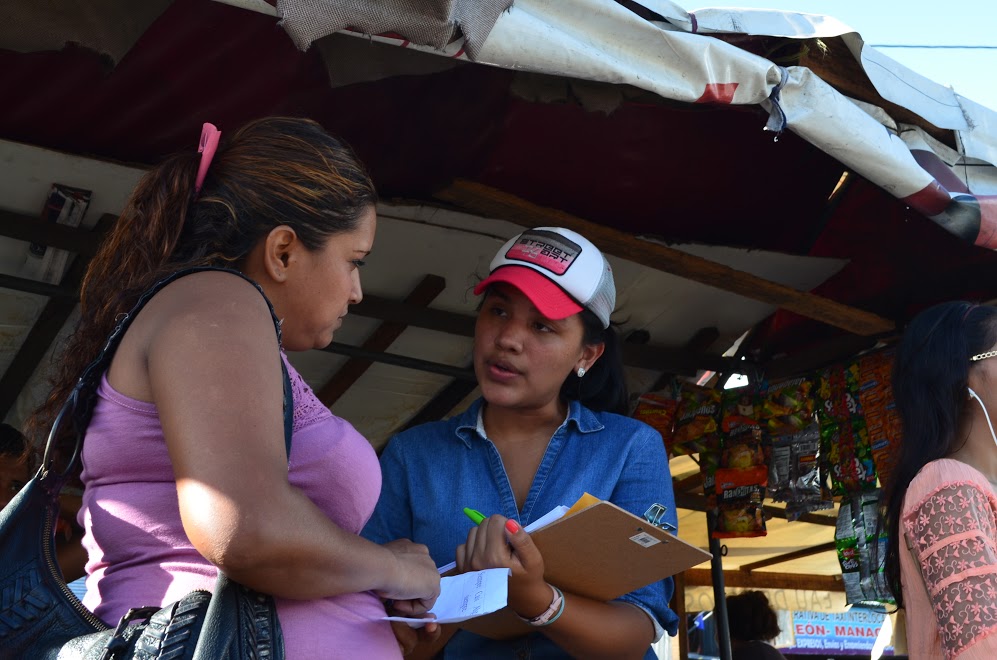
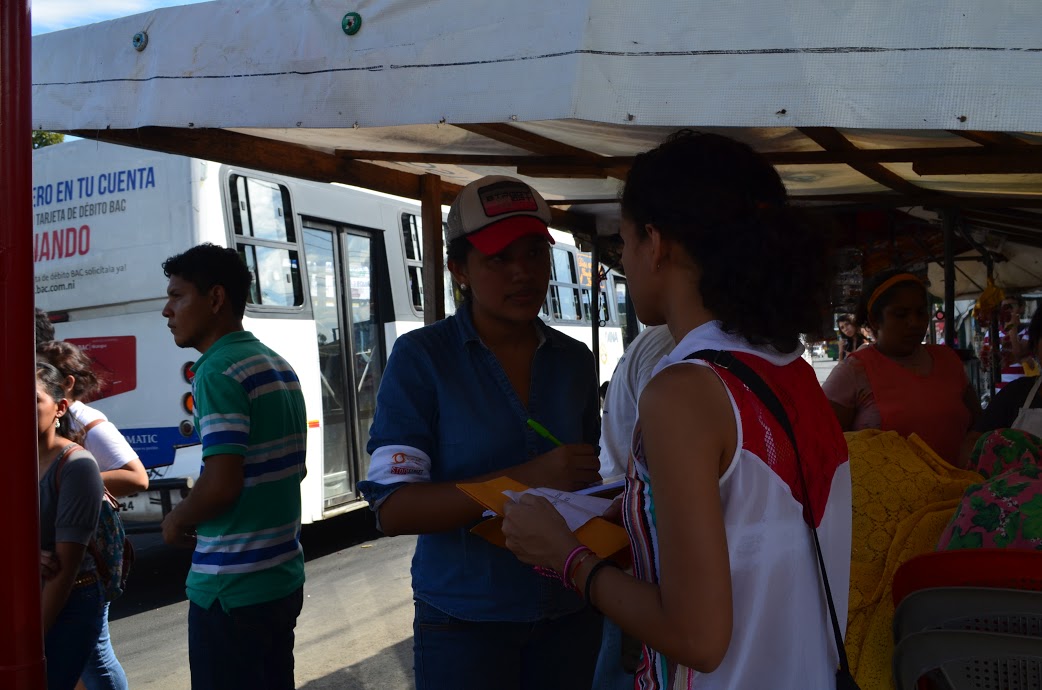
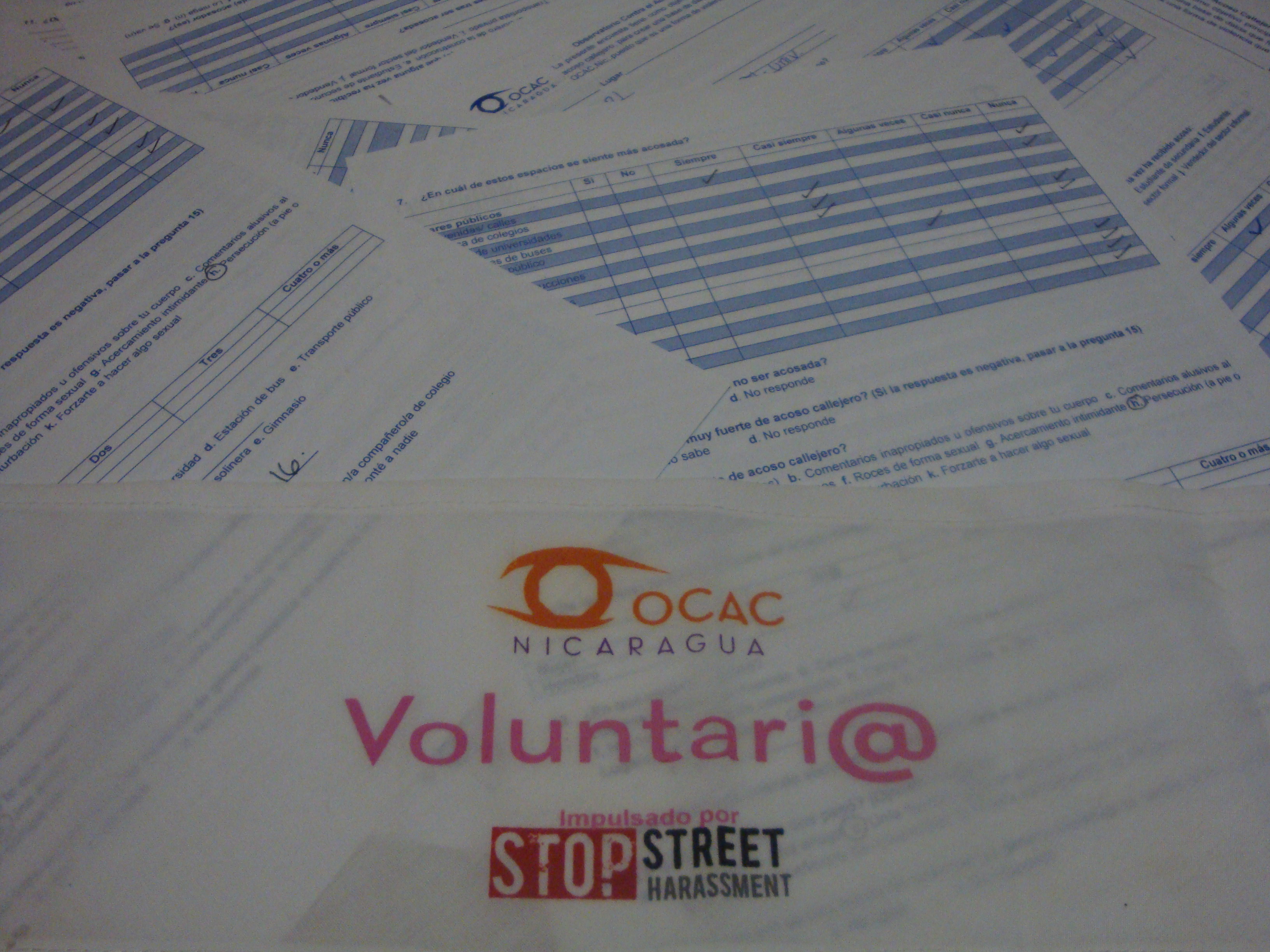
Así que empezamos, desde hace un mes (cuando obtuvimos el financiamiento de SSH), a aplicar una encuesta en las estaciones de buses a mujeres de 14 a 60 años. Las preguntas están enfocadas en descubrir los tipos de acoso callejero más frecuente, la especificación de una experiencia fuerte y la determinación de si el acoso callejero es o no violencia de género.

Y los resultados hasta el momento han sido sorprendentes. Un grupo fijo de ocho voluntarias hemos encuestado 5 días durante este último mes,  y nos encontramos con que esta experiencia nos ha servido para recopilar información estadística, pero más aún para conocer de primera mano lo que piensa la gente, su forma de actuar ante el acoso callejero y las opiniones que antes no pensamos encontrarnos (ya que además de contestarnos la encuesta, muchas de ellas nos brindan mayor información sobre sus múltiples experiencias).

Muchas mujeres se mostraban dispuestas a contar sus historias, porque nunca antes habían sido escuchadas, pero muchas otras también se mostraron sumamente incómodas o avergonzadas cuando les preguntábamos qué experiencia fuerte habían tenido. También nuestras voluntarias se encontraron con opiniones como: “si contestás los hombres te van a pegar y te van a violar”, “no es violencia porque no me están pegando” u otras expresiones que demostraban la naturalización del problema.

Además, nos encontramos con un alto porcentaje de mujeres  que calla. Muchas les expresaron a las voluntarias que no sabían cómo reaccionarían los hombres y que preferían ignorarlo.

Y por supuesto, el número de mujeres que han tenido experiencias fuertes de acoso callejero es significativo, aunque debido a la naturalización, en ocasiones, a las mujeres les es  difícil identificar que son o fueron víctimas de violencia. Algunas mujeres habían sido testigos de masturbación en público en autobuses, en caponeras, en taxis, en sus barrios y hasta afuera de su propia casa. Otro gran número de mujeres había sido víctima de exhibicionismo de genitales, la mayoría de ellas cuando eran pre o adolescentes. Una de las mujeres contó que mientras barría la acera de su casa, un ciclista le dejó ver su entrepierna. Ella sólo tenía 9 años. El caso más grave con el que nos encontramos hasta ahora fue el de una señora a quien un desconocido había intentado violar en la calle, cuando ella tenía 20 años.

Aún nos falta mes y medio para terminar de llenar las encuestas, y nuestro compromiso contra el acoso callejero ha incrementado, ya que nos convencemos cada vez más de que visibilizar el problema es el primer paso para lograr que las mujeres dejen de verlo como algo común y que los hombres están en libertad de hacer. Hoy más que nunca, esperamos lograr una incidencia positiva a raíz de los resultados obtenidos con este pequeño estudio.

In English (using Google Translate)

Just over three months ago, a group of university students came together with the idea of doing something against street harassment in Nicaragua. We started looking for information and found Stop Street Harassment was providing financing for a fairly specific initiative. We found that the first thing needed was to conduct a survey to collect data about women’s experiences with this violence and how often it happens to them.

So we started a month ago (when we got the financing SSH) to implement a survey at bus stations to women ages 14 to 60 years. The questions are focused on discovering the most common types of street harassment, the specification of a powerful experience and the determination of whether or not street harassment is gender violence.

And the results so far have been amazing. Eight volunteers have surveyed across five days during the past month, and we find that this experience has helped us to collect statistical information, but even more to learn first-hand what people think, how they react to street harassment and their opinions.

Many women were reluctant to tell their stories at first because they had never shared them before, and many were also extremely uncomfortable or embarrassed when we asked about their toughest experiences of street harassment. Also our volunteers heard opinions like: “If you reply to their words, men will hit you and rape you,” or “It is not violence, no one is hitting me,” and other expressions showing the naturalization of the problem.

In addition, we found a high percentage of women who were silent when harassed. Many expressed their concern that they did not know how men would react and so preferred to ignore it.

And of course, the number of women who have had tough experiences of street harassment is significant, although due to the natrualization of it, sometimes women find it difficult to identify who are or were victims of violence. Some women had witnessed public masturbation in buses, in taxis, in their neighborhoods and even outside their home. Another large number of women had been victims of genital exhibitionism, mostly when they were pre or teenagers. One of the women said that while sweeping the sidewalk outside her home, a cyclist showed her his crotch. She was only 9 years old. The worst case we encountered so far was that of a woman who had experienced attempted rape by a stranger on the street when she was 20.

We still have a month and a half to finish filling out surveys, and our commitment against street harassment has increased and convinced us more that exposing the problem is the first step in getting women to stop seeing it as common and something that men are free to do. Today more than ever, we hope to achieve a positive impact due to the results obtained with this small study.

Noelia Gutiérrez is founder of Observatorio Contra el Acoso Callejero, Nicaragua. 

Share

Filed Under: SSH programs, street harassment

Nepal: Self Defense Sessions and Forum Theater

October 21, 2014 By Contributor

Our six Safe Public Spaces Mentees are half-way through their projects. This week we are featuring their blog posts about how the projects are going so far. This third post is from our team in Nepal. Their projects are supported by SSH donors. If you would like to donate to support the 2015 mentees, we would greatly appreciate it!

The main goal of our project is to decrease the occurrence of street harassment in Kathmandu city. In the start of the month of October, we did an interactive program to discuss on issues about street harassment. About 15 people attended the event and we had a diverse group of participants ranging from school level students to even PHD research students. We asked the if they had ever faced street harassment or if they had ever witnessed street harassment among any members in their community. We also briefed them about our upcoming events. We also familiarized them with the website of Hollaback! Kathmandu and showed them ways that they could report their stories on the website if they ever faced street harassment.

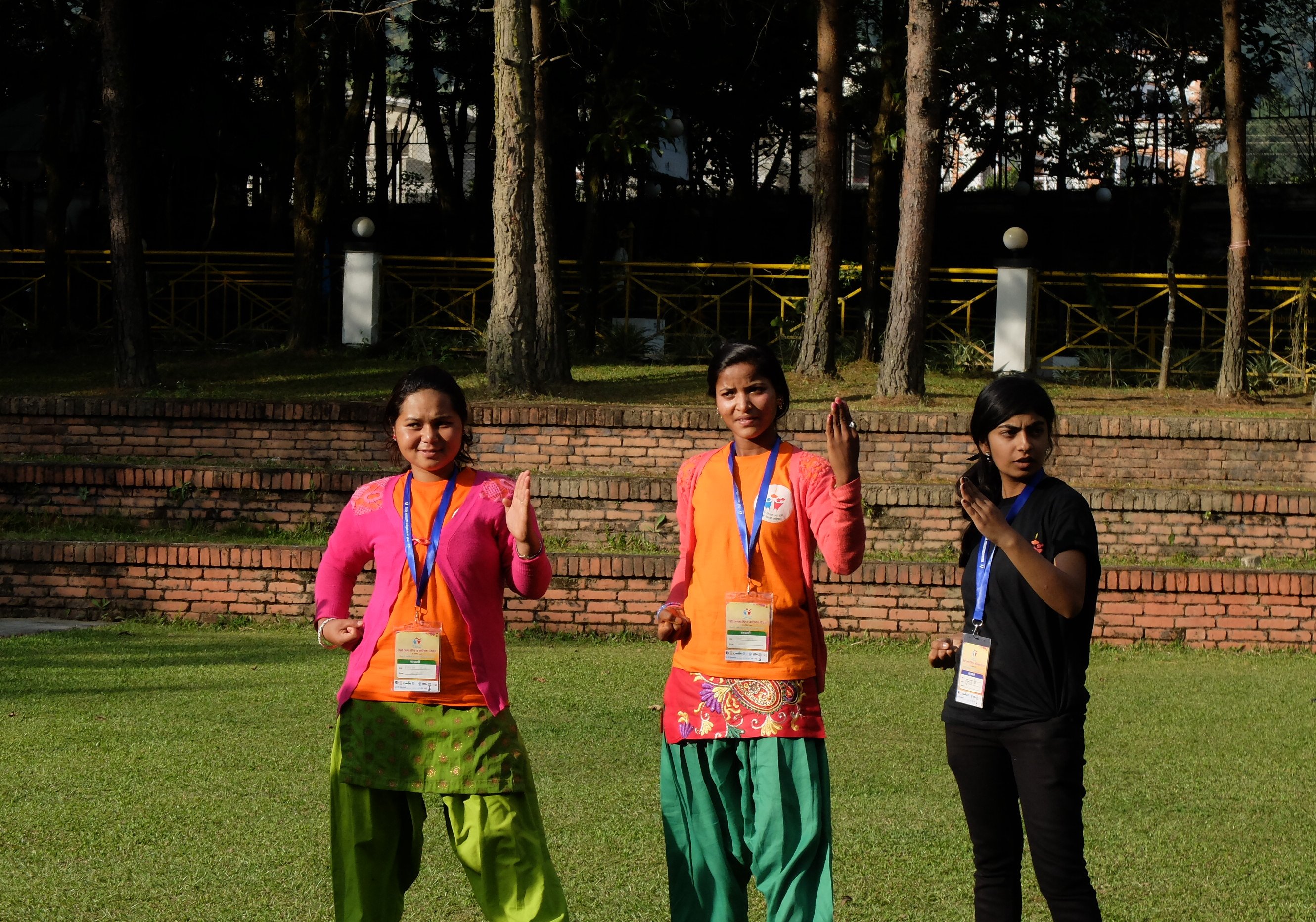
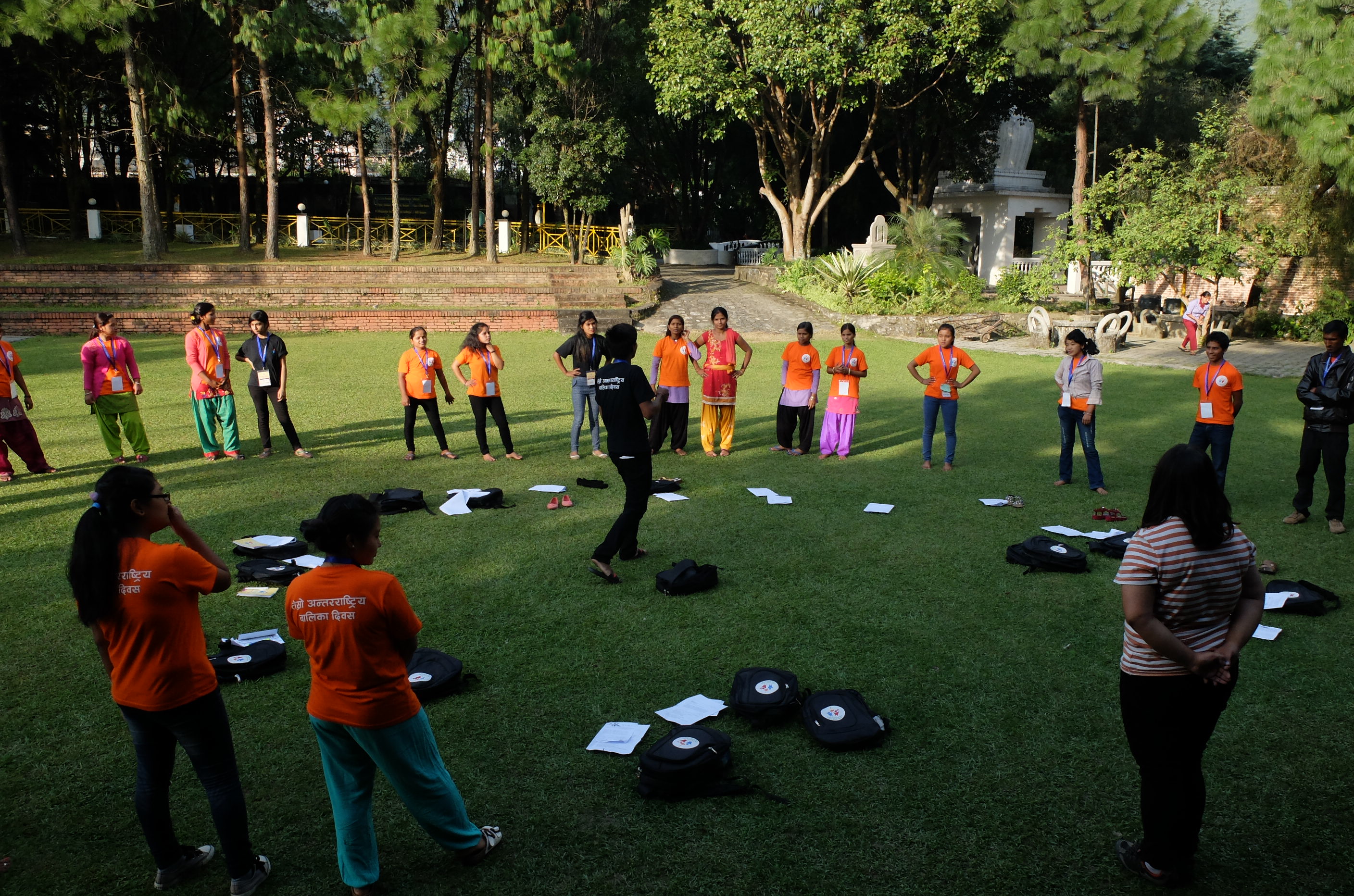
The other event that we recently conducted was the Self Defense session at the Girl Power Conference which took place from the October 11 013 for the Third International Day of the Girl Child. Thirteen organizations including Women LEAD Nepal, UNESCSO, UNHCR, UNICEF, UNFPA, Equal Access, Restless Development, VSO, CARE Nepal, CWIN Nepal, PLAN Nepal AMK and Yuwalaya organized the three day conference with a theme of empowering the adolescent girls and ending the cycle of violence.

The Self Defense session ran in two parts that were an hour long. A total of 30 participants in each group were present in one session. More than 62 participants total attended from over 31 districts of Nepal. During the Self Defense session, the participants held an interactive session about street harassment and the things that they should do if they were ever harassed- such as filing an FIR. There was a mixture of both boys and girls adolescents. We explained that they could learn these self defense techniques so as to protect their female members of their community and teach these techniques to their peers when they get back to school.

When asked to the participants what the best activity was of the day, most of the participants said that they really enjoyed doing the self defense sessions since it re-energized them and involved a fun physical exercise. They said that now they really felt empowered themselves and would also share their learning about self defense and ways to deal with street harassment when they would go back to their communities.

Another project on the pipeline for our SSH project is the forum theater for which we have recruited around 10 volunteers who are willing to commit their time for the activity. The volunteers are mostly high school students. We have also decided to collaborate with an expert on forum theater from a theater organization here in Kathmandu who will train our volunteers for the theater project. After the training session is over, we will visit different sectors and perform the forum theater project. We will shortly begin the training and then visit various schools, colleges and universities to do the forum theater and also conduct workshops and sessions on street harassment.

Since the 16 Days of Activism Against Gender Violence is going to be held in December, we are also making plans for how we can use that time to effectively bring attention to street harassment.

Aparna Singh is the Programs and Communications Associate for Women LEAD Nepal

Share

Filed Under: SSH programs, street harassment

« Previous Page
Next Page »

Share Your Story

Share your street harassment story for the blog. Donate Now

From the Blog

  • #MeToo 2024 Study Released Today
  • Join International Anti-Street Harassment Week 2022
  • Giving Tuesday – Fund the Hotline
  • Thank You – International Anti-Street Harassment Week 2021
  • Share Your Story – Safecity and Catcalls Collaboration

Buy the Book

  • Contact
  • Events
  • Join Us
  • Donate
  • Facebook
  • Instagram
  • Pinterest
  • Tumblr
  • Twitter
  • YouTube

Copyright © 2026 Stop Street Harassment · Website Design by Sarah Marie Lacy