• About Us
    • What Is Street Harassment?
    • Why Stopping Street Harassment Matters
    • Meet the Team
      • Board of Directors
      • Past Board Members
    • In The Media
  • Our Work
    • National Street Harassment Hotline
    • International Anti-Street Harassment Week
    • Blog Correspondents
      • Past SSH Correspondents
    • Safe Public Spaces Mentoring Program
    • Publications
    • National Studies
    • Campaigns against Companies
    • Washington, D.C. Activism
  • Our Books
  • Donate
  • Store

Stop Street Harassment

Making Public Spaces Safe and Welcoming

  • Facebook
  • Instagram
  • Pinterest
  • Tumblr
  • Twitter
  • YouTube
  • Home
  • Blog
    • Harassment Stories
    • Blog Correspondents
    • Street Respect Stories
  • Help & Advice
    • National Street Harassment Hotline
    • Dealing With Harassers
      • Assertive Responses
      • Reporting Harassers
      • Bystander Responses
      • Creative Responses
    • What to Do Before or After Harassment
    • Street Harassment and the Law
  • Resources
    • Definitions
    • Statistics
    • Articles & Books
    • Anti-Harassment Groups & Campaigns
    • Male Allies
      • Educating Boys & Men
      • How to Talk to Women
      • Bystander Tips
    • Video Clips
    • Images & Flyers
  • Take Community Action
  • Contact

Racial Discrimination + Street Harassment

October 21, 2014 By HKearl

This Huffington Post article, written by our board member Patrick McNeil, is excerpted with permission.

“Today marks 20 years since the United States ratified an international human rights treaty aimed at protecting people from racial discrimination (it’s called the Convention on the Elimination of all forms of Racial Discrimination, or CERD).

The committee that monitors implementation of the treaty met in Geneva earlier this year, and it dedicates an entire section of its observations and recommendations to violence against women.

In acknowledging steps the United States has taken to reduce how often violence against women occurs, the committee said it “remains concerned at the disproportionate number of women from racial and ethnic minorities, particularly African-American women, immigrant women, and American Indian and Alaska Native women, who continue to be subjected to violence, including rape and sexual violence.” That includes — as advocates know all too well — street harassment….

In a national study released earlier this year, SSH found that Black and Hispanic respondents were more likely to say they’ve experienced street harassment (though due to sample size, the racial categories were combined for women and men). And the incidents normally aren’t isolated. Compared to white people, people of color were more likely to report experiencing it sometimes, often or daily (41 percent vs. 24 percent), while white people were more likely to say they’ve experienced it once or rarely.

While the study’s sample is limited, what it suggests is a story we see all too often: women of color in public spaces being harassed — or worse.

Earlier this month, a woman named Mary Spears was killed in Detroit after saying no to a man’s advances and refusing to give him her phone number, prompting Mychal Denzel Smith to ask — who cries when black women die from street harassment?

“Mary Spears’s right to move about freely in the world was denied to her, her life taken from her, and there are no marches,” Smith said. “There are no widespread calls to protect the autonomy of black women and their bodies. The community leaders haven’t deemed this unacceptable and a fate no one should ever face simply because they reject a man’s advances.”

Perhaps street harassment — and these sometimes ugly, horrifying extensions of it — isn’t what the CERD committee had in mind when writing about the ongoing violence enacted toward women in the United States. But it certainly should be.

The committee also urged the United States to “undertake awareness raising campaigns on the mechanisms and procedures available to seek remedies for violence against women.” Organizations like SSH, Hollaback and others are doing just that. Their efforts to teach men and boys not to harass — we should all hope — will lead, someday, to that permanent, systemic change we need to achieve safer public spaces for all.”

Share

Filed Under: national study, race, street harassment Tagged With: CERD, racial discrimination

Kenya: Preparing for a Campaign on the Ferry

October 21, 2014 By Contributor

Our six Safe Public Spaces Mentees are half-way through their projects. This week we are featuring their blog posts about how the projects are going so far. This second post is from our team in Kenya. Their projects are supported by SSH donors. If you would like to donate to support the 2015 mentees, we would greatly appreciate it!

Planning about the ferry “Stop Gender Harassment” with our team at the Teens Watch Centre

We plan to hold a campaign about harassment on the ferry. Our pre-planning meeting in the community started with a word of prayer. Then Cosmos, the project manager, informed the participants that the purpose of the meeting was to learn more about street harassment, especially as we plan the five day exhibition at the stand on the ferry ramp dubbed “Stop gender based harassment on the ferry.”

Cosmos informed the participants that madam Holly at Stop Street Harassment had already raised and sent kshs. 22,000 which was for the support of the five day event. Cosmos expressed the situation on the ground that currently about eighteen women and two males had openly expressed their sadness on being badly touched or harassed on the ferry. Cosmos said that all was not in vain that fortunately one sex pest has been sentenced to two years prison term after a confident non fearing lady caught him and led him to the police post where he was immediately booked and taken to court the next morning.

Cosmos expressed that the reason for this campaigns is to have victims of this kind of harassment open up so that we can let people know that our Likoni ferry will not tolerate such kind of pests. He urged the participants to attend the exhibition in large numbers and support the campaign without fear.

Talking to the Community about”stop gender harassment in our ferry” at the Kwale community hall

The pre-planning meetings have gone on well so far we have been able to reach out to three hundred and fifty participants from our community. This has included 112 males and 188 females. The most successful meeting was at the Kwale Community Social Hall where over 200 participants came to deliberate on the “Stop gender harassment on our ferry” campaign.  The participants arrived early and we discussed the topic in a participatory manner. One lady shared her story about how when she was carrying a baby in her back a man kept stroking her buttocks pretending he was playing with the kid. She expressed her sadness that no male who was around her on the ferry did anything but just stared at her and some laughed. She expressed her last sentiments with pain, “We are not toys to play with, respect our bodies” she pointed at the men.

A school girl also took the mike and expressed how a man old enough to be her dad kept rubbing his erect penis on her back in the crowded ferry. It felt so shocking and depressing she says. She ended with this message “Please, our fathers respect yourselves and we shall respect you. Zip-it-up”.

An elderly mother that we had invited to share her experience started by congratulating Teens Watch and the Stop Street Harassment campaign saying this campaign should not be a onetime event and we need to plan for it every year. She said she was one of the main victims of the sexual harassment on the ferry she said that it was around six o’clock when she boarded the ferry and as usual the ferry was packed with people, about two thousand to be exact. As a lady, she said, I tried my best to go towards where most women were packed. Of course the ferry as it is now it’s not a female friendly vessel. Soon the pushing and jostling started and I sensed a man patting my buttocks as if it was romance. I pushed further on and he kept following me pretending he was being pushed.

Suddenly I felt hard warmth pressing on me. By then the ferry was midway and everyone was concentrated on the ferry reaching the off ramp. The hardness was so uncomfortable I looked him straight in the eye harshly and he backed off. It was not until I reached the other side to get off that a lady screamed, “What’s on your back?” and as I turned and strained my neck behold a big lump of sperm was smeared on my back.

I was furious! Ladies came to my rescue wiped the sperm out. I tried to look for the man who had a yellow t-shirt on, but I couldn’t find him, there were so many people in yellow. In short, I am so annoyed with this pests, as you know I am not the only one. Many women are suffering quietly, but from now on, women I want to tell you to stand up for your rights. When a man dares to press on you, raise the red card, scream, and let his acts be known. And for the men and our brothers who are here, support us against this sex beasts that pretend to be men. She ended by saying, “a man does not count as a man because of pressing his penis on a helpless woman but by protecting women against harassment. Thank you.”

Resolutions passed in this pre-planning meeting

* That the Kenya ferry services should think about separating women from the men to avoid harassment.
* That the Kenya ferry should have CCTV cameras that work on the ferry and be operated at all times.
* That the Kenya ferry should allow the Teens Watch Centre to have posters displayed to Stop Street Harassment to create awareness and warnings to those intending to violate the rules.
* That the county senate should debate on a policy towards making street harassment or sex pest an act punishable by jail in Kenya.
* That women should speak up when assaulted or harassed and that men should support them when need arises.
* That we should identify a local women leader to push this campaign.
* That the five day exhibition and campaign should be held in December when schools are closed and more people are free so that they can participate.

Mr. Cosmus W. Maina is the Project Co-ordinator for the Teen Watch Centre in Diani Beach, Kenay, and the lead for the Safe Public Spaces team in Kenya.

Share

Filed Under: public harassment, SSH programs, street harassment

Serbia: Surveying Youth about Street Harassment

October 20, 2014 By Contributor

Our six Safe Public Spaces Mentees are half-way through their projects. This week we are featuring their blog posts about how the projects are going so far. This first post is from our team in Serbia. Their projects are supported by SSH donors. If you would like to donate to support the 2015 mentees, we would greatly appreciate it!

After the political change fourteen years ago, the civil sector in Serbia has been dealing with the transformation of extremely violent society. There are high rates of domestic violence, juvenile delinquency, slow judiciary, inadequate laws and even less adequate penalties, and a society that was not ready to change. These are just some of the problems that demanded immediate reaction. Thanks to consistent efforts of feminist groups and NGOs, we have a new set of laws and certainly more awareness about gender-based violence.

However, these circumstances led to the minimizing the issue of street harassment. Since there was no published survey, members of our group, Equity Youth Association, believed that the right way to start dealing with this issue is to collect the data, first. In Niš, Serbia, there is a University and over 19 secondary schools, so we decided to focus our survey on youth between 18 and 30 years old.

So far, we have conducted a survey in three secondary schools and at two Faculties. We weren’t very optimistic about how open schools and Facilities would be for collaboration since the education system had various difficulties at the beginning of the school year. We have been pleasantly surprised that we haven’t been rejected, yet.
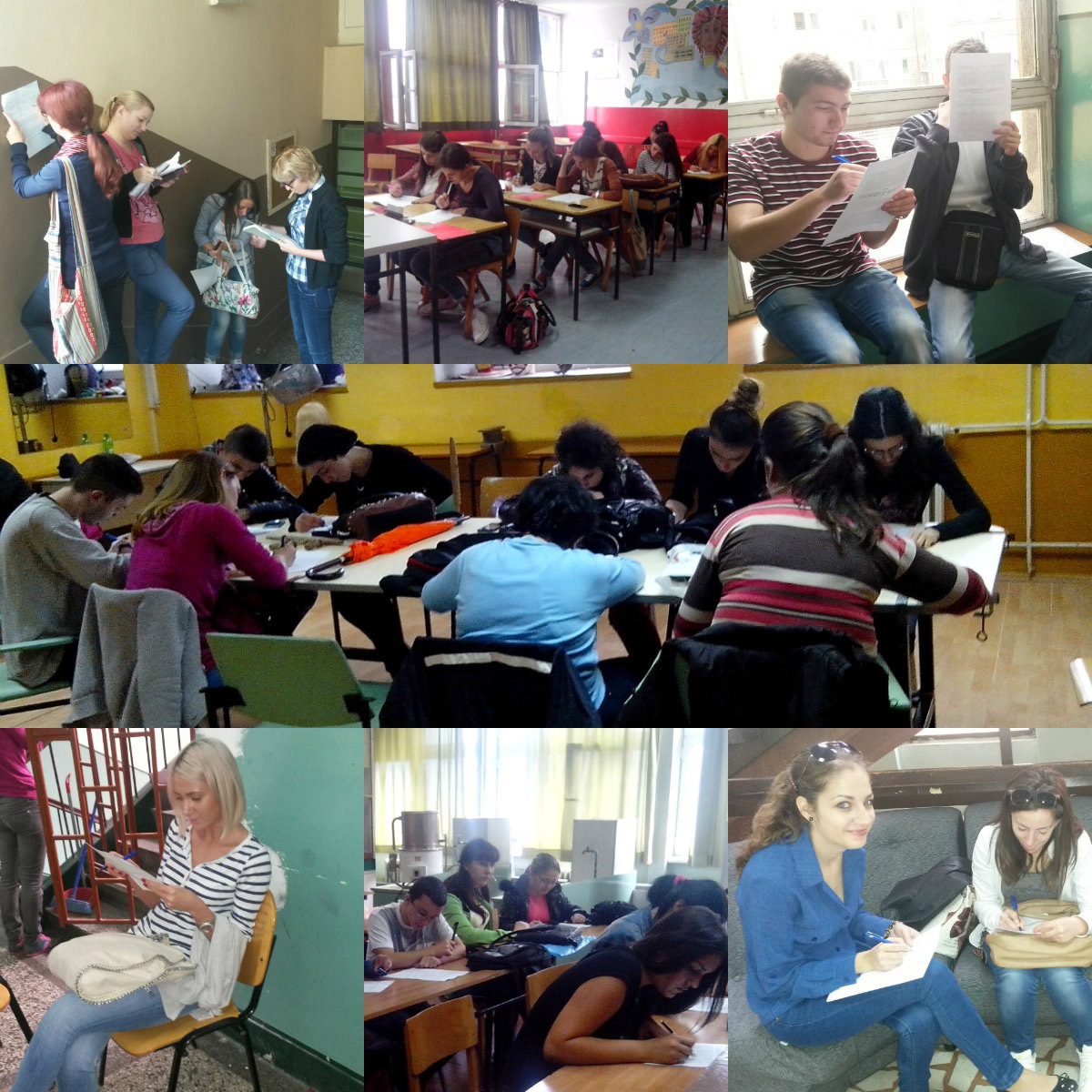
Students taking their surveys!

What has encouraged us the most is the reaction of the psychologist of the school that has mostly female students: “I’m so glad you have brought up this subject. Our girls are completely unaware of what harassment is. And how couldn’t they be? We live in society where it is normal to stare and comment on everybody and everything. They are expecting to be looked at. They are taught that looking good is the only thing that matters. They validate themselves through how many offensive, primitive comments they receive daily. It’s disturbing.”

It was upsetting to hear that most of the described behaviors from our survey are seen as “normal” and an “every-day thing”. But, the fact that majority of girls aren’t feeling pleasant when they experienced these things was an indicator that this is something that can be changed.

Boys were quite honest, as well: “Of course I have done this. What is the other way to approach a girl, anyway? I have to draw her attention somehow. Once she meets me, she will know that I’m better than that.” So, they are aware that is wrong, they just don’t know what the alternative is.

One of the teachers shared her story with us: “During my class, in the classroom on ground floor, a man approached the window and started masturbating. Kids started to scream and he luckily ran away. But, I was so shocked that I was unable to move. When I come to think of it, I didn’t tell anybody about this, until now.”

We have also noticed that there are city parks where usually young people are gathered that are recognized as places where harassment occurs. Strangely enough, even though they are always full with young people, especially during the summer, street lighting in these places is not very good.

There are, as well, a few questions in our survey about the LGBT population, or people who are perceived as LGBT because of the stereotypes. These questions, as we have expected, were the one that have received the most reactions. One of the principals said that kids in his school are “normal” and have no idea what those words like gay and lesbian mean.

One of the girls got very angry when she read these questions. She had marched to her teacher and screamed: “Look what they are asking us. They are probably thinking that it’s ok to be a faggot or a dyke, but I would kill them all.”

The teacher was visibly uncomfortable because of the girl’s reaction and this is how she tried to make things right: “But, it’s not “their” fault that “they” are like “that”. I read about this. Something happens in mother’s body during third month of pregnancy that causes them to be like “that”.”

Living in homophobic society, we were expecting to get all kinds of reactions, but we weren’t prepared for this amount of ignorance. It is more than obvious that we need education among all structures of society.

The last set of questions in our survey is about legislation and the lack of the definition of sexual harassment in public places in our legal system. The students’ answers were rather discouraging. One law student wrote, “Making a legal frame won’t change a thing. Prosecutors are not able to prove there was a murder, let along street harassment. Rule of law is unattainable for us.”

However we are grateful for each and every reaction we get and every question answered. Hopefully, the results will indicate what should be our next step and what could really make a change.

Marija Stanković, Equity Youth Association and the lead SSH Safe Public Spaces Mentee in Serbia. 

Share

Filed Under: LGBTQ, SSH programs, street harassment

“Do not ever make a woman feel unsafe.”

October 20, 2014 By Contributor

I have never been grabbed by a stranger in my life.

I was walking around in the West Village after work today; talking with my mom on the phone about visiting Georgia at the end of the month. I had my headphones on, but I always keep one ear off, just to stay alert/aware of my surroundings. Even though the West Village is a family friendly, brownstone neighborhood, you honestly never know. Which brings me to this:

As I was talking with my mom, a man, obviously a bus boy of some kind because of his apron, walking in front of me. Did the usual up-and-down as I walked towards him. I kept my head down and continued walking, as I normally do. Because I was talking to my mom and not listening to music, I heard him call me “Sweet Baby.” Nothing out of the norm, usual annoyance.

Then, he grabbed my arm. He physically put his hand on me, this stranger. Immediately I figured out in a fight-or-flight situation, I’m fight.

I snapped around, with my headphones still on, practically yelling, pointed my finger in his face and said,

“Don’t you dare ever f**king touch a woman without her permission. Do you understand me?”

He froze. And said sorry with his hands up, and slowly backed away. I continued,

“Take this as a f**king lesson. Do not ever make a woman feel unsafe. Do not ever make anyone feel unsafe. Be fucking ashamed of yourself. Learn from this. Remember this.”

And as I was telling this to my brother, he made a really great point. Thank God I had that reaction. Because you never know what people are capable of, and if he had really intended to harm me, there’s only so far you can run. There’s only so much you can do if you freeze up, which is a lot of women’s natural reaction to a physical threat.

I got mad, I defended myself. And I felt really f**king good about it. And I never usually call people like that out, ever.

But the minute you put your hands on a stranger, male to female, male to male, female to male, you’ve got to fight. Because you never know what someone’s intentions are the minute they put their hands on you.

– Rebecca Florence

Location: West Village, NYC

Share your street harassment story for the blog.
See the book 50 Stories about Stopping Street Harassers for more idea

Share

Filed Under: Stories, street harassment

“I have been followed with a video camera pointed at my butt”

October 19, 2014 By Contributor

I used to live in DC and the harassment is obnoxious. I have been followed with a video camera pointed at my butt while leaving a grocery store. I have had guys park their car and sit at the bus stop and harass me to get my number. One time when I was only 16, a metro bus driver in Northeast D.C flicked his tongue at me in a sexual way when I boarded the bus and when I got off of the bus. It made me feel so uncomfortable. I couldn’t believe that a grown man could behave like that even in a professional setting.

– RJ

Location: Washington, DC

Share your street harassment story for the blog.
See the book 50 Stories about Stopping Street Harassers for more idea

Share

Filed Under: Stories, street harassment

« Previous Page
Next Page »

Share Your Story

Share your street harassment story for the blog. Donate Now

From the Blog

  • #MeToo 2024 Study Released Today
  • Join International Anti-Street Harassment Week 2022
  • Giving Tuesday – Fund the Hotline
  • Thank You – International Anti-Street Harassment Week 2021
  • Share Your Story – Safecity and Catcalls Collaboration

Buy the Book

  • Contact
  • Events
  • Join Us
  • Donate
  • Facebook
  • Instagram
  • Pinterest
  • Tumblr
  • Twitter
  • YouTube

Copyright © 2026 Stop Street Harassment · Website Design by Sarah Marie Lacy