• About Us
    • What Is Street Harassment?
    • Why Stopping Street Harassment Matters
    • Meet the Team
      • Board of Directors
      • Past Board Members
    • In The Media
  • Our Work
    • National Street Harassment Hotline
    • International Anti-Street Harassment Week
    • Blog Correspondents
      • Past SSH Correspondents
    • Safe Public Spaces Mentoring Program
    • Publications
    • National Studies
    • Campaigns against Companies
    • Washington, D.C. Activism
  • Our Books
  • Donate
  • Store

Stop Street Harassment

Making Public Spaces Safe and Welcoming

  • Facebook
  • Instagram
  • Pinterest
  • Tumblr
  • Twitter
  • YouTube
  • Home
  • Blog
    • Harassment Stories
    • Blog Correspondents
    • Street Respect Stories
  • Help & Advice
    • National Street Harassment Hotline
    • Dealing With Harassers
      • Assertive Responses
      • Reporting Harassers
      • Bystander Responses
      • Creative Responses
    • What to Do Before or After Harassment
    • Street Harassment and the Law
  • Resources
    • Definitions
    • Statistics
    • Articles & Books
    • Anti-Harassment Groups & Campaigns
    • Male Allies
      • Educating Boys & Men
      • How to Talk to Women
      • Bystander Tips
    • Video Clips
    • Images & Flyers
  • Take Community Action
  • Contact

“I go home feeling that I am a nothing to them”

December 12, 2013 By Contributor

I am 16 and I have a part-time job after school. I get out in the early evening, but it’s dark by 4:30 p.m. in the winter, and I’ve had a few uncomfortable situations, but never scary. This particular day I left work I had barely walked two yards from the door when a man coming towards me stopped abruptly to block my path. “You’re gonna catch a cold missy!” he said. I thought he meant it like a caring adult to any kid, but then he added, “You’re ta-tas are hanging out.”

I became very aware that this man was standing purposefully in my way, commenting on my body and coming closer. I quickly walked around him and mumbled ‘okay’ and he said, “You sure you’re okay? miss?” I replied, “Yes, I’m fine thank you.”

I tried to walk away without looking back as he replied, “Yes you are fine…” and I stopped listening because I felt nauseous and I couldn’t tell if he was still following me. As I speed walked away I called two friends to possibly deter him from following me, neither answered. The third friend did and when I was sure I had lost the man I explained what happened and how afraid I was. She dryly replied, “You’ll get over it.” and changed the subject.

But I can’t. I can’t get over the looks and the car horns and unintelligible things called out of moving cars, or the groups of boys singing to me about my body, or the men leaning over to get a better look. I can’t get over it because I go home feeling that I am a nothing to them, and they’ll forget what they said but I won’t be able to shake the fear of seeing them again tomorrow.

– WM

Share your street harassment story for the blog.
Check out the new book 50 Stories about Stopping Street Harassers!

 

Share

Filed Under: Stories, street harassment

“I am afraid always”

December 11, 2013 By Contributor

One night after a dance class, I went to Walmart. As I left, I noticed a man walk into the store. He had ragged, torn jeans and muddy boots and was wearing a white tank top. It was pretty chilly outside. I was walking to my car, but I heard someone following me. I thought it was just someone else leaving, but I turned around to see that same man following me. I started walking faster. My heart was pounding and my hands were shaking nervously. I was afraid that he was going to grab me or attack me. He said “Gettin’ cold sweetheart?”

That was enough to make me burst into tears. I was scared to death. I replied “No, I’m fine.”

Then I practically ran to my car. It took me several tries to get the key into the door to unlock it since I was shaking. Once I got in, I drove home; probably 20 miles over the speed limit. I was hyperventilating. Scared to death. Since that night, I don’t go anywhere alone at night. I’m afraid to go pump gas into my car at night, I don’t go to Walmart late at night, and even during the daytime, I watch my surroundings constantly. That experience changed my life. I am afraid always, even if I am surrounded by friends or my boyfriend.

– Rachel B.

Location: Georgia

Share your street harassment story for the blog.
Check out the new book 50 Stories about Stopping Street Harassers!
Share

Filed Under: Stories, street harassment

“I’m tired of having to be combat-ready all the time”

December 11, 2013 By Contributor

A while ago I thought I’d help motivate myself to get out of the house and get active by making myself tea and going for a walk around my block. After all, I love walking, and I’m too broke to join a gym. I was all excited about it, had my tea, made it to the other side of the block and was really enjoying being out in the sun, with all the happy little houses around….and then was heftily sexually harassed as I passed a house full of people who were hanging out in their front yard. They talked about my body parts for at least the entire time I was in earshot, loudly talking about me in the third person and shouting instructions and opinions at me. It was mostly one guy, but there were both guys and girls laughing along with him.

I’ve realized this is pretty common any time I walk places. Street harassment is alive and well in Los Angeles.

This is why I don’t leave my house as much as I’d like to, and why I no longer skate anywhere – because I just can’t muster the energy to deal with scary douches. I’m tired of having to be combat-ready all the time. So now I mostly just stay home or only drive places (even if I could walk there).

– MAG

Location: North Hollywood, CA

Share your street harassment story for the blog.
Check out the new book 50 Stories about Stopping Street Harassers!
Share

Filed Under: Stories, street harassment

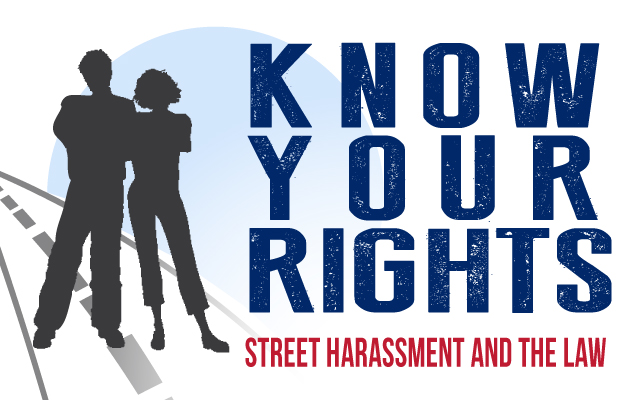
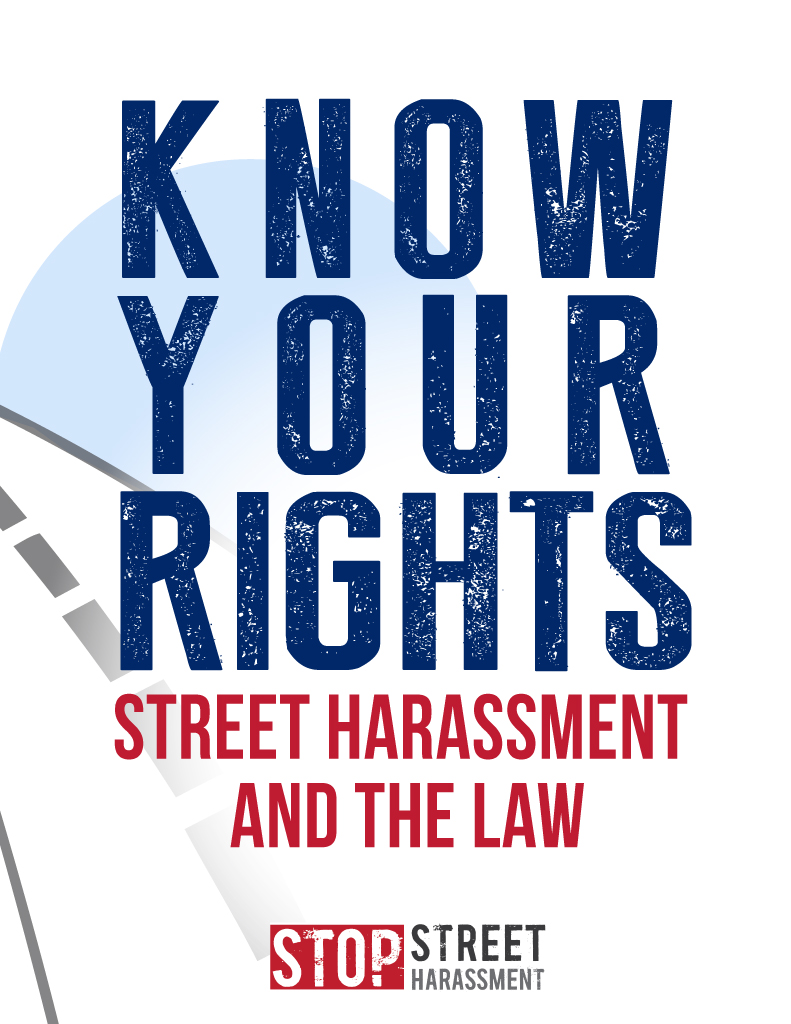
Know Your Rights: Street Harassment and the Law

December 10, 2013 By SSHIntern

Stop Street Harassment is pleased to announce the release of our newest publication and online resource Know Your Rights: Street Harassment and the Law.

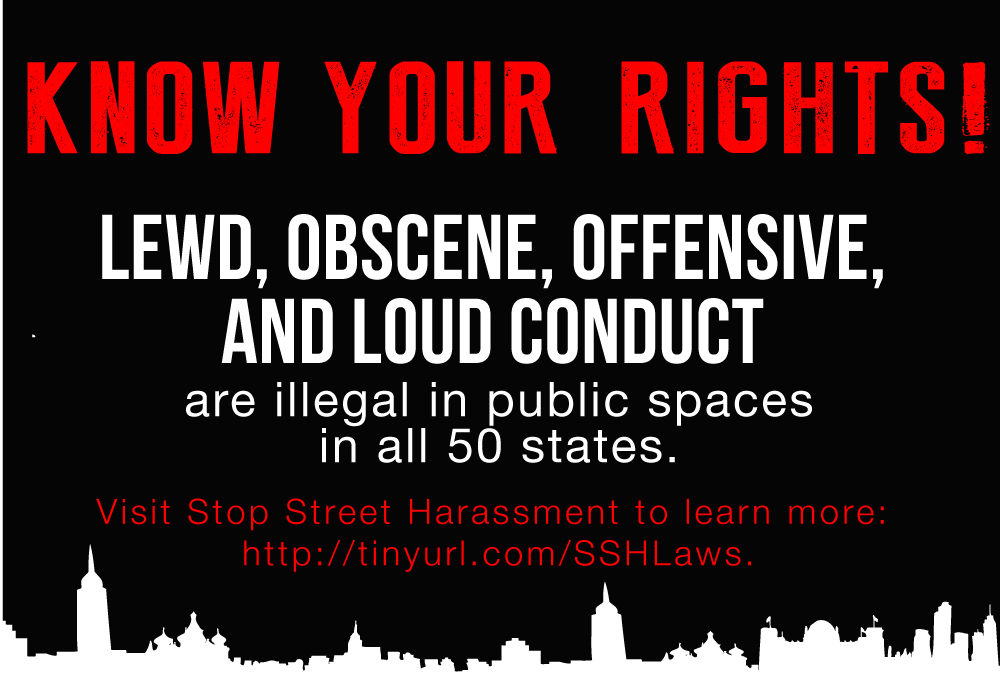
We’ve spent the summer and fall surveying the laws in all 50 U.S. states and D.C. and we have good news: many common street harassment behaviors (such as groping, indecent exposure, and up-skirt photos) are illegal across the U.S. That means you can report street harassment to the police and hold a street harasser legally accountable for his or her actions (when you feel that’s appropriate).

Street harassment is not specifically criminalized the way sexual harassment in the workplace and schools is. However, state laws like Disorderly Conduct, Invasion of Privacy, and Sexual Misconduct prohibit many common street harassment behaviors. Each state has their own set of rules about public behavior and sexual harassment, so we’ve laid out what the relevant crimes are called in each state’s code and let you know exactly what’s legal and what isn’t.

As of today – Human Rights Day – you can find all of this information online or you can download a PDF of the complete toolkit.

We think the Know Your Rights toolkit is a ground-breaking project in the fight against street harassment because, for the first time, all of the state-level criminal law that could be used to stop street harassment has been compiled, analyzed, and made accessible to anyone who needs them. In a society that says street harassment is a compliment, we want you to be able to say, “No, it’s disorderly conduct.”

We hope you will use this information to exercise your right to protection from the police when you experience illegal street harassment and to encourage your local lawmakers to further protect women, people of color, and members of the LGBTQ community in public spaces.

Of course, we know that reporting harassment to the police or criminalizing harassment are not the only ways to end street harassment. In some cases, these may not even be the best ways. Criminalizing behavior can be problematic when laws are disproportionately applied to low-income communities and communities of color. With that in mind, Stop Street Harassment encourages you to engage with your local law enforcement to ensure the law is always applied fairly and that your community handles street harassment in the most constructive way possible. We endeavor to provide you with information so that you can advocate for your rights to safe public spaces and to the other freedoms you are entitled to under the law, such as due process.

As we’ve said before, there is no best way to deal with street harassment – every person and situation differs. Ending street harassment for good will require a multi-pronged approach, including education, awareness campaigns, and engaging the legal system. If a street harasser does commit a crime against you, we want to equip you to make an informed decision. Armed with that knowledge, you can then decide whether or not to report harassers to law enforcement, especially for crimes like up-skirt photos, public masturbation, stalking, and groping.

Take a look at your state’s section of the toolkit to get an idea of the kinds of street harassment that are illegal – or to report a crime that has already happened. You’ll also find useful information in the Introduction, including what to expect when you report street harassment and how to deal with harassment from police officers themselves.

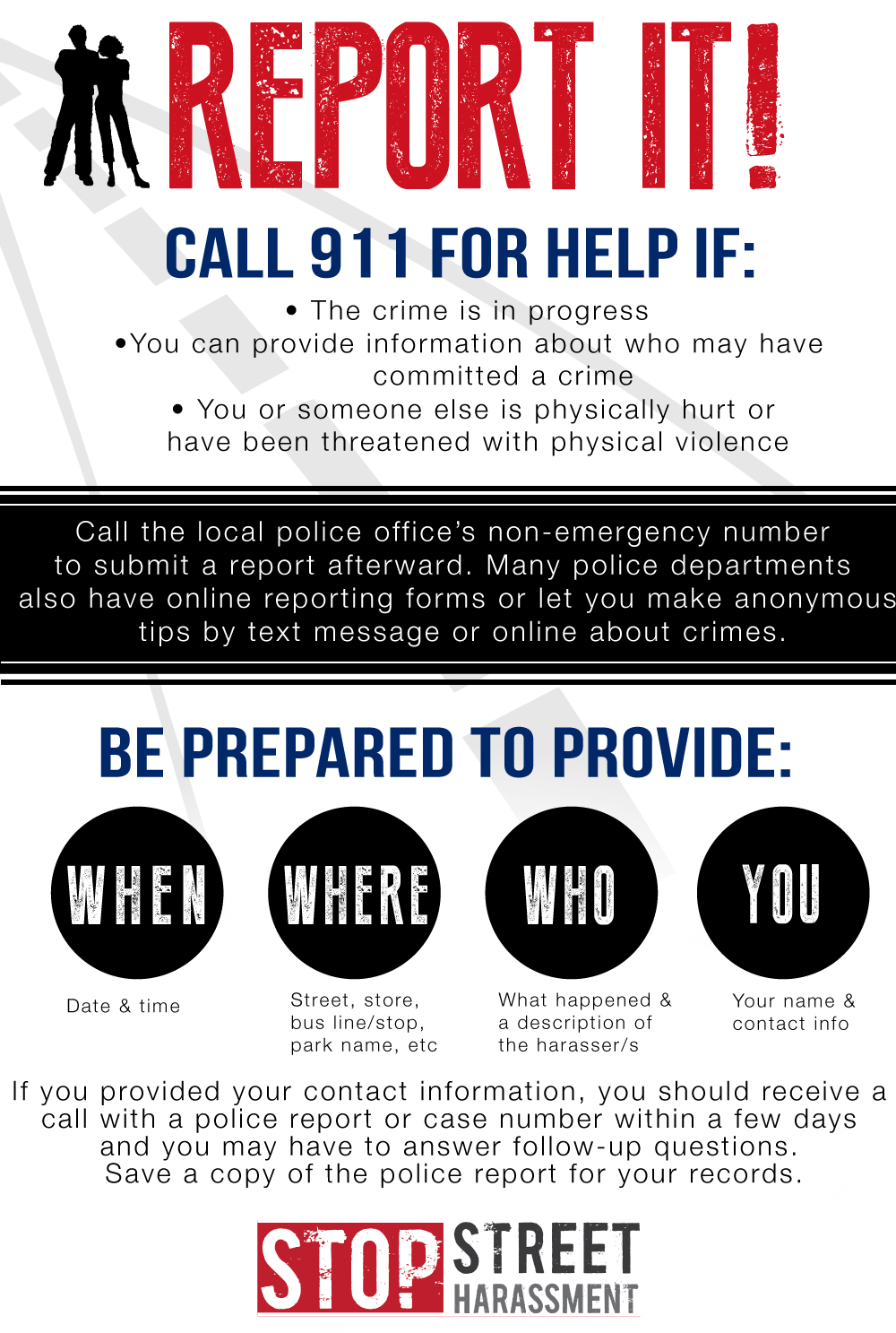
Finally, we’d like to add one important takeaway from our work on the project: in speaking with several police officers around the country, we learned that you can engage a police officer or call 911 any time you feel threatened, even before a crime has been committed. This seems obvious in retrospect, but 75% of women report they have been followed and yet few report it to the police. If you think someone is following you, or you feel otherwise scared, intimidated, or threatened, you have the right to help from the police.

They say knowledge is power, friends, so here’s a nation’s worth.

Have you reported street harassment to the police? What happened? What did you learn about your local laws from our toolkit? How do you plan to use this knowledge? Share your story in the comments

Talia Hagerty has been an intern with Stop Street Harassment since June 2013. She is also a peace economics consultant working on a variety of projects that ensure the equitable economic participation of all. She holds a B.A. in Economics from Eckerd College and an M.S. in Global Affairs with a concentration in Peacebuilding from New York University. Talia blogs about peacebuilding, human rights, economic development, and witty responses to street harassment. Follow her on Twitter: @taliahagerty.

Share

Filed Under: Resources, SSH programs, street harassment

Reporting Street Harassment to the Police: A Success Story

December 10, 2013 By SSHIntern

For many women, and some men, street harassment may be such a normal occurrence that they don’t even think of reporting it to police. Similarly, it’s not uncommon to be reluctant to report even serious incidents for fear that officers won’t take the report seriously, that they will engage in victim blaming, or that you will be subject to further harassment. (Unfortunately, this can be the case and we encourage you to file a complaint if this happens to you).

But Stop Street Harassment’s newest resource, Know Your Rights: Street Harassment and the Law, reveals that many common street harassment behaviors are in fact illegal across the U.S., giving you grounds to report an incident and seek help.

In preparation for the launch of our toolkit, I spoke to Officer Harris of the University of Washington Police Department about an incident of street harassment that he recently responded to.

The University of Washington Incident

The incident began as too many do: a female student was out for an evening run near the University of Washington campus when a man allegedly jumped out from around a corner, grabbed her by the arm, and said, “How are you doing tonight?”

As anyone who has experienced street harassment knows, a harasser’s language may be benign in itself but it usually comes with an intimidating interaction.

The student responded with a few choice words and crossed the street. (While SSH doesn’t recommend profanity or insults, an assertive response can help prevent sexual assault and/or feelings of disempowerment.)

After making sure the man hadn’t followed her – although he did leer in her direction – the young woman returned home and called University Police. Harris responded to the call, checked the area where the incident took place, and the young woman identified the man in question. He was arrested and charged with assault.

While it would be better if street harassment didn’t happen at all, the situation Harris described is ideal in terms of the young woman’s safety and the police response. I asked Officer Harris if he felt there was any room for discretion in determining whether or not to arrest the offender.

“No,” he said, “she was afraid for her safety and her well-being.” Given that it was after dark and “the guy grabbed her and really scared her,” he added, “I think most police officers would have taken that very seriously.”

Unfortunately, we know that not all officers see street harassment so clearly. But Officer Harris presented the perspective we hope all police officers will have and the standard that you should hold your community police to.

“Even if somebody made rude comments,” Harris said, “or made somebody feel unsafe, even if it wasn’t a crime yet, we would still go and talk to them.” Officer Harris stressed that no one should feel “unqualified” to call the police because what happened to her or him did not escalate to physical assault. It is appropriate, he told me, for an officer to have a “knock-it-off” conversation with someone even before an incident becomes criminal.

“A lot of very serious incidents start off as ‘it’s not that serious, it’s not a big deal.’ … But we’ll be glad to go investigate and keep things from escalating.”

In a society that says street harassment is a “compliment,” or “no big deal,” Harris’ perspective may sound too good to be true. But in fact, it may be a sign that advocacy efforts do work.

Notably, Victim’s Advocate Natalie Dolci provides the University of Washington officers with a variety of training and support to best address sexual assault, stalking, and gender-based violence.

I asked Harris what his main takeaways were from the training he has received and what advice he might have for other officers.

* He shared that he learned what a lasting impact sexual assault and sexual abuse can have on a person, and stressed that it’s important for officers to take every case very seriously.

* He included street harassment in that sentiment, noting that officers have a role to play in preventing street harassment from “becoming a habit” or escalating.

* He also added that his department works to have a positive relationship with the community and looks “for directions from the community on what problems they have or what they need help with.

Reach out to your department,” he said, “and let them know what you need.”

Have you reported street harassment to the police? What happened? What did officers in your community do well, or what would you like them to do differently? Leave your stories and ideas in the comments, and check out our new Know Your Rights toolkit to learn about the laws in your state.

Talia Hagerty has been a Stop Street Harassment intern since June 2013. She also is a peace economics consultant working on a variety of projects that ensure the equitable economic participation of all. She holds a B.A. in Economics from Eckerd College and an M.S. in Global Affairs with a concentration in Peacebuilding from New York University. Talia blogs about peacebuilding, human rights, economic development, and witty responses to street harassment. Follow her on Twitter: @taliahagerty.

Share

Filed Under: male perspective, Resources, Stories, street harassment

« Previous Page
Next Page »

Share Your Story

Share your street harassment story for the blog. Donate Now

From the Blog

  • #MeToo 2024 Study Released Today
  • Join International Anti-Street Harassment Week 2022
  • Giving Tuesday – Fund the Hotline
  • Thank You – International Anti-Street Harassment Week 2021
  • Share Your Story – Safecity and Catcalls Collaboration

Buy the Book

  • Contact
  • Events
  • Join Us
  • Donate
  • Facebook
  • Instagram
  • Pinterest
  • Tumblr
  • Twitter
  • YouTube

Copyright © 2026 Stop Street Harassment · Website Design by Sarah Marie Lacy