• About Us
    • What Is Street Harassment?
    • Why Stopping Street Harassment Matters
    • Meet the Team
      • Board of Directors
      • Past Board Members
    • In The Media
  • Our Work
    • National Street Harassment Hotline
    • International Anti-Street Harassment Week
    • Blog Correspondents
      • Past SSH Correspondents
    • Safe Public Spaces Mentoring Program
    • Publications
    • National Studies
    • Campaigns against Companies
    • Washington, D.C. Activism
  • Our Books
  • Donate
  • Store

Stop Street Harassment

Making Public Spaces Safe and Welcoming

  • Facebook
  • Instagram
  • Pinterest
  • Tumblr
  • Twitter
  • YouTube
  • Home
  • Blog
    • Harassment Stories
    • Blog Correspondents
    • Street Respect Stories
  • Help & Advice
    • National Street Harassment Hotline
    • Dealing With Harassers
      • Assertive Responses
      • Reporting Harassers
      • Bystander Responses
      • Creative Responses
    • What to Do Before or After Harassment
    • Street Harassment and the Law
  • Resources
    • Definitions
    • Statistics
    • Articles & Books
    • Anti-Harassment Groups & Campaigns
    • Male Allies
      • Educating Boys & Men
      • How to Talk to Women
      • Bystander Tips
    • Video Clips
    • Images & Flyers
  • Take Community Action
  • Contact

South Africa: SA’s Dirty Laundry

November 11, 2016 By Correspondent

Nyasha Joyce Mukuwane, Johannesburg, South Africa, SSH Blog Correspondent

sadirtylaundryWith the onset of the 16 Days of Activism Against Gender-Based Violence on Nov. 25, some activists are using visual creativity to bring home the facts of rape culture in South Africa.

Rape is a widespread problem. According to a 2013 Medical Research Council (MRC) survey, up to 3,600 people could be raped in the country every day. The Institute for Security Studies (ISS) claims that only one in 13 rape cases are reported to police.  Fewer than 30 cases go through for prosecution and trial  of which only 10 result in a conviction.

Jenny Nijenhuis and Nondumiso Lwazi Msimanga are collaborating in a creative installation of artivism in order to create awareness around rape in South Africa. They are collecting 3,600 pieces of underwear to hang a washing line approximately 1.2 kilometres long displaying the underwear during the 16 Days of Activism.

The preferred route for hanging the installation is from Arts On Main on Berea Road, right into Fox Street and left into Albrecht Street to SoMa´s entrance. This route from Arts On Main to SoMa covers 400m in distance. The goal is to run the washing line down both sides of each of the streets involved, thereby covering a distance of 800m. The balance of the line and installation will continue to the gallery entrance and up into the upstairs gallery area.

Speaking about the installation, Nijenhuis says,

“We wish to curate/choreograph an activation/disruption of the space in and around the gallery for 10 of the 16 Days of Activism whilst the installation is up. The space will thus be used as a point of reflection through works dealing in this subject matter. Nondumiso Msimanga will be working on a performance art piece titled ‘On the Line.’ The performance will display a female at the different developmental stages and rites of passage of becoming a woman, in a cyclical narrative of rituals. We have also posted an open call inviting contributions towards the project from the broadest spectrum of disciplines including (but not limited to) the visual arts, performances (maximum length 15 minutes), interventions, music, dance, talks, poetry, video (maximum length 15 minutes) and theatre.

The point being for artists to show how art, when used for the purpose of socio-political activism, has the power and ability to shift the status quo. Activism aims to promote, impede, or direct social, political, economic, or environmental change – to make societal improvements and to correct social injustice. Through this call, we’re inviting artists to truly observe, reflect and comment on what the rape crisis in SA looks like. We hope to bring this message to people on the street, and not just to the audiences that frequent galleries.”

Installation Dates: 25 November to 4 December 2016
Location: SoMa Art + Space – Streets of the Maboneng Precinct in Johannesburg

In order to successfully produce the installation the artists need to collect 3600 panties. Since the project is not for profit, a donations Facebook page has been set up. The panties drive asks anyone prepared to support the project to donate their old and unwanted panties or underpants. These are being collected at various collection points across the country. Donate. | More information on this project.

Nyasha is the public awareness coordinator at the Nisaa Institute for Women’s Development in Johannesburg, South Africa, where the main goal is counselling and sheltering survivors of domestic abuse. She has edited two books by survivors that are available to download for free from the website www.nisaa.org.za.

Share

Filed Under: 16 days, correspondents, street harassment Tagged With: 16 days of activism, art, rape, south africa, underwear

We Will Continue Working to Make Public Places Safer for All

November 10, 2016 By HKearl

As an organization that works to make public places safer for everyone, we are dismayed at the rhetoric that the president-elect uses when talking about women. We are upset when he suggests that there are people in our country who should be indiscriminately deported, or who should be prevented from entering our country simply because of their religion. We disagree with the language the president-elect uses and policy plans he suggests which divide us and belittle us.

We are outraged that a sexual abuser will be president.

We fear that the disrespect and hate shown by him to large demographics of the population — including immigrants, persons of color, persons with disabilities, LGBQTIA-identified folks, and all women — will be seen by some as tacit approval to harass and assault those demographics with even greater aggression and audacity.

This makes modeling respectful behavior and speaking out against those who harass, discriminate and abuse others more crucial than ever, as is finding and receiving support if it happens to you.

1. Use our national street harassment hotline (run in partnership with RAINN and Defend Yourself) to find 24/7 support in Spanish and English, online and via secure IM chat.

a. Find ideas for dealing with harassers in the book 50 Stories About Stopping Street Harassers.

b. Make a tax-deductible donation so we can serve even more people on the hotline.

2. Share your story of harassment on our blog to raise awareness. On the blog, you can also share stories about how you did something when you witnessed harassment — inspire others to do something, too.

3. Plan to take action during International Anti-Street Harassment Week and help bring local and international attention to the issues. April 2-8, 2017, www.meetusonthestreet.org.

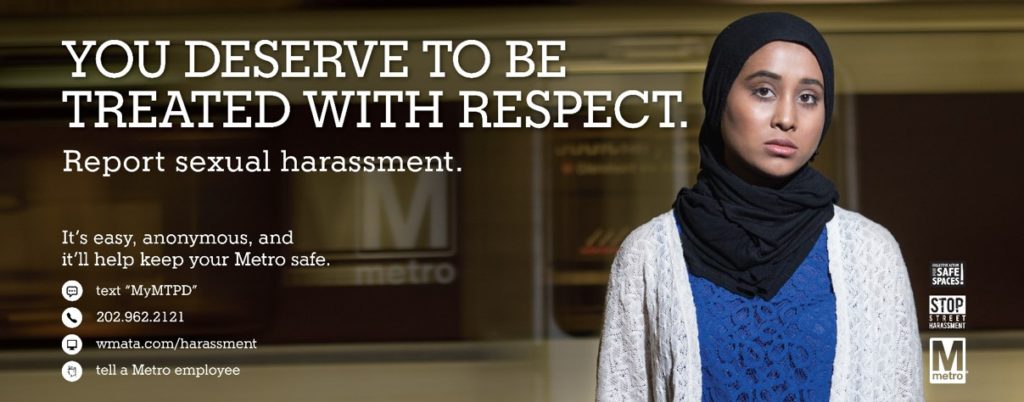
4. If you’re in the Washington, D.C. area and witness or experience harassment on the transit system, you can report it.

WMATA anti-harassment transit campaign

Rest assured, we will continue working to make public spaces more welcoming for all. Join us. Together, we must ensure that justice, equality and love prevail.

The Stop Street Harassment Board of Directors

Share

Filed Under: SSH programs, street harassment Tagged With: election statement, trump

“I had to sacrifice my run for these men”

November 9, 2016 By Contributor

I was fifteen years old. I was running outside alone on the street in a sports bra, without a shirt on, because it was hot and I have problems running in the heat (even a light tank top makes a difference). I was being stared at by many middle aged men and once I was honked at by what looked like some twenty year old guy in beat up truck. I was appalled because I clearly look like a fifteen year old and he had to be twenty. I ran with my shirt on for the remainder and ran slower so I would not get too hot. I had to sacrifice my run for these men.

Optional: What’s one way you think we can make public places safer for everyone?

I have no clue. We now will have a bad role model for president. If Mr. President can “grab people by the pussy” then what is stopping other men?

– SW

Location: Longboat Key, FL

Need support? Call the toll-free National Street Harassment hotline: 855-897-5910

Share your street harassment story for the blog.
See the book 50 Stories about Stopping Street Harassers for idea
s.

Share

Filed Under: Stories, street harassment Tagged With: older male harasser, running, teenager

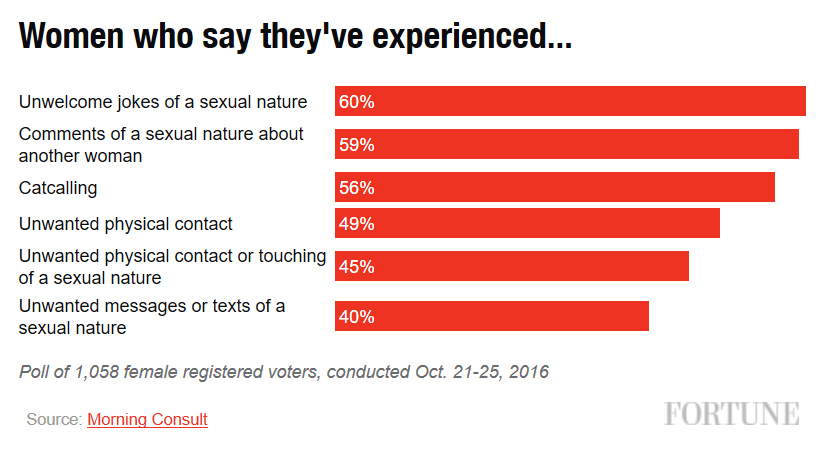
45% of American Women Have Experienced Unwanted Sexual Touching

November 7, 2016 By HKearl

nov2016-fortunepollonsexualmisconduct

A new phone poll of more than 1,000 randomly selected registered female voters in the USA finds that sexual abuse is common. Among the findings, 56% had experienced “catcalling” and 45% had experienced unwanted sexual touching.

Read more at Fortune.com.

Share

Filed Under: Resources, street harassment Tagged With: statistics, study, usa

“He told me I had ‘No where to run.’

November 5, 2016 By Contributor

I was walking to school, and when I was nearing the bottom of a hill a construction worker looked at me, smiled, and as I passed he told me I had “No where to run.” This type of thing had never happened to me before,it was the middle of the day. I love walking to school but I don’t know when I’ll be comfortable with it again.

Optional: What’s one way you think we can make public places safer for everyone?

Maybe get into the habit of reporting people instead of just letting it go because the persons “a jerk who won’t actually do anything”.

– Anonymous

Location: San Francisco, a block from Lombard Street

Need support? Call the toll-free National Street Harassment hotline: 855-897-5910

Share your street harassment story for the blog.
See the book 50 Stories about Stopping Street Harassers for idea
s.

Share

Filed Under: Stories, street harassment Tagged With: teenager

« Previous Page
Next Page »

Share Your Story

Share your street harassment story for the blog. Donate Now

From the Blog

  • #MeToo 2024 Study Released Today
  • Join International Anti-Street Harassment Week 2022
  • Giving Tuesday – Fund the Hotline
  • Thank You – International Anti-Street Harassment Week 2021
  • Share Your Story – Safecity and Catcalls Collaboration

Buy the Book

  • Contact
  • Events
  • Join Us
  • Donate
  • Facebook
  • Instagram
  • Pinterest
  • Tumblr
  • Twitter
  • YouTube

Copyright © 2026 Stop Street Harassment · Website Design by Sarah Marie Lacy